

Bulk Aquaculture Equipment Buying Guide for Large Fish Farms
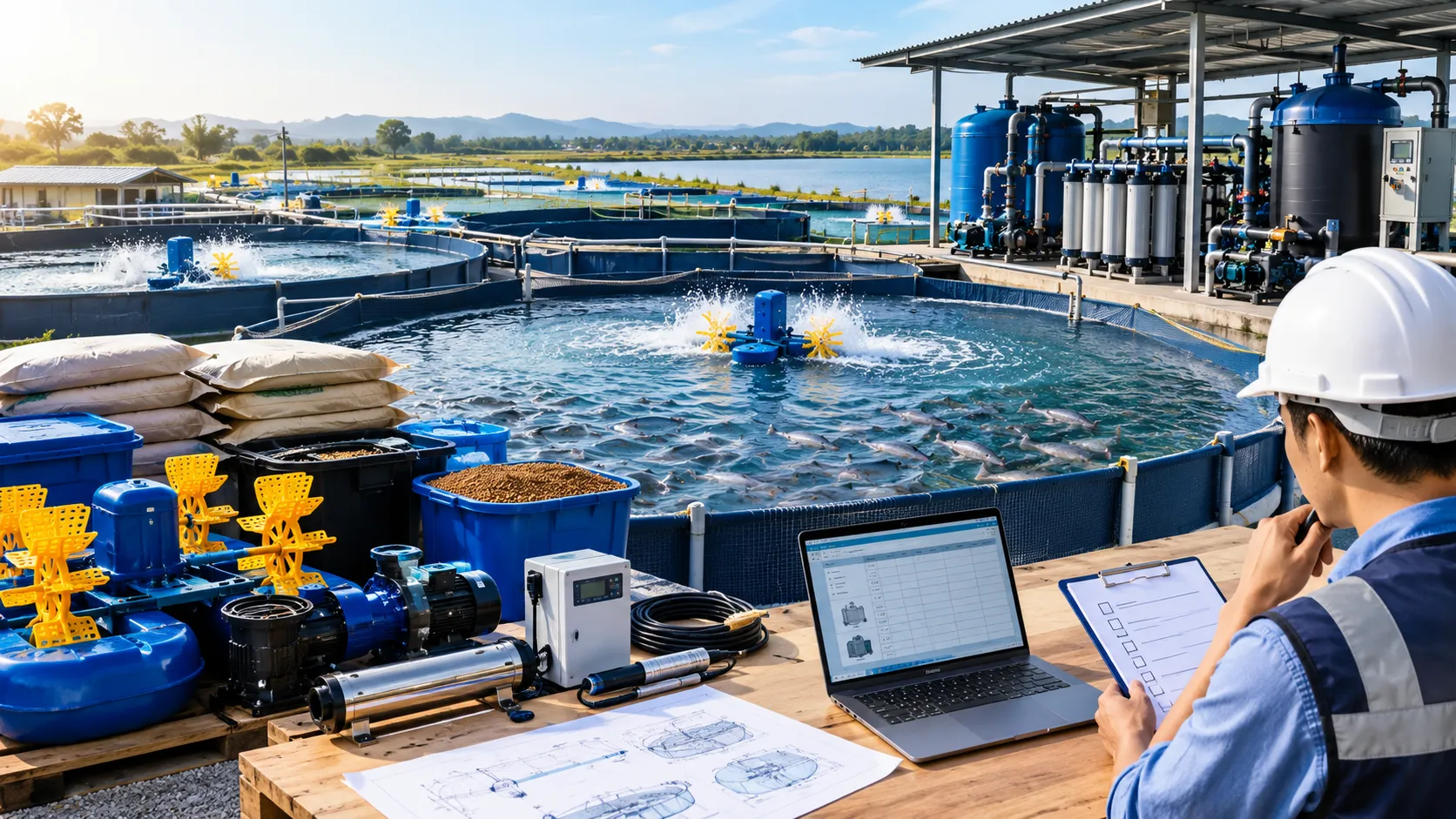
Bulk Aquaculture Equipment: Planning Purchases for Large Fish Farms
Bulk aquaculture equipment purchasing is an important part of managing a successful commercial fish farm. As aquaculture businesses expand their production, they need reliable equipment to support fish growth, maintain water quality, improve feeding efficiency, and reduce operating costs. Buying equipment in bulk can help fish farmers control purchasing expenses, maintain consistent equipment standards, and prepare for future production needs.
Large-scale fish farms use a wide range of equipment, including fish farming tanks, pond aerators, water pumps, filtration systems, automatic fish feeders, oxygen supply systems, water quality monitoring devices, and harvesting tools. Choosing the right equipment requires careful planning because every fish farm has different requirements based on its species, production capacity, farming method, and available resources.
For example, a commercial tilapia farm may require pond aeration systems, feed distribution equipment, water pumps, and harvesting nets. A recirculating aquaculture system (RAS) facility may need mechanical filters, biological filters, oxygenation equipment, ultraviolet sterilizers, and advanced monitoring systems.
Planning bulk aquaculture equipment purchases involves more than comparing supplier prices. Fish farmers must evaluate equipment quality, energy efficiency, compatibility, installation requirements, shipping costs, maintenance needs, and warranty coverage. Proper planning also helps prevent unnecessary purchases, equipment shortages, and production interruptions.
This guide explains how to plan bulk aquaculture equipment purchases for large fish farms, compare suppliers, calculate equipment requirements, create a realistic budget, and choose durable equipment that supports long-term commercial aquaculture operations.
Why Bulk Aquaculture Equipment Purchasing Matters for Large Fish Farms
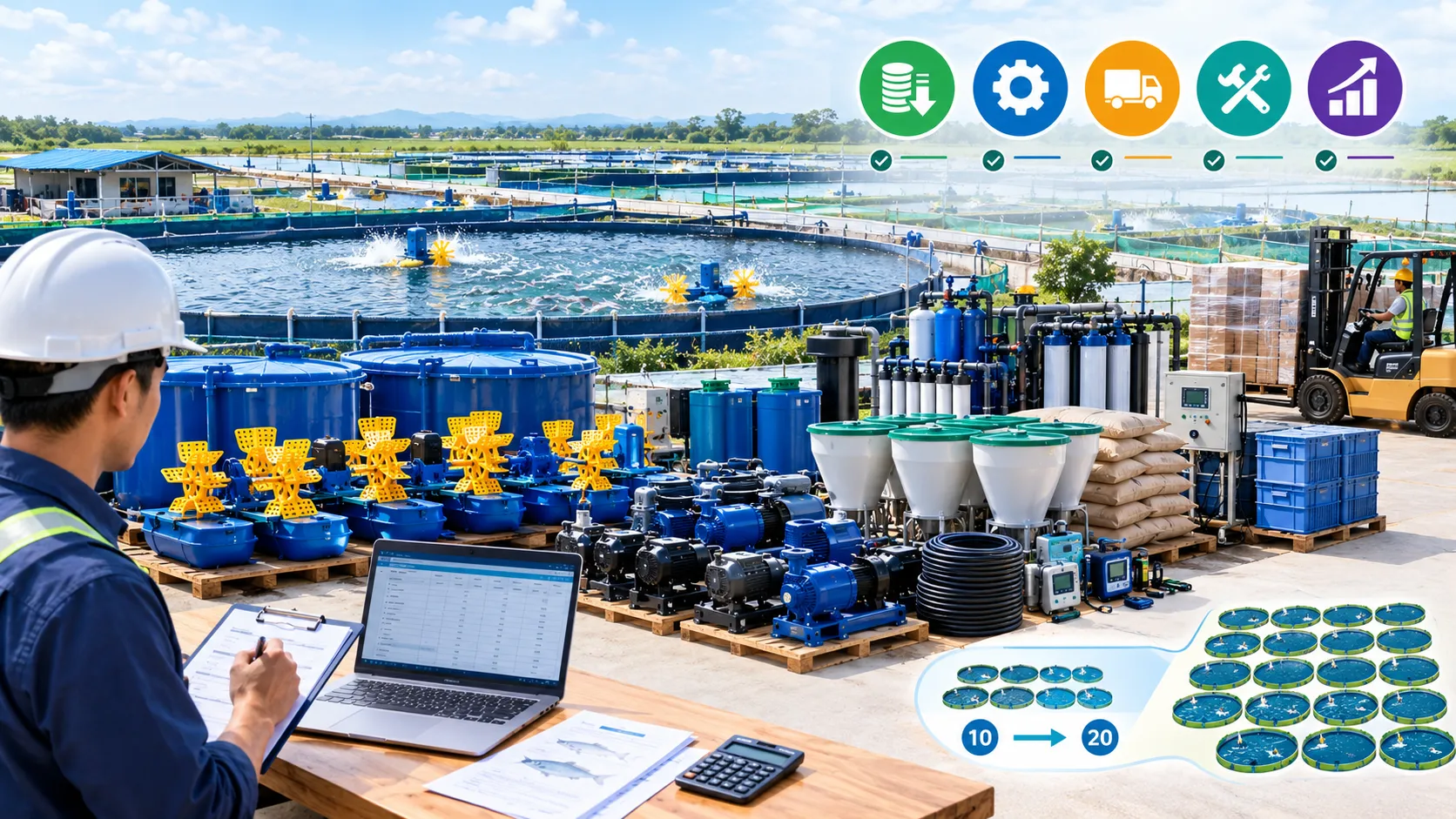
Bulk purchasing allows commercial fish farms to order multiple units of essential equipment through a single purchasing process. Instead of buying individual pumps, aerators, feeders, or monitoring devices whenever a need arises, farm managers can plan their requirements in advance and negotiate suitable purchasing terms.
One major advantage is the potential to reduce costs. Suppliers may offer volume discounts, lower per-unit shipping costs, or more favorable terms for large orders. However, savings depend on the supplier, order quantity, delivery arrangements, and product specifications.
Bulk purchasing also helps standardize equipment across a fish farm. When several production ponds use compatible aerators, pumps, and monitoring devices, staff can follow consistent operating procedures and simplify maintenance.
- Better budget planning: Farm managers can estimate equipment expenses before starting a new production cycle.
- Consistent equipment availability: Purchasing critical equipment in advance can reduce delays during farm expansion.
- Simplified supplier management: Working with fewer qualified suppliers can make ordering, invoicing, and warranty claims easier.
- Improved maintenance planning: Standardized equipment can simplify spare-parts inventory and staff training.
- Support for expansion: A planned purchasing strategy helps farms prepare for additional ponds, tanks, or production units.
For example, a farm expanding from 10 ponds to 20 ponds may need additional aerators, pumps, feeding equipment, electrical components, and water testing devices. Ordering based on a complete equipment plan can help prevent mismatched products and repeated delivery charges.
Nevertheless, buying in bulk is not always the cheapest option. Equipment that deteriorates in storage, becomes outdated, or exceeds the farm's actual needs can increase total costs. Large fish farms should balance volume discounts with storage capacity, cash flow, product lifespan, and expected production growth.
Types of Aquaculture Equipment Needed for Large-Scale Fish Farming
The equipment required for commercial aquaculture depends on whether the farm uses earthen ponds, concrete tanks, fiberglass tanks, floating cages, or a recirculating aquaculture system.
Understanding the main equipment categories helps farm managers prepare a complete purchasing list.
1. Fish holding and production equipment
This category includes fish farming tanks, pond liners, pond construction components, floating cages, nets, and grading equipment. These products support fish stocking, growing, handling, and harvesting.
2. Aeration and oxygen equipment
Paddlewheel aerators, diffused-air systems, air blowers, oxygen cones, oxygen generators, and related components help maintain adequate dissolved oxygen levels. The appropriate system depends on stocking density, water depth, species, and oxygen demand.
3. Water circulation and pumping equipment
Water pumps, pipes, valves, fittings, and drainage systems move water between ponds, tanks, filters, and treatment units. Pump capacity must match the required flow rate and operating conditions.
4. Filtration and water treatment equipment
Mechanical filters remove suspended solids, while biological filters support beneficial bacteria that convert toxic ammonia into less harmful compounds through nitrification. Depending on the system, additional equipment may include UV sterilizers, degassing units, and water treatment devices.
5. Feeding equipment
Automatic fish feeders, feed blowers, feed storage bins, conveyors, and weighing systems help distribute feed efficiently. The equipment should suit the feed type, pellet size, feeding schedule, and production scale.
6. Water quality monitoring equipment
Dissolved oxygen meters, pH meters, thermometers, salinity meters, ammonia test kits, and other monitoring devices help farmers assess water conditions.
7. Harvesting and handling equipment
Harvesting nets, grading machines, fish counters, weighing scales, fish transport containers, and handling tools support safe and efficient harvesting operations.
8. Safety and backup equipment
Backup generators, emergency aerators, oxygen cylinders or suitable oxygen reserves, alarms, and essential spare parts can help protect fish during equipment failure or power interruptions.
Before purchasing equipment in bulk, classify each item according to its importance, expected service life, replacement frequency, and role in maintaining fish health.
How to Calculate Equipment Needs for Commercial Fish Farms
Accurate equipment calculations help prevent overspending and reduce the risk of buying insufficient equipment. Before contacting suppliers, farm managers should document their production targets, facility layout, water requirements, and operating conditions.
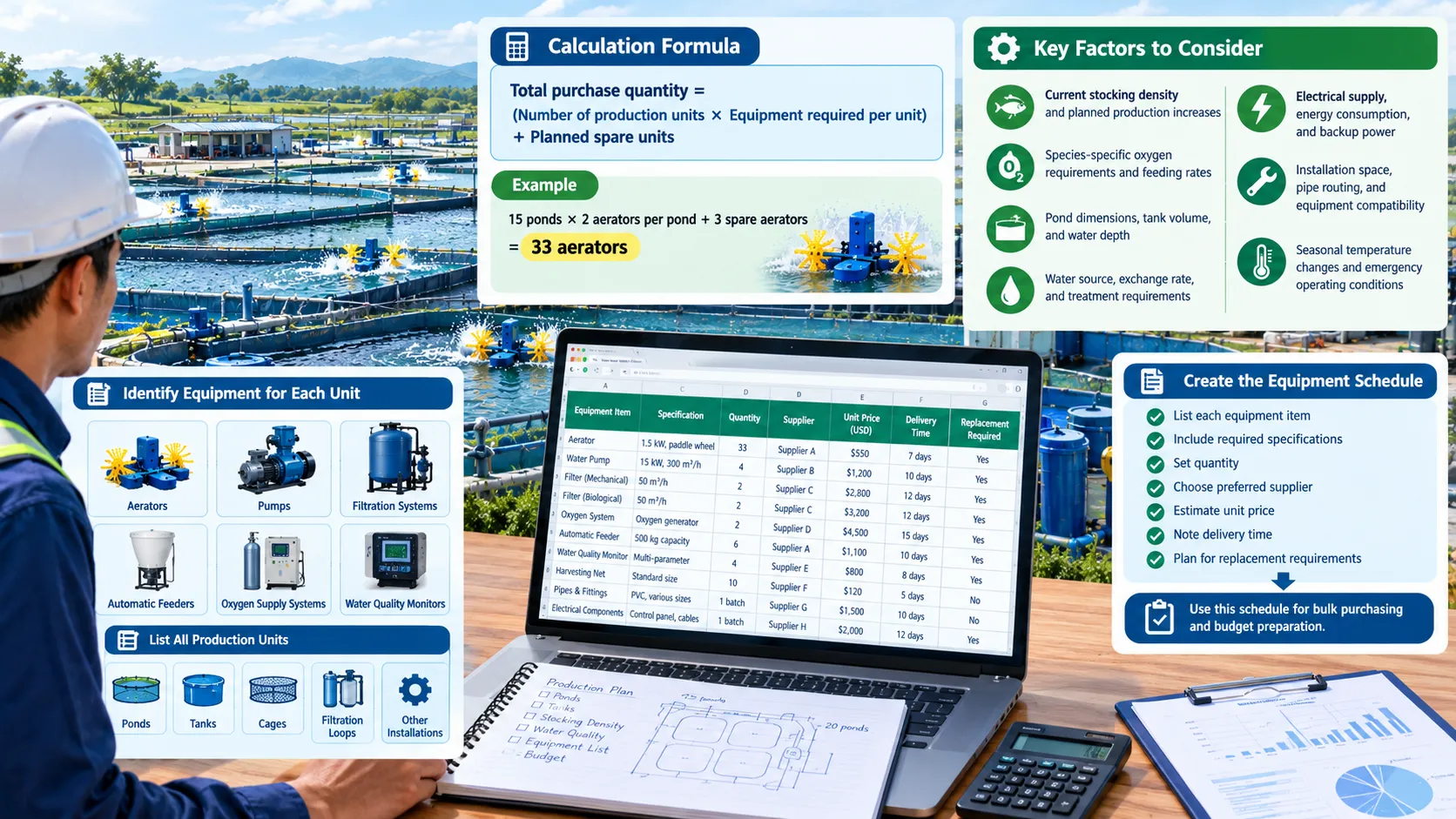
Start by calculating the number of production units. Record the number of ponds, tanks, cages, filtration loops, and other installations that require equipment.
Next, identify the equipment required for each unit. For example, if every pond needs two aerators and the farm operates 15 ponds, the initial requirement is 30 aerators. Additional units may be necessary for backup capacity, depending on the farm's risk assessment.
A simple calculation is:
Total purchase quantity = Number of production units × Equipment required per unit + planned spare units
For example, if a farm has 15 ponds, requires two aerators per pond, and plans to hold three spare aerators, the total purchase quantity is:
15 × 2 + 3 = 33 aerators.
This example is illustrative. Actual aerator requirements must be determined from pond conditions, stocking density, oxygen demand, equipment performance, and professional system design.
For pumps and filtration systems, calculate the required water flow rate, total dynamic head, filtration capacity, and expected operating hours. A qualified aquaculture system designer or engineer can help determine the correct specifications for larger installations.
Farm managers should also consider:
- Current fish stocking density and planned production increases.
- Species-specific oxygen requirements and feeding rates.
- Pond dimensions, tank volume, and water depth.
- Water source, exchange rate, and treatment requirements.
- Electrical supply, energy consumption, and backup power.
- Installation space, pipe routing, and equipment compatibility.
- Seasonal temperature changes and emergency operating conditions.
Create a spreadsheet listing each equipment item, required specification, quantity, preferred supplier, estimated unit price, delivery time, and replacement requirements. This equipment schedule becomes the foundation for bulk purchasing and budget preparation.
Essential Fish Farming Equipment to Buy in Bulk
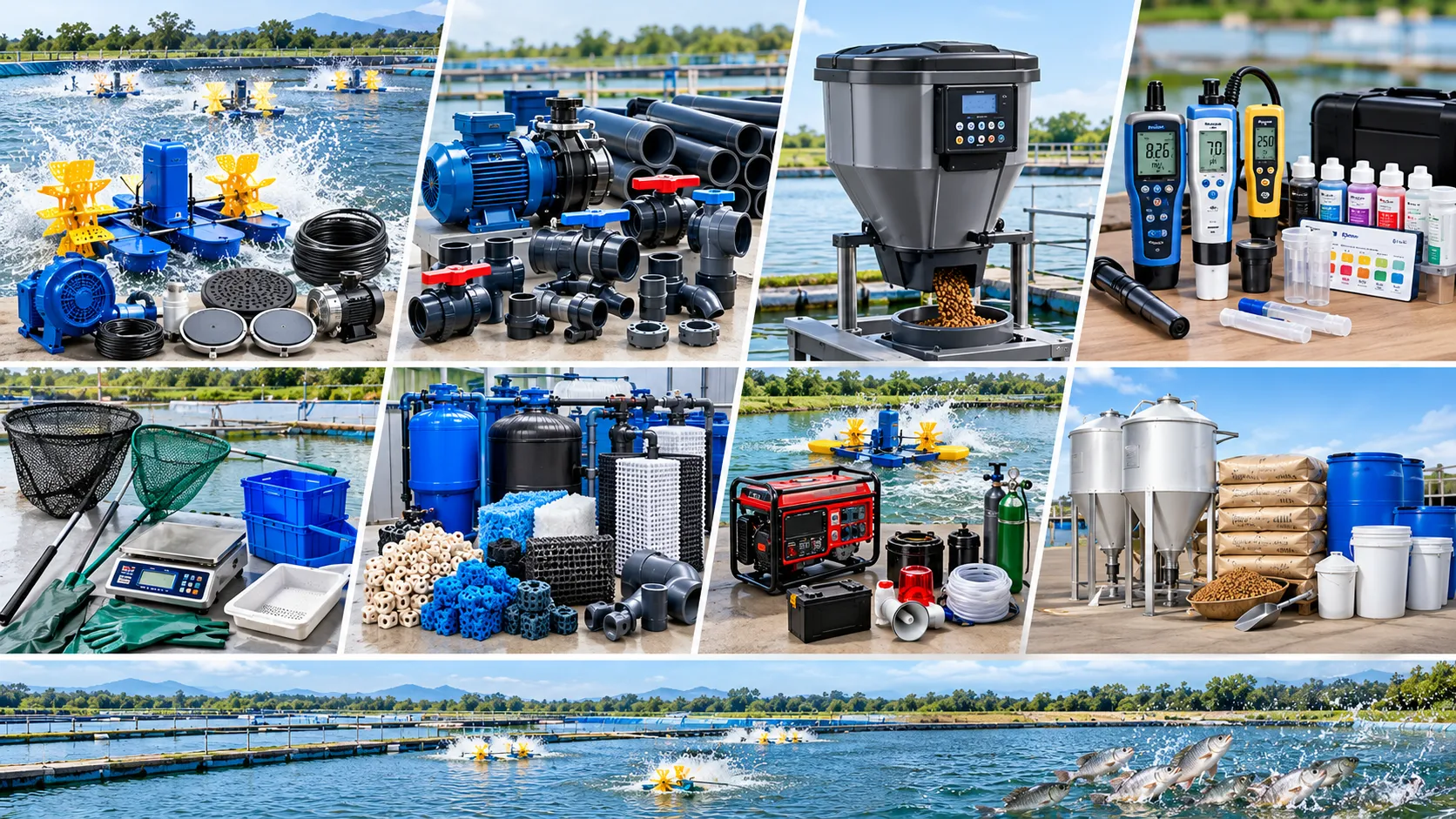
Large fish farms commonly purchase frequently used equipment and standardized components in bulk. The most suitable products depend on the farm's production system and the condition of existing equipment.
- Aerators and oxygen delivery components: Aerators are essential for many intensive pond systems. Farms may purchase paddlewheel aerators, diffused-air equipment, blowers, diffusers, and replacement motors. Emergency aeration should be considered separately from normal operating equipment.
- Water pumps and plumbing supplies: Pumps, pipes, valves, connectors, seals, and fittings are often needed across multiple production units. Selecting compatible sizes and materials helps simplify installation and maintenance.
- Automatic fish feeders: Farms with several ponds or tanks may benefit from purchasing standardized feeders. Features such as adjustable feeding rates, programmable schedules, and feed compatibility should be evaluated.
- Water quality testing equipment: Monitoring tools such as dissolved oxygen meters, pH meters, temperature sensors, and ammonia test kits support routine farm management. Include calibration solutions, probes, and consumables where required.
- Nets and fish handling tools: Grading nets, harvesting nets, weighing equipment, and transport containers may be suitable for bulk orders when multiple teams or production units operate simultaneously.
- Filtration components: Commercial RAS facilities may require filter media, mechanical filter parts, biological filter media, pipe fittings, and replacement components. Confirm compatibility with the installed filtration system.
- Safety and backup supplies: Depending on the farm's risk assessment, these may include emergency aerators, generator components, alarms, oxygen delivery accessories, and critical replacement parts.
Feed storage containers and other consumable supplies may also be purchased in larger quantities if storage conditions are suitable.
However, not every product should be bought in large volumes. Electronic monitoring devices, specialized control systems, and expensive equipment with rapidly changing specifications may be better purchased in smaller batches or according to confirmed installation requirements.
For each product category, compare the purchase price with expected lifespan, maintenance requirements, energy use, and replacement availability.
How to Choose Reliable Bulk Aquaculture Equipment Suppliers
A reliable supplier can help a commercial fish farm maintain consistent operations and avoid costly delays. Choosing the right supplier requires checking product quality, technical knowledge, delivery performance, and after-sales service.
Start by identifying suppliers that specialize in aquaculture equipment rather than relying only on general industrial equipment sellers. Aquaculture specialists may better understand dissolved oxygen requirements, corrosion resistance, pump selection, filtration needs, and equipment compatibility.
Request detailed product specifications before comparing quotations. These should include model numbers, materials, dimensions, flow rates, power ratings, operating limits, expected maintenance requirements, and warranty conditions.
Evaluate suppliers using the following criteria:
- Industry experience: Look for experience supplying commercial fish farms, hatcheries, shrimp farms, or RAS facilities.
- Product range: Check whether the supplier can provide the equipment categories required for the project.
- Quality assurance: Request applicable test reports, technical documentation, and evidence of manufacturing quality controls.
- Bulk-order capacity: Confirm that the supplier can deliver the required quantity within the project timeline.
- Technical support: Ask whether installation guidance, troubleshooting, and maintenance assistance are available.
- Spare-parts availability: Confirm access to replacement motors, seals, sensors, impellers, filters, and other critical components.
- Warranty and returns: Review coverage, exclusions, claim procedures, and responsibility for defective products.
- Customer references: Where possible, speak with commercial farms that have purchased similar equipment.
Ask for written quotations from at least two or three suitable suppliers. Provide the same equipment specifications, quantities, delivery location, and required delivery date so that comparisons are fair.
For expensive or unfamiliar equipment, consider a sample order, product demonstration, factory inspection, or technical review before committing to a large purchase.
Do not select a supplier based on price alone. A supplier offering a lower quotation may still create higher costs if equipment quality is inconsistent, technical support is limited, or deliveries are unreliable.
How to Create a Budget for Large-Scale Aquaculture Equipment Purchases
A realistic equipment budget helps fish farm operators plan capital expenditure, control cash flow, and avoid unexpected costs during installation.
Begin by separating equipment purchases into essential categories. These may include production infrastructure, aeration, pumping, filtration, feeding, monitoring, harvesting, electrical systems, installation, and backup equipment.
Next, estimate the quantity and price of each item. Use supplier quotations whenever possible instead of relying entirely on general market estimates.
The budget should include:
- Equipment purchase costs: The cost of tanks, aerators, pumps, filters, feeders, and other required products.
- Shipping and handling: Freight, packaging, unloading, and transport to the farm.
- Installation expenses: Labor, wiring, plumbing, foundations, and system integration.
- Operating costs: Electricity, consumables, routine servicing, and other recurring expenses.
- Spare parts: Critical components required to keep essential systems operational.
- Training and commissioning: Expenses associated with testing and safely starting new equipment.
- Contingency allowance: A reasonable reserve for unexpected costs, based on project complexity and risk.
For large projects, obtain separate quotations for equipment and installation where appropriate. This can help identify unnecessary charges and clarify each supplier's responsibilities.
A phased purchasing strategy may be useful when a farm is expanding gradually. For example, managers might purchase essential aeration and water circulation equipment first, then acquire additional feeding automation or monitoring upgrades as production grows.
However, avoid postponing safety-critical systems simply to reduce initial expenditure. Backup power, emergency aeration, alarms, and appropriate oxygen reserves should be considered during the original design.
Review the budget against expected production capacity, available working capital, financing costs, and projected operating expenses. The aim is to purchase equipment that supports the farm's production goals without creating avoidable financial pressure.
Fish Farming Tanks, Ponds, and Cage Systems: What to Consider
Fish farming tanks, earthen ponds, lined ponds, concrete raceways, and floating cage systems provide different production environments. The best option depends on the fish species, site conditions, water supply, available space, production goals, and management capacity.
Earthen ponds are widely used for species such as tilapia and catfish. Equipment planning may include aerators, pond water pumps, drainage structures, harvesting nets, and water testing devices. Check pond depth, shape, water circulation, and access for equipment installation.
Lined and concrete ponds may offer greater control over water management, depending on their design. Consider liner durability, surface protection, drainage, pipe connections, and compatibility with cleaning procedures.
Fish farming tanks made from fiberglass, polyethylene, or other suitable materials can be used in hatcheries, nurseries, and intensive production systems. Check structural strength, tank volume, drain design, material safety, and the requirements for cleaning and disinfection.
Floating cage systems are used in suitable lakes, reservoirs, and coastal environments. Purchasing considerations include cage frame materials, net strength, mooring systems, corrosion resistance, access for feeding, and local environmental and navigation requirements.
Recirculating aquaculture systems (RAS) reuse treated water through filtration and water treatment equipment. They require coordinated planning for tanks, mechanical filtration, biological filtration, pumping, aeration or oxygenation, and monitoring systems.
Before purchasing tanks or cage systems in bulk, verify that the proposed design suits the site and the intended species. Large tanks require appropriate foundations and structural support, while cages must withstand local environmental conditions.
Compatibility is especially important when equipment comes from different manufacturers. Tank outlets, pipe dimensions, filtration connections, and pump capacities should be checked before ordering.
Aquaculture Aeration Systems and Oxygen Equipment for Fish Farms
Dissolved oxygen is one of the most important water quality parameters in aquaculture. Fish need sufficient oxygen for respiration, growth, feeding, and normal physiological function. Oxygen shortages can cause stress, reduced feeding, poor growth, and fish mortality.
Large commercial fish farms may use paddlewheel aerators, surface aerators, diffused-air systems, blowers, oxygen cones, or other oxygen transfer equipment.
Paddlewheel aerators are commonly used in many pond-based production systems because they circulate water and transfer oxygen at the surface. Diffused-air systems release air through submerged diffusers and may be suitable for particular ponds, tanks, or treatment applications.
Oxygen injection or oxygen generation systems may be appropriate for intensive production facilities with high oxygen demand. Their design should account for oxygen transfer efficiency, gas supply, system pressure, safety, and operating costs.
When buying aeration equipment in bulk, evaluate:
- Motor power and electrical requirements.
- Oxygen transfer performance under relevant operating conditions.
- Pond or tank dimensions and water depth.
- Corrosion resistance and suitability for continuous operation.
- Energy efficiency and maintenance requirements.
- Availability of motors, bearings, impellers, and other spare parts.
- Compatibility with backup power and emergency operating procedures.
Do not calculate aeration requirements using pond area alone. Stocking density, biomass, water temperature, feeding rate, organic loading, water circulation, and equipment performance all influence oxygen demand.
Farm managers should also plan for equipment failure. Backup aerators, alarms, emergency oxygen supplies, and reliable generators can reduce the risk of oxygen-related losses during power outages or mechanical breakdowns.
Before placing a bulk order, verify the manufacturer's performance data and confirm that the equipment suits the actual production environment. Correct sizing and reliable maintenance are more important than purchasing the largest available units.
Water Pumps, Filtration Systems, and Water Quality Monitoring Equipment
Water pumps, filtration systems, and monitoring devices work together to maintain suitable conditions for fish production. Selecting compatible equipment is especially important for intensive fish farms and recirculating aquaculture systems.
Water pumps
Water pumps move water between ponds, tanks, filtration units, reservoirs, and treatment systems. Their selection depends on the required flow rate, total dynamic head, pipe layout, water characteristics, and operating schedule.
For bulk purchases, check pump materials, motor efficiency, seal quality, installation requirements, and replacement-part availability. Pumps should be sized for the actual hydraulic conditions rather than their advertised maximum flow rate alone.
Filtration systems
Mechanical filters remove suspended solids, uneaten feed, and other particles. Biological filters support microorganisms that convert ammonia produced by fish and organic waste into nitrite and then nitrate under suitable conditions.
RAS facilities may also use foam fractionation, degassing, UV treatment, or other technologies where appropriate. Each component should be selected according to system design, water flow, fish biomass, and treatment objectives.
When purchasing filtration equipment, review filter capacity, media compatibility, cleaning requirements, pressure losses, and access for maintenance.
Water quality monitoring equipment
Monitoring equipment helps farm managers identify changes before they threaten fish health. Common instruments include dissolved oxygen meters, pH meters, temperature sensors, salinity meters, conductivity meters, and ammonia or nitrite testing kits.
More advanced farms may use automated sensors, alarms, and monitoring controllers to track important parameters continuously.
Before buying monitoring devices in bulk, confirm measurement ranges, accuracy, calibration procedures, sensor lifespan, replacement probe availability, and data compatibility.
Keep calibration solutions and suitable testing consumables available. Staff should understand how to take measurements, interpret results, and respond when readings fall outside the farm's operating targets.
A well-planned system combines suitable equipment with regular monitoring, preventive maintenance, and clear operating procedures.
Automatic Fish Feeders and Bulk Aquaculture Feeding Equipment
Feed is one of the major recurring expenses in commercial aquaculture. Efficient feeding equipment can help distribute feed consistently, reduce unnecessary labor, and support better feed management.
Automatic fish feeders are used in ponds, tanks, cages, and some intensive production facilities. Depending on the design, they may dispense feed at scheduled intervals or provide controlled distribution throughout the day.
Large fish farms may also use feed storage bins, conveyors, weighing equipment, feed blowers, and centralized feeding systems.
When purchasing feeders in bulk, consider the following factors:
- Feed compatibility: Confirm that the feeder can handle the intended pellet size, shape, and feed type.
- Feeding capacity: Check hopper volume and maximum delivery rate against the number and size of fish.
- Adjustability: Look for settings that allow operators to control feeding frequency and quantity.
- Weather resistance: Outdoor equipment should be suitable for humidity, rain, sunlight, and the farm's environmental conditions.
- Power supply: Verify electrical requirements, battery options, and backup arrangements.
- Cleaning and maintenance: Ensure the feeder can be inspected and cleaned easily.
- Control systems: Check whether timers, sensors, or remote controls are appropriate for the farm's needs.
The correct feeding strategy depends on species, fish size, water temperature, biomass, feed formulation, and observed feeding behavior. Automatic feeders should not replace routine observation and adjustment.
Buying standardized feeders in bulk can simplify training and spare-parts management. However, test representative units before ordering large quantities, particularly if the farm uses a new feeding technology.
Feed storage equipment also requires careful planning. Fish feed should be protected from moisture, pests, contamination, and excessive heat, with inventory managed according to manufacturing dates and shelf life.
How to Evaluate Aquaculture Equipment Quality and Durability
Aquaculture equipment often operates in wet, corrosive, and demanding environments. Poor-quality equipment can increase maintenance costs, interrupt production, and create risks for fish health.
Before placing a bulk order, evaluate the product's construction, materials, performance specifications, manufacturing quality, and suitability for continuous use.
For equipment exposed to water, check corrosion resistance and the suitability of metals, coatings, plastics, seals, and electrical enclosures. Saltwater and brackish-water environments can be particularly demanding, so materials must match the intended application.
For pumps, assess flow performance, head capacity, motor efficiency, seal quality, and operating limits. For aerators, review oxygen transfer data, energy consumption, mechanical stability, and maintenance access. For automatic feeders, examine dispensing consistency, weather protection, and control reliability.
Ask suppliers for technical data sheets, user manuals, applicable test reports, warranty details, and information about replacement parts. Where relevant, verify electrical safety documentation and recognized certifications for the exact model being supplied.
A practical quality assessment includes:
- Checking product specifications against the farm's requirements.
- Inspecting materials, workmanship, connections, and protective finishes.
- Reviewing manufacturer testing and quality control procedures.
- Confirming that equipment complies with applicable safety requirements.
- Evaluating energy consumption and expected maintenance needs.
- Checking the availability of technical support and spare parts.
- Testing representative units before accepting a large delivery.
Avoid relying on vague claims such as "premium quality" or "industrial grade" without supporting evidence. Ask for measurable specifications and written confirmation of important performance requirements.
For high-value orders, agree on an inspection and acceptance process before shipment. This can include checking quantities, serial numbers, product condition, and functional performance after installation.
Shipping, Storage, and Delivery Planning for Bulk Equipment Purchases
Shipping and storage planning are important because large equipment orders can involve heavy machinery, multiple deliveries, imported components, and limited warehouse space.
Start by agreeing on a delivery schedule with the supplier. Equipment should arrive in the correct sequence so that installation teams have the necessary components when needed.
For example, tanks, major pumps, and filtration units may need to arrive before installation accessories, electrical controls, and final commissioning supplies. A coordinated schedule helps reduce storage expenses and construction delays.
When comparing shipping arrangements, consider freight costs, packaging, unloading equipment, transport access, insurance where appropriate, and responsibility for damaged or missing items.
For imported equipment, check applicable customs documentation, duties, taxes, clearance procedures, and expected transit times. Delivery estimates should account for possible delays rather than relying on the shortest advertised shipping period.
Storage conditions depend on the equipment type. Electrical components and sensors may require dry, protected storage. Motors and pumps should be stored according to manufacturer instructions, while pipes, nets, and tanks should be protected from damage, contamination, and excessive environmental exposure.
Use an inventory system to record product names, model numbers, quantities, serial numbers, storage locations, delivery dates, and inspection status.
When receiving bulk orders:
- Compare delivered quantities with the purchase order.
- Inspect packaging for signs of impact or moisture damage.
- Check model numbers and product specifications.
- Record missing items and visible defects immediately.
- Keep warranty documents, manuals, and invoices accessible.
- Confirm that essential accessories and installation parts are included.
Do not assume that a shipment is complete simply because the main equipment has arrived. Small components such as fittings, seals, sensors, fasteners, and electrical accessories can delay an entire installation if they are missing.
Aquaculture Equipment Maintenance, Spare Parts, and Warranty Considerations
Maintenance planning helps commercial fish farms protect their equipment investment and reduce unexpected breakdowns. Even durable equipment requires inspection, cleaning, calibration, lubrication where specified, and replacement of worn components.
Create a maintenance schedule based on manufacturer recommendations, operating hours, water conditions, and the importance of each system.
Aerators may require inspection of motors, bearings, shafts, and electrical connections. Pumps may need checks for seals, impellers, vibration, and flow performance. Filters require cleaning and monitoring, while water quality sensors need appropriate calibration and probe maintenance.
Bulk purchases can make spare-parts management easier because farms can standardize equipment models. However, ordering spare parts should be based on failure risk, lead time, and operational importance rather than simply buying every available component.
Critical spare parts may include pump seals, bearings, impellers, aerator motors, feeder components, sensor probes, filter accessories, and electrical protection devices.
Warranty terms should be reviewed before purchase. Check the warranty period, covered defects, exclusions, labor costs, shipping responsibility, and procedures for submitting claims. Also determine whether repairs must be completed by an authorized service provider.
For imported equipment, ask whether replacement parts and technical assistance are available locally or must be shipped from overseas.
Maintain records of installation dates, serial numbers, inspections, repairs, energy consumption, and replacement history. These records help farm managers identify recurring failures and decide when equipment should be repaired or replaced.
Finally, train staff to recognize warning signs such as unusual vibration, overheating, reduced water flow, abnormal noise, inconsistent feeding, or unexpected changes in dissolved oxygen.
Maintenance is not just a technical responsibility. It is an important part of protecting fish welfare, production continuity, and the long-term value of bulk aquaculture equipment purchases.
Conclusion
Bulk aquaculture equipment purchasing helps large fish farms plan expansion, manage procurement costs, standardize equipment, and prepare for long-term production requirements. However, successful purchasing depends on selecting equipment that matches the farm's species, production system, stocking density, water conditions, and operational goals.
Before placing an order, calculate equipment quantities, prepare a detailed budget, compare supplier quotations, and verify technical specifications. Consider the total cost of ownership, including shipping, installation, electricity, maintenance, spare parts, and potential downtime.
Reliable suppliers, durable equipment, proper storage, preventive maintenance, and backup systems can help reduce operational risks. Farms should also test unfamiliar equipment before committing to large quantities and ensure that critical systems such as aeration, pumping, and water quality monitoring are appropriately designed.
With careful planning, commercial fish farmers can make informed purchasing decisions and build an efficient aquaculture operation that supports fish health, consistent production, and sustainable business growth.
FAQs
1. What is bulk aquaculture equipment purchasing?
Bulk aquaculture equipment purchasing means buying large quantities of fish farming equipment, such as pumps, aerators, feeders, and filters.
2. What equipment is essential for a large commercial fish farm?
Essential equipment includes fish tanks, ponds, aerators, water pumps, automatic feeders, filtration systems, and water quality monitoring devices.
3. How can fish farmers save money when buying aquaculture equipment in bulk?
Farmers can save money by comparing suppliers, negotiating discounts, standardizing equipment, and evaluating shipping, maintenance, and operating costs.
4. How do I choose a reliable bulk aquaculture equipment supplier?
Choose suppliers with industry experience, quality products, competitive prices, reliable delivery, warranty coverage, technical support, and available spare parts.
5. Which factors affect the cost of bulk aquaculture equipment?
Equipment prices depend on specifications, quantity, quality, shipping, installation, import duties, energy consumption, maintenance, and expected lifespan.
6. Should large fish farms buy all their equipment at once?
No, farms can purchase equipment in phases according to construction schedules, budgets, expansion plans, and essential operational requirements.
7. What should I check before purchasing aquaculture aerators in bulk?
Check oxygen transfer performance, motor power, energy efficiency, corrosion resistance, maintenance requirements, and suitability for your fish farm.
8. How important is water quality monitoring equipment in commercial aquaculture?
Water quality monitoring equipment helps farmers measure oxygen, temperature, pH, and other parameters to maintain healthy fish and stable production.
9. What is the best way to manage spare parts for aquaculture equipment?
Maintain an organized inventory of critical spare parts based on equipment importance, replacement frequency, supplier availability, and potential breakdown risks.
10. Is bulk aquaculture equipment purchasing suitable for small fish farms?
Yes, bulk purchasing can benefit small farms by reducing unit costs, provided storage expenses, available budgets, and actual equipment needs are considered.