

Commercial Aquaculture Procurement Guide for Fish Farms
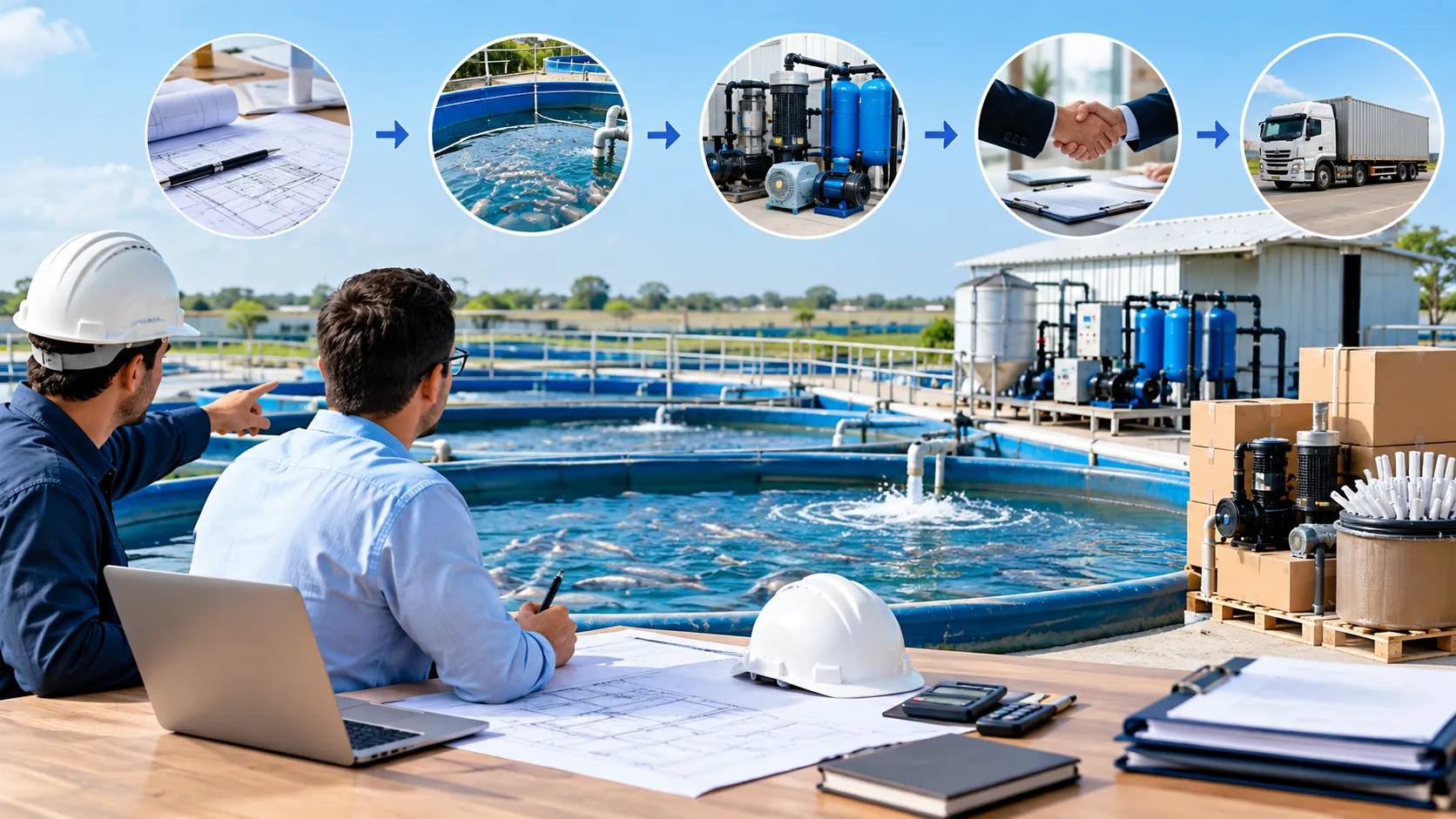
Commercial Aquaculture Procurement: From Project Requirements to Supplier Offers
Commercial aquaculture procurement is an essential process for businesses planning, developing, or expanding commercial fish farming operations. It involves identifying project requirements, selecting suitable aquaculture systems, sourcing equipment, comparing supplier offers, and purchasing products that meet technical, operational, and budget requirements.
For commercial fish farms, choosing the right equipment and suppliers can directly affect production efficiency, fish health, water quality, energy consumption, and long-term profitability. Whether a business is establishing a new fish farm, developing a recirculating aquaculture system, or upgrading an existing production facility, an organized procurement strategy helps reduce purchasing risks and improve project outcomes.
The process involves several important decisions, including selecting fish farming systems, determining equipment specifications, evaluating manufacturers, requesting quotations, and reviewing supplier warranties and after-sales services.
Understanding how commercial aquaculture procurement works allows farm owners, project managers, aquaculture engineers, and purchasing teams to make informed decisions. Instead of choosing equipment based only on price, businesses can evaluate suppliers according to product quality, technical compatibility, operating costs, and long-term support.
Commercial Aquaculture Project Requirements and Planning
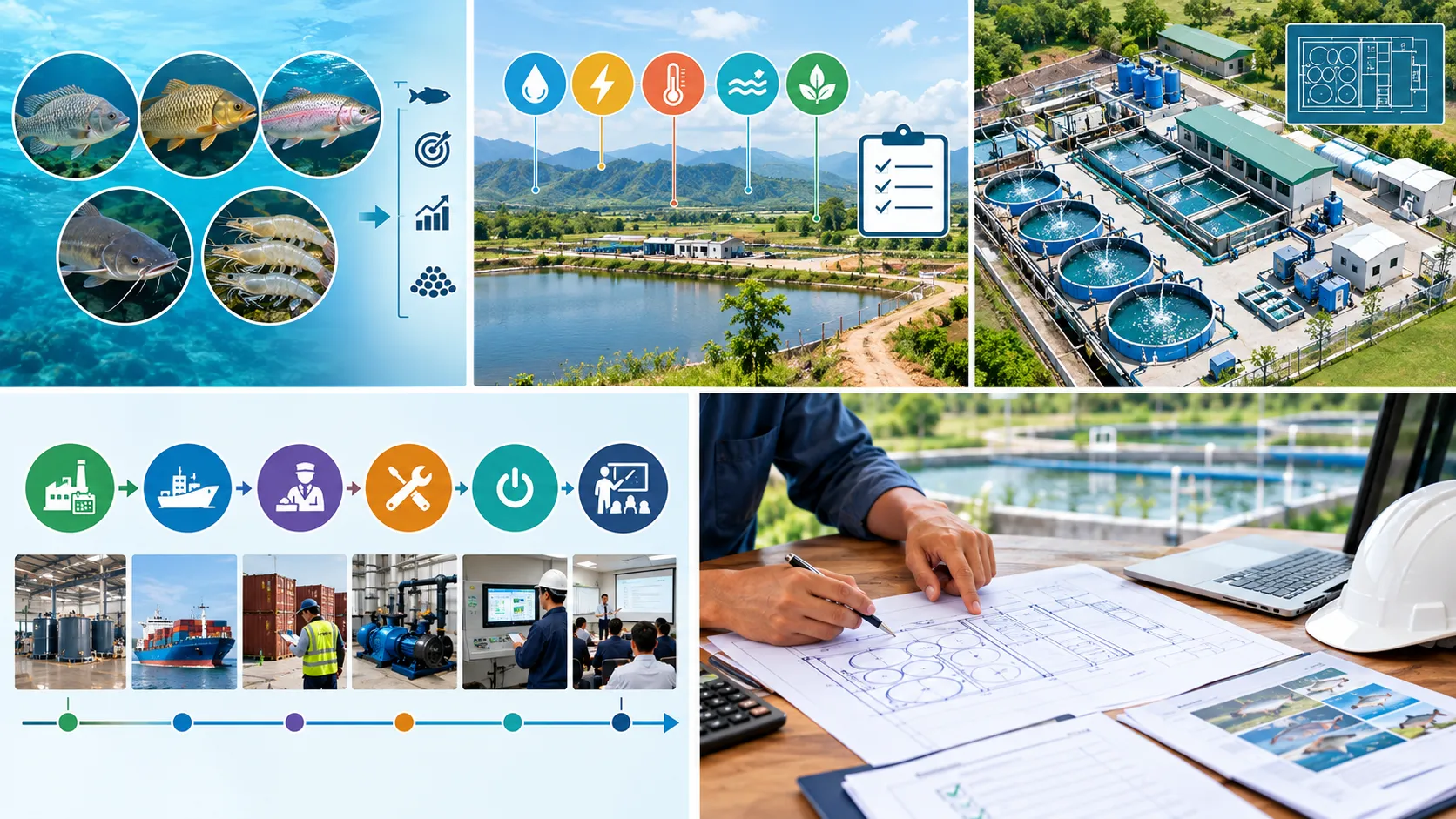
Successful aquaculture procurement begins with clear project requirements. Before contacting suppliers, businesses should determine what they intend to produce, how much production capacity they need, and which farming system will support their objectives.
Project planning provides the foundation for equipment selection, supplier communication, and budget preparation.
Fish Species and Production Goals
The first step is identifying the species to be farmed. Tilapia, common carp, rainbow trout, catfish, and Pacific white shrimp have different environmental and production requirements.
For example, rainbow trout generally requires cooler, well-oxygenated water, while tilapia is suited to warmer conditions. These differences influence tank design, aeration requirements, water circulation, heating, and cooling equipment.
Businesses should also establish their expected annual production, target harvest size, stocking density, and production schedule.
Farm Location and Environmental Conditions
The project location affects water availability, electricity supply, ambient temperature, drainage, and construction requirements.
A farm located in a hot climate may require additional measures to manage water temperature and dissolved oxygen. Facilities using groundwater may need equipment to address water chemistry, dissolved gases, or other water quality issues.
Before purchasing equipment, businesses should evaluate water sources, water quality, land availability, and applicable environmental regulations.
Production Capacity and Facility Design
The planned production capacity determines the number and size of tanks, ponds, raceways, or production units required.
For intensive systems, procurement planning must also account for filtration capacity, hydraulic loading, oxygen demand, waste removal, and backup power.
Project managers should prepare a preliminary facility layout showing production areas, filtration equipment, water storage, feed storage, access routes, and maintenance spaces.
Project Timeline and Operational Needs
A realistic procurement schedule should include equipment manufacturing, shipping, customs clearance where applicable, installation, commissioning, and staff training.
Long-lead items, such as customized filtration systems, large pumps, automated feeders, and complete RAS packages, should be identified early.
Clear project requirements help suppliers provide accurate quotations and reduce the risk of purchasing equipment that cannot support the planned production system.
Aquaculture Systems for Commercial Fish Farming Projects
Selecting the appropriate aquaculture system is one of the most important decisions in commercial aquaculture procurement. Different systems have different equipment requirements, infrastructure costs, water demands, and operating conditions.
The best choice depends on the target species, available resources, production objectives, environmental conditions, and investment capacity.
Pond Aquaculture Systems
Pond aquaculture is widely used for commercial fish farming because it can be relatively straightforward to establish where suitable land and water are available.
Typical procurement requirements include pond preparation equipment, water pumps, aerators, feeding systems, nets, water testing kits, and harvesting equipment.
The number and capacity of aerators should be determined according to pond size, stocking density, species requirements, and expected oxygen demand.
Recirculating Aquaculture Systems (RAS)
A recirculating aquaculture system treats and reuses water, reducing the amount of new water required compared with many flow-through systems.
A typical RAS installation may include:
- Fish tanks and plumbing networks.
- Mechanical solids filtration.
- Biological filtration for ammonia control.
- Water circulation pumps.
- Aeration and oxygenation equipment.
- Carbon dioxide removal systems.
- Ultraviolet disinfection or other suitable treatment.
- Water quality sensors and monitoring controls.
- Emergency aeration and backup power.
RAS procurement requires particular attention to system integration. Equipment should be sized for the intended biomass, feed loading, water flow, and expected waste production.
Purchasing individual components without evaluating their compatibility can lead to inadequate filtration, poor oxygen transfer, or unstable water quality.
Flow-Through and Raceway Systems
Flow-through systems continuously supply water to production units and discharge it after use or treatment. Raceway systems are commonly associated with species such as rainbow trout.
Procurement requirements may include water intake structures, distribution channels, tanks or raceways, screens, oxygenation equipment, flow measurement devices, and effluent treatment facilities.
Biofloc and Aquaponics Systems
Biofloc technology uses microbial communities to help manage nutrients and organic waste in appropriately managed aquaculture systems. It may require strong aeration, water quality monitoring, and solids management equipment.
Aquaponics combines aquaculture with hydroponic plant production. Procurement may therefore include fish tanks, biofilters, pumps, grow beds or channels, aeration systems, and equipment for monitoring both fish water and plant nutrient conditions.
Understanding the selected production system allows businesses to prepare accurate equipment specifications and request relevant supplier offers.
Essential Aquaculture Equipment and Supplies
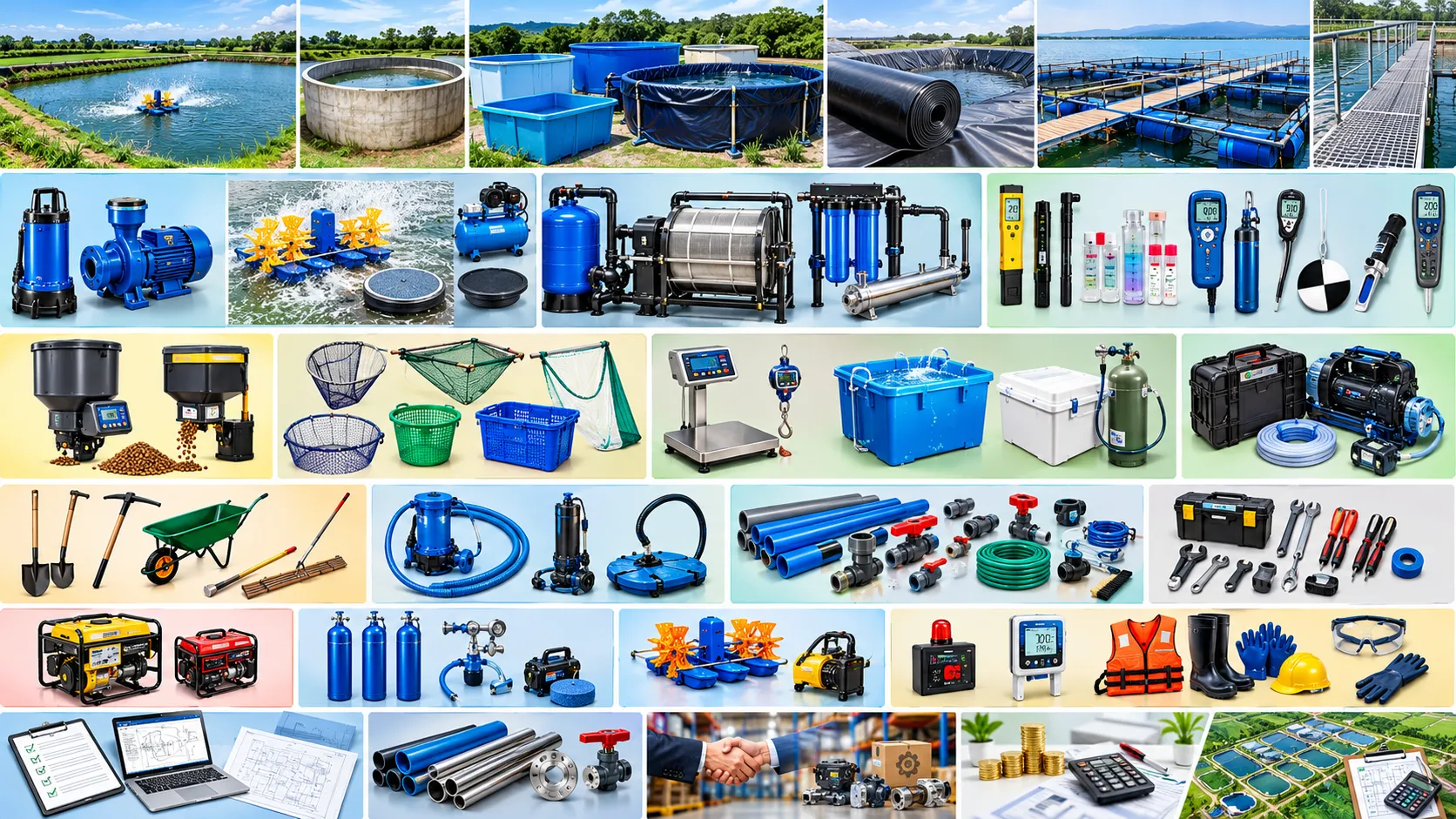
1. Containment and Infrastructure
- Ponds, Tanks, and Cages: Earthen ponds, concrete tanks, fiberglass tanks, tarpaulin tanks, and floating cages selected according to fish species, production scale, and farming method.
- Pond Liners: High-density polyethylene (HDPE) liners and specialized pond liners to reduce water seepage and protect pond structures.
- Gratings and Walkways: Perforated platforms, drainage grates, and walkways for safe access and routine farm maintenance.
2. Water Quality and Aeration Systems
- Water Pumps: Submersible and centrifugal pumps for water circulation, pond filling, drainage, and recirculating aquaculture systems (RAS).
- Aerators and Oxygenation Equipment: Paddlewheel aerators, diffused air systems, air stones, air compressors, and oxygen generators to maintain adequate dissolved oxygen.
- Filtration Units: Mechanical drum filters, solids removal filters, biological filters, and ultraviolet (UV) disinfection units to improve water quality and support fish health.
3. Monitoring and Testing Instruments
- Water Test Kits and Meters: Digital meters and chemical test kits for measuring pH, dissolved oxygen (DO), ammonia, nitrite, nitrate, and other essential water quality parameters.
- Temperature and Water Clarity Tools: Digital thermometers, temperature sensors, and Secchi disks for monitoring water temperature and transparency.
- Salinity Measurement Equipment: Refractometers and salinometers for measuring salinity in brackish water and marine aquaculture systems.
4. Feeding and Stock Management Equipment
- Fish Feeders: Programmable automatic feeders and demand feeders to improve feeding consistency and reduce feed waste.
- Handling and Grading Equipment: Dip nets, seine nets, cast nets, grading baskets, sorting bins, and fish pumps for harvesting and fish size management.
- Weighing and Transportation Equipment: Digital scales, weighing balances, live-haul tanks, insulated transport boxes, and portable oxygen systems for safe fish handling and transportation.
5. Maintenance and Farm Tools
- Earthmoving and Pond Cleaning Tools: Shovels, pickaxes, grub hoes, wheelbarrows, mud rakes, and leveling boards for pond preparation and maintenance.
- Sludge Removal Equipment: Sludge pumps, bottom cleaners, and waste collection tools for removing accumulated organic matter.
- General Maintenance Supplies: Replacement pipes, valves, fittings, hoses, cleaning brushes, and basic repair tools for routine equipment maintenance.
6. Backup and Emergency Equipment
- Backup Power Systems: Generators and backup power supplies to maintain essential farm operations during electrical failures.
- Emergency Oxygen Equipment: Reserve oxygen cylinders, emergency aerators, and oxygen delivery systems to protect fish during oxygen shortages.
- Safety and Alarm Systems: Water quality alarms, oxygen monitoring alarms, protective clothing, gloves, and other essential safety supplies.
7. Equipment Procurement and Supplier Evaluation
- Technical Specifications: Confirm equipment capacity, flow rates, operating pressure, oxygen transfer performance, and compatibility with the farm's production system.
- Durability and Material Quality: Evaluate corrosion resistance, waterproofing, construction materials, and suitability for freshwater or saltwater environments.
- Supplier Support: Compare quotations, warranties, installation services, spare parts availability, and after-sales technical support.
- Operating and Maintenance Costs: Assess electricity consumption, replacement components, maintenance requirements, and expected equipment lifespan.
- Procurement Planning: Match equipment quantities and specifications with production targets, stocking density, farm layout, and the available budget.
Technical Specifications for Aquaculture Equipment Procurement
Technical specifications describe the performance, dimensions, materials, and operating conditions required from purchased equipment. They help buyers compare supplier offers on an equivalent basis.
Without clear specifications, two suppliers may quote products with similar descriptions but significantly different capabilities.
Define Performance Requirements
Every major equipment item should have measurable performance requirements.
For example, pump specifications should include the required flow rate, total dynamic head, motor power, electrical supply, connection size, and operating environment.
Aeration equipment should be evaluated according to oxygen transfer performance, power consumption, installation conditions, and suitability for the intended water body.
Filtration specifications should address design flow, solids loading, treatment capacity, media requirements, and expected maintenance.
Specify Materials and Construction
Aquaculture equipment operates in wet environments and may be exposed to saltwater, cleaning agents, sunlight, and corrosive conditions.
Material selection should therefore reflect the application. Depending on the equipment, suitable materials may include food-contact-compatible plastics, corrosion-resistant metals, and appropriately rated seals and coatings.
Buyers should specify any required material grades, corrosion resistance, temperature limits, and compatibility with the water chemistry.
Establish Electrical and Control Requirements
Electrical specifications should identify voltage, frequency, phase, motor protection, enclosure ratings, control interfaces, and relevant local electrical requirements.
For automated aquaculture systems, buyers should also define sensor compatibility, alarm functions, data logging, remote monitoring, and communication protocols where needed.
Include Installation and Acceptance Requirements
Technical specifications should explain what the supplier must provide, including installation drawings, operating manuals, spare parts lists, maintenance instructions, and commissioning support.
Where appropriate, contracts should define acceptance tests and measurable performance criteria.
Clear specifications make commercial aquaculture procurement more transparent, reduce misunderstandings, and help businesses purchase equipment that fits their actual production requirements.
Aquaculture Procurement Planning and Budget Requirements
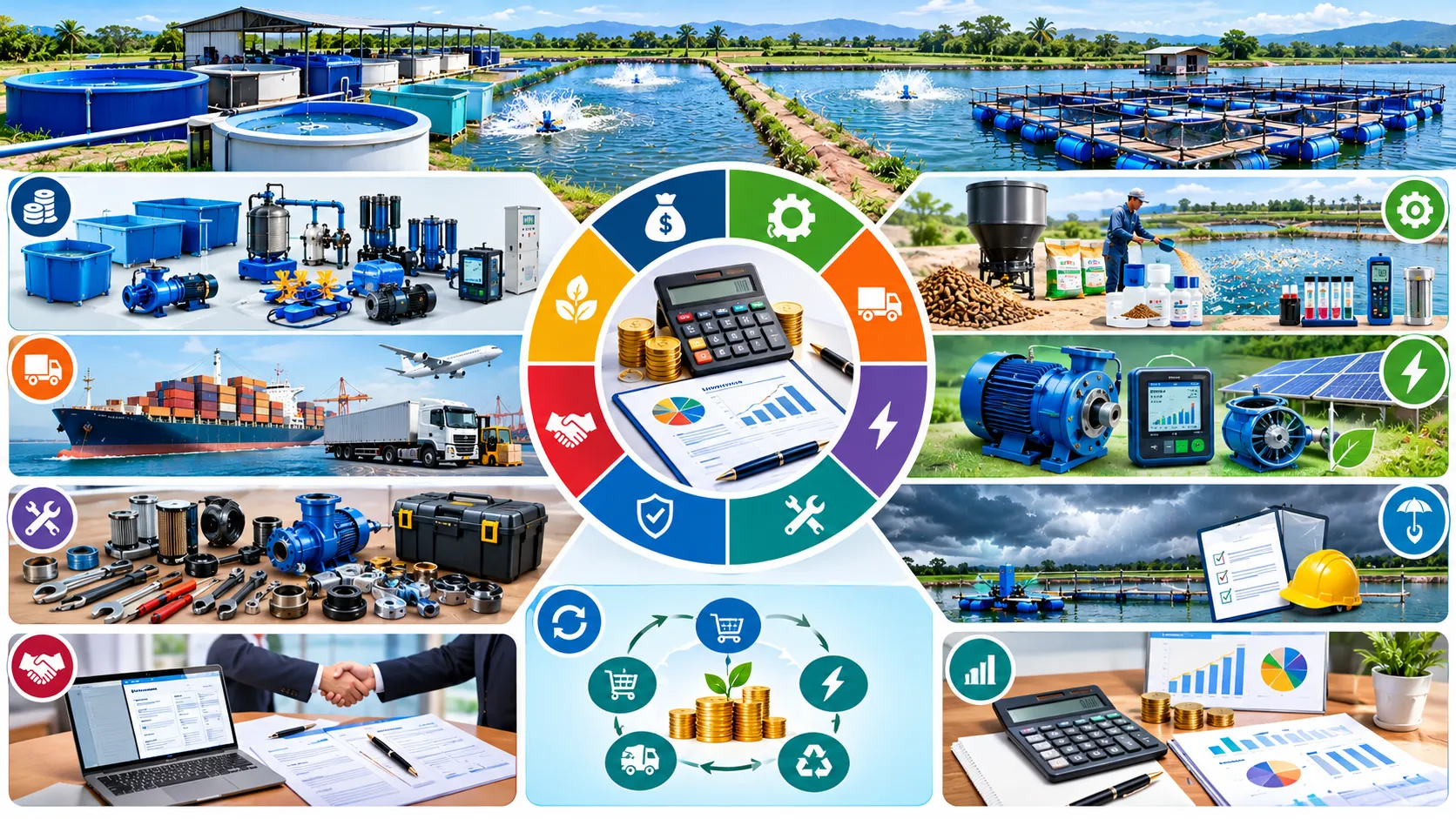
An effective aquaculture procurement budget should cover the complete cost of purchasing, installing, operating, and maintaining equipment. Planning for both initial investment and long-term operating expenses helps fish farmers control costs and avoid unexpected financial problems.
- Capital Expenditure (CAPEX): Initial investments in fish tanks, ponds, raceways, water pumps, filtration systems, aeration equipment, oxygenation systems, electrical infrastructure, plumbing networks, monitoring devices, automation systems, and backup power equipment.
- Operating Expenditure (OPEX): Recurring expenses for electricity, fish feed, labor, water treatment, oxygen supply, equipment maintenance, replacement parts, water testing supplies, and waste management.
- Shipping, Taxes & Installation Costs: Additional expenses for freight, shipping insurance, customs duties, import taxes, currency conversion, local transportation, equipment installation, commissioning, and operator training.
- Equipment Energy Efficiency: Comparison of energy consumption, pump efficiency, blower performance, and operating costs to identify equipment that delivers long-term savings.
- Maintenance & Replacement Budget: Estimated costs for routine servicing, spare parts, filter replacement, pump repairs, sensor calibration, and equipment upgrades throughout the facility's operating life.
- Contingency Planning: Additional financial allowances for unexpected expenses, shipping delays, construction changes, installation adjustments, and supplier-related risks.
- Supplier Quotations & Cost Comparison: Evaluation of supplier offers based on equipment specifications, purchase prices, warranties, delivery schedules, installation services, and after-sales support.
- Total Cost of Ownership (TCO): Assessment of the complete lifecycle cost of aquaculture equipment, including purchase, installation, energy consumption, maintenance, replacement, and disposal expenses.
- Budget Allocation & Financial Planning: Distribution of available funds across essential equipment, infrastructure, operational requirements, and emergency reserves according to production capacity and business objectives.
A comprehensive procurement budget enables aquaculture businesses to compare supplier offers accurately, manage financial risks, select cost-effective equipment, and maintain sustainable farm operations.
Commercial Aquaculture Equipment Suppliers and Manufacturers
Choosing the right suppliers is a central part of commercial aquaculture procurement. Businesses may purchase individual components from specialized manufacturers or obtain integrated systems from companies that design and supply complete aquaculture facilities.
The best sourcing strategy depends on technical complexity, budget, project size, and available engineering expertise.
Specialized Equipment Manufacturers
Some manufacturers focus on particular product categories, such as water pumps, drum filters, biological filtration media, oxygenation equipment, automatic feeders, and monitoring sensors.
Specialized manufacturers may offer detailed technical information and product options suited to particular operating conditions.
Integrated Aquaculture System Providers
Integrated suppliers can provide multiple components designed to work together. This can simplify project coordination, particularly for RAS installations.
However, buyers should verify the exact scope of supply. A proposal described as a complete system may exclude civil construction, electrical installation, water treatment equipment, backup systems, or commissioning services.
Local and International Suppliers
Local suppliers may offer shorter delivery times, easier communication, convenient maintenance, and faster access to spare parts.
International suppliers may provide specialized technology, larger product ranges, or equipment designed for specific production requirements.
When evaluating international offers, businesses should assess import requirements, shipping arrangements, warranty coverage, technical support, and replacement-part availability.
Examples of Aquaculture Technology Companies
Businesses researching equipment suppliers may investigate established companies such as:
- Pentair: associated with water treatment, filtration, and aquaculture-related technologies.
- Xylem: provides water handling, pumping, and related technologies.
- AKVA group: supplies technology and equipment for various aquaculture operations.
- OxyGuard: specializes in water quality monitoring and control equipment.
- Faivre: offers equipment for fish farming and aquaculture applications.
These companies represent different parts of the aquaculture technology market; they should not be assumed to supply every component required by a particular project. Buyers must verify product availability, regional service coverage, technical suitability, and current commercial terms directly with each manufacturer.
Reliable Aquaculture Supplier Selection Criteria
Selecting a reliable aquaculture supplier requires evaluating product quality, technical expertise, industry experience, and long-term service support.
- Technical Capability: Assess the supplier’s technical knowledge, equipment specifications, performance data, engineering drawings, and ability to recommend suitable aquaculture systems.
- Industry Experience & References: Review the supplier’s experience in commercial fish farming, recirculating aquaculture systems (RAS), hatcheries, and similar projects. Request customer references and examples of completed installations.
- Product Quality & Reliability: Evaluate manufacturing standards, construction materials, corrosion resistance, equipment durability, performance testing, and replacement parts availability.
- Warranty & After-Sales Service: Confirm warranty coverage, repair procedures, installation assistance, operator training, technical support, and maintenance services.
- Financial & Commercial Reliability: Verify company registration, quotation validity, payment terms, delivery commitments, financial stability, and trade references before placing large orders.
- Certifications & Compliance: Check relevant product certifications, safety requirements, electrical standards, and environmental regulations applicable to the equipment and project location.
- Spare Parts Availability: Ensure essential components, including pumps, motors, filters, sensors, and aeration parts, are readily available to minimize operational downtime.
- Delivery Time & Logistics: Evaluate manufacturing lead times, shipping arrangements, packaging quality, customs documentation, and the supplier’s ability to deliver equipment according to the project schedule.
- Customization & System Compatibility: Determine whether the supplier can customize equipment to meet production capacity, water quality requirements, fish species, and existing infrastructure specifications.
- Technical Support & Maintenance: Assess the availability of remote troubleshooting, on-site servicing, preventive maintenance programs, and emergency assistance.
- Total Cost of Ownership (TCO): Compare purchase prices alongside energy consumption, installation expenses, maintenance requirements, replacement costs, and expected equipment lifespan.
- Supplier Evaluation & Risk Assessment: Use a consistent evaluation checklist or scoring system to compare suppliers based on technical performance, product quality, commercial terms, delivery reliability, and long-term support.
A structured supplier selection process helps aquaculture businesses reduce procurement risks, improve equipment reliability, and establish dependable long-term supplier relationships.
Aquaculture Equipment Sourcing and Supplier Research
Effective supplier research helps procurement teams discover suitable products, identify alternative technologies, and obtain competitive offers.
The process should begin with the technical requirements rather than a general search for the cheapest available equipment.
Use Targeted Supplier Searches
Search for suppliers using specific product names and measurable requirements.
For example, instead of searching only for "fish farm equipment," a procurement team might search for commercial fish tank filtration systems, aquaculture water circulation pumps, industrial fish farm aeration systems, or RAS biological filters.
Targeted searches make it easier to identify manufacturers whose products match the project's needs.
Research Manufacturer Websites
Manufacturer websites can provide product catalogs, technical datasheets, installation guides, performance specifications, and contact details.
Buyers should compare the published specifications with their procurement requirements and ask manufacturers to clarify missing information.
A supplier's marketing claims should not replace technical verification.
Explore Industry Directories and Trade Events
Aquaculture trade exhibitions, industry associations, and specialist directories can help buyers identify equipment manufacturers and distributors.
Industry events may also provide opportunities to discuss technical requirements directly with manufacturers and compare available technologies.
Contact Multiple Suppliers
For significant purchases, request offers from several qualified suppliers where practical.
Provide each supplier with the same technical requirements, delivery location, expected order quantity, and quotation deadline.
This improves the comparability of offers and reduces the likelihood of receiving proposals based on different assumptions.
Verify Supplier Credentials
Check company details, manufacturing capabilities, product documentation, references, and service arrangements.
When purchasing through distributors, clarify whether the distributor is authorized to sell the product and provide warranty support.
A structured sourcing process gives businesses a clearer understanding of market options and helps identify suppliers capable of meeting both technical and commercial expectations.
Aquaculture Procurement Checklists and Documentation
Procurement checklists and documentation help aquaculture businesses verify project requirements before issuing purchase orders. They improve coordination between project managers, engineers, finance teams, and suppliers while reducing procurement errors.
Before requesting quotations, confirm fish species, production capacity, system type, equipment quantities, water treatment requirements, electrical specifications, installation needs, budget, delivery schedule, and safety requirements.
Maintain technical documents, including equipment specifications, drawings, datasheets, performance requirements, and installation instructions. Commercial records should include supplier quotations, pricing details, payment terms, warranties, delivery conditions, and purchase orders. International shipments may also require invoices, packing lists, transport documents, and customs paperwork.
During delivery, record equipment quantities, model and serial numbers, visible damage, missing components, and deviations from the purchase order. Keep inspection reports, factory acceptance test records, and written supplier communications for future reference.
Aquaculture Equipment Quotations and Supplier Offers
Supplier quotations provide commercial and technical details that help aquaculture businesses evaluate equipment options, compare prices, and select suitable suppliers.
- Supplier Information: Verify the supplier’s legal business name, contact details, business address, quotation number, and issue date to establish a clear procurement record.
- Equipment Specifications & Models: Review product names, model numbers, quantities, technical datasheets, rated capacities, operating limits, and compatibility with the proposed aquaculture system.
- Unit Prices & Total Costs: Compare individual equipment prices, total order value, applicable taxes, discounts, and additional charges to understand the complete purchase cost.
- Shipping & Transportation Charges: Check packaging expenses, freight costs, shipping insurance, customs duties, import taxes, and local transportation fees where applicable.
- Manufacturing & Delivery Schedules: Confirm production lead times, dispatch dates, estimated arrival dates, installation timelines, and procedures for managing potential delays.
- Payment Terms & Quotation Validity: Review deposit requirements, payment milestones, accepted currencies, outstanding payment conditions, and the period during which the quoted prices remain valid.
- Warranty & After-Sales Support: Compare warranty duration, coverage limitations, repair procedures, spare parts availability, technical assistance, and maintenance services.
- Installation & Commissioning Scope: Determine whether equipment installation, system integration, performance testing, commissioning, and operator training are included in the supplier’s offer.
- Included & Excluded Items: Identify missing accessories, control panels, electrical components, plumbing connections, sensors, and other essential items that could increase the final project cost.
- Technical Clarifications & Compliance: Request additional information about filtration capacity, pump operating points, aeration performance, electrical requirements, safety standards, and compatibility with project specifications.
- Quotation Comparison & Evaluation: Compare supplier offers using consistent technical and commercial criteria, including equipment performance, total delivered cost, delivery reliability, warranty coverage, and long-term operating expenses.
- Negotiation & Revised Supplier Offers: Request revised quotations when specifications are unclear, costs are inconsistent, delivery terms are unsuitable, or important equipment and services are missing.
A structured quotation evaluation process helps procurement teams identify hidden costs, reduce purchasing risks, and select aquaculture equipment that meets technical requirements and budget expectations.
Commercial Aquaculture Equipment Price Comparison
Comparing commercial aquaculture equipment prices requires more than reviewing the unit price shown on a quotation. Buyers should evaluate equivalent specifications and calculate the overall cost of obtaining operational equipment.
A structured comparison helps businesses identify genuine savings without sacrificing reliability or performance.
Compare Equivalent Equipment
Ensure that all quotations cover the same capacity, performance, material requirements, accessories, and service scope.
For example, two pumps may have similar purchase prices but different flow rates, efficiency levels, motor protection, and maintenance requirements.
Likewise, filtration systems with different treatment capacities should not be compared solely by their advertised dimensions or nominal flow rates.
Calculate the Total Delivered Cost
The total delivered cost may include:
- Equipment purchase price.
- Packaging and freight.
- Cargo insurance.
- Customs duties and import taxes, where applicable.
- Local transportation and handling.
- Installation and commissioning.
- Required accessories and spare parts.
These costs can significantly change the apparent difference between supplier offers.
Compare Energy Consumption
Electricity costs are particularly important for equipment operating continuously.
A simplified annual energy calculation is:
Annual energy consumption (kWh) = Average electrical power (kW) × Operating hours per year.
For example, equipment drawing an average of 2 kW and operating continuously for 8,760 hours would consume approximately 17,520 kWh annually.
Actual consumption may vary with operating conditions, loading, and control settings.
Multiplying annual energy consumption by the applicable electricity tariff provides an estimate of annual electricity costs.
Consider Maintenance and Replacement Costs
A lower purchase price may be offset by frequent maintenance, expensive consumables, shorter service life, or limited spare-part availability.
Businesses should compare expected maintenance requirements, warranty coverage, replacement components, and the cost of downtime.
Use a Standard Comparison Table
A procurement team can evaluate offers using a consistent format:
| Evaluation Factor | Supplier A | Supplier B | Supplier C |
| Equipment model | Record model | Record model | Record model |
| Technical compliance | Meets/Does not meet | Meets/Does not meet | Meets/Does not meet |
| Equipment price | Quoted amount | Quoted amount | Quoted amount |
| Delivery cost | Quoted amount | Quoted amount | Quoted amount |
| Installation cost | Quoted amount | Quoted amount | Quoted amount |
| Delivery time | Confirmed estimate | Confirmed estimate | Confirmed estimate |
| Warranty | Stated terms | Stated terms | Stated terms |
| Energy consumption | Rated or estimated | Rated or estimated | Rated or estimated |
| After-sales support | Verified details | Verified details | Verified details |
| Total evaluated cost | Calculated amount | Calculated amount | Calculated amount |
This method helps decision-makers identify the most suitable offer based on cost, performance, and long-term value.
Aquaculture Supplier Quality Standards and Certifications
Quality standards and certifications help buyers assess whether equipment, manufacturing processes, and management systems meet recognized requirements.
However, certification alone does not guarantee that a product is suitable for a specific aquaculture project.
Procurement teams should verify both the authenticity of relevant certifications and the equipment's actual technical performance.
ISO Quality Management Standards
The International Organization for Standardization (ISO) publishes standards used by organizations across many industries.
ISO 9001 addresses quality management systems. A valid certification may provide useful evidence of an organization's quality management practices, but it does not automatically certify every product or establish that the equipment meets a particular aquaculture specification.
Buyers should verify the certificate's scope, validity, and issuing certification body.
Electrical and Product Safety Requirements
Electrical equipment may need to comply with applicable national regulations and recognized product safety standards.
Depending on the product and destination market, relevant documentation may include electrical safety test reports, conformity declarations, and applicable certifications.
For equipment sold in the European Economic Area, buyers should determine whether CE marking and the associated conformity requirements apply to the specific product.
CE marking should not be treated as a universal quality award or proof that every performance claim is correct.
Materials and Water Compatibility
Equipment components that contact water must be suitable for the intended application.
Buyers should verify material specifications, corrosion resistance, and any applicable requirements for drinking-water contact or food-contact materials when those requirements are relevant.
Requirements for drinking-water systems should not automatically be assumed to apply to every aquaculture installation.
Environmental and Operational Compliance
Commercial aquaculture projects may be subject to local environmental permits, wastewater discharge limits, worker safety requirements, and electrical installation regulations.
Businesses should identify the applicable rules before purchasing equipment.
Performance Verification
For critical equipment, request relevant test reports, operating data, factory acceptance testing, and documented performance guarantees.
The most useful approach combines appropriate certifications with technical documentation, supplier verification, and equipment acceptance testing.
Supplier Offer Evaluation and Procurement Cost Analysis
Once quotations have been collected, the next step is to evaluate supplier offers systematically.
The objective is to identify the proposal that best meets the project's technical, commercial, operational, and financial requirements.
Step 1: Check Technical Compliance
Begin by comparing each offer with the approved procurement specifications.
Classify each requirement as compliant, non-compliant, or requiring clarification.
Major technical gaps should be resolved before price-based ranking. An inexpensive system that cannot provide the required flow, filtration capacity, or oxygen supply may be unsuitable regardless of its price.
Step 2: Evaluate Commercial Conditions
Review the total quoted price, payment schedule, delivery commitments, warranty coverage, installation costs, and any exclusions.
Check whether quotations use the same currency and whether taxes and transportation are included.
For international procurement, also consider exchange-rate exposure and the responsibilities assigned to the buyer and seller under the agreed delivery terms.
Step 3: Assess Supplier Risk
Consider the supplier's relevant experience, financial reliability, technical resources, spare-parts availability, and ability to meet the proposed schedule.
Assess the consequences of a supplier failing to deliver or provide support, especially when equipment is critical to fish survival.
Step 4: Calculate Lifecycle Costs
Lifecycle cost analysis considers expenses incurred over the equipment's expected operating life.
Depending on the product, this may include purchase, installation, electricity, maintenance, consumables, repairs, replacement parts, and disposal.
For major investments, a discounted cash flow analysis can help compare alternatives with different initial prices and future operating expenses.
Step 5: Apply a Weighted Evaluation Model
A weighted scoring model can help procurement teams compare qualified suppliers consistently.
For example:
| Evaluation Criterion | Example Weight |
| Technical compliance | 30% |
| Total evaluated cost | 25% |
| Equipment quality and reliability | 15% |
| Delivery schedule | 10% |
| Warranty and after-sales support | 10% |
| Supplier experience and references | 10% |
| Total | 100% |
These weights are illustrative and should be adjusted to the project's priorities. For a critical RAS installation, reliability and technical performance may deserve greater emphasis than the initial purchase price.
Score each supplier against the same criteria, using documented evidence rather than assumptions.
Step 6: Document the Recommendation
Prepare an evaluation report explaining the shortlisted suppliers, technical differences, total evaluated costs, identified risks, and reasons for recommending a particular offer.
A documented evaluation supports transparent decision-making and helps project stakeholders understand why a supplier was selected.
Conclusion
Commercial aquaculture procurement is an essential process for building and managing a successful fish farming business. From defining project requirements and selecting suitable aquaculture systems to comparing equipment prices and evaluating supplier offers, every step contributes to better purchasing decisions.
By focusing on technical specifications, equipment quality, supplier reliability, budget planning, and long-term operating costs, businesses can reduce procurement risks and improve operational efficiency. Comparing quotations carefully also helps identify suppliers that offer the right balance of price, performance, warranty, and after-sales support.
Ultimately, a well-planned procurement strategy helps commercial fish farms invest in suitable equipment, maintain water quality, support fish health, and achieve sustainable production goals. Careful supplier selection and proper documentation create a strong foundation for long-term aquaculture business growth.
Frequently Asked Questions (FAQs)
1. What is commercial aquaculture procurement?
Commercial aquaculture procurement involves sourcing, evaluating, and purchasing fish farming equipment, supplies, and services according to project requirements, budgets, and technical specifications.
2. Why is aquaculture procurement important for fish farming?
Aquaculture procurement helps businesses select suitable equipment, control purchasing costs, improve operational efficiency, maintain water quality, and support reliable fish production.
3. What equipment is needed for commercial aquaculture?
Commercial aquaculture commonly requires fish tanks, water pumps, aerators, filtration systems, automatic feeders, monitoring instruments, harvesting tools, and backup power equipment.
4. What is a recirculating aquaculture system (RAS)?
A recirculating aquaculture system treats and reuses water through filtration, biological treatment, and circulation, helping reduce freshwater requirements in intensive fish farming.
5. How do I choose a reliable aquaculture equipment supplier?
Evaluate suppliers based on technical expertise, product quality, industry experience, warranty coverage, delivery reliability, spare parts availability, and after-sales technical support.
6. What should an aquaculture equipment quotation include?
An equipment quotation should include product specifications, quantities, unit prices, total costs, delivery schedules, payment terms, warranty conditions, and installation services.
7. How can I compare aquaculture equipment prices?
Compare equivalent equipment specifications, purchase prices, shipping charges, installation expenses, energy consumption, maintenance requirements, warranty coverage, and expected equipment lifespan.
8. What is the total cost of ownership (TCO) in aquaculture?
Total cost of ownership includes equipment purchase, installation, electricity, maintenance, replacement parts, operating expenses, and disposal costs throughout the equipment's useful life.
9. Which certifications matter when purchasing aquaculture equipment?
Relevant certifications depend on equipment type and destination market; buyers should verify applicable ISO quality systems, electrical safety requirements, conformity documentation, and product standards.
10. How many suppliers should I contact for aquaculture quotations?
Contact at least three qualified suppliers when practical, providing identical specifications to compare technical compliance, pricing, delivery schedules, warranties, and support fairly.