

Commercial Aquaculture Supplier Selection
Commercial Aquaculture Supplier Selection: Key Factors to Review
Commercial aquaculture is an important part of the global food production industry, supplying fish, shrimp, and other aquatic products to consumers, restaurants, seafood processors, and retailers. As fish farming continues to grow, choosing the right supplier has become an essential decision for commercial fish farms, hatcheries, shrimp farms, and large-scale aquaculture businesses.
A reliable aquaculture supplier provides more than fish feed, fingerlings, tanks, pumps, and water treatment products. The right partner helps maintain water quality, improve fish health, reduce operational risks, and support consistent production. On the other hand, choosing a supplier based only on low prices can lead to poor-quality products, delayed deliveries, increased mortality, and unnecessary financial losses.
Commercial aquaculture supplier selection requires a careful review of product quality, industry experience, pricing, certifications, delivery performance, technical support, and long-term supply capacity. Businesses must also consider sustainability, biosecurity, and compliance with relevant aquaculture regulations.
This guide explains the key factors to review when selecting a commercial aquaculture supplier. Whether you operate a freshwater fish farm, a recirculating aquaculture system (RAS), a shrimp production facility, or a commercial hatchery, these considerations can help you make a more informed purchasing decision.
[ Explore Aquaculture Supplies ]
Why Choosing the Right Commercial Aquaculture Supplier Matters
The quality of your suppliers directly affects the performance and profitability of your aquaculture operation. Fish and shrimp farming depend on consistent access to essential inputs, including nutritionally balanced feed, healthy fingerlings, reliable equipment, and effective water management products.
An experienced supplier understands these requirements and can recommend products suited to your species, production system, stocking density, and farm size.
For example, a tilapia farm may require floating fish feed, aeration equipment, water quality testing kits, and healthy fingerlings. A shrimp farm may need specialized shrimp feed, post-larvae, pond aerators, and products for monitoring salinity and dissolved oxygen.
Choosing the right supplier can provide several benefits:
- Better product quality: Consistent feed quality, healthy stocking material, and dependable equipment support stable production.
- Lower operational risks: Reliable suppliers help reduce the chances of stock shortages, equipment failures, and unexpected interruptions.
- Improved cost management: Competitive pricing and predictable delivery schedules make it easier to manage operating expenses.
- Access to technical expertise: Knowledgeable suppliers can help identify suitable equipment and troubleshoot common production challenges.
- Long-term business stability: Strong supplier relationships support purchasing plans, inventory management, and production growth.
Supplier selection should therefore be treated as a strategic business decision rather than a simple purchasing task.
Factors to Consider When Selecting an Aquaculture Supplier
Before choosing a supplier, create a clear list of your farm's requirements. Different aquaculture businesses need different products, so the best supplier for one operation may not be suitable for another.
- Product range: Check whether the supplier offers the feed, fingerlings, pumps, aerators, filtration systems, water testing equipment, and other products your operation needs.
- Product quality: Request specifications, ingredient information, test reports, and relevant quality documentation.
- Experience: Evaluate the supplier's experience with your fish or shrimp species and production system.
- Pricing: Compare total purchasing costs, including transportation, installation, maintenance, and replacement expenses where applicable.
- Availability: Confirm whether essential products are available consistently throughout the production cycle.
- Delivery performance: Review delivery schedules, shipping conditions, order tracking, and procedures for handling damaged or delayed shipments.
- Technical support: Determine whether the supplier provides product guidance, installation assistance, maintenance advice, or staff training.
- Compliance: Check applicable licenses, certificates, import requirements, and local regulations.
- Scalability: Make sure the supplier can support your future production requirements as your farm expands.
It is also helpful to distinguish between suppliers of live aquatic animals, feed manufacturers, equipment distributors, and water treatment providers. Each category requires different quality checks. For example, live fingerlings need health and transport assessments, while pumps require performance specifications and warranty information. A structured evaluation helps you compare suppliers fairly and avoid making decisions based on marketing claims alone.
How to Evaluate Aquaculture Supplier Experience and Reputation
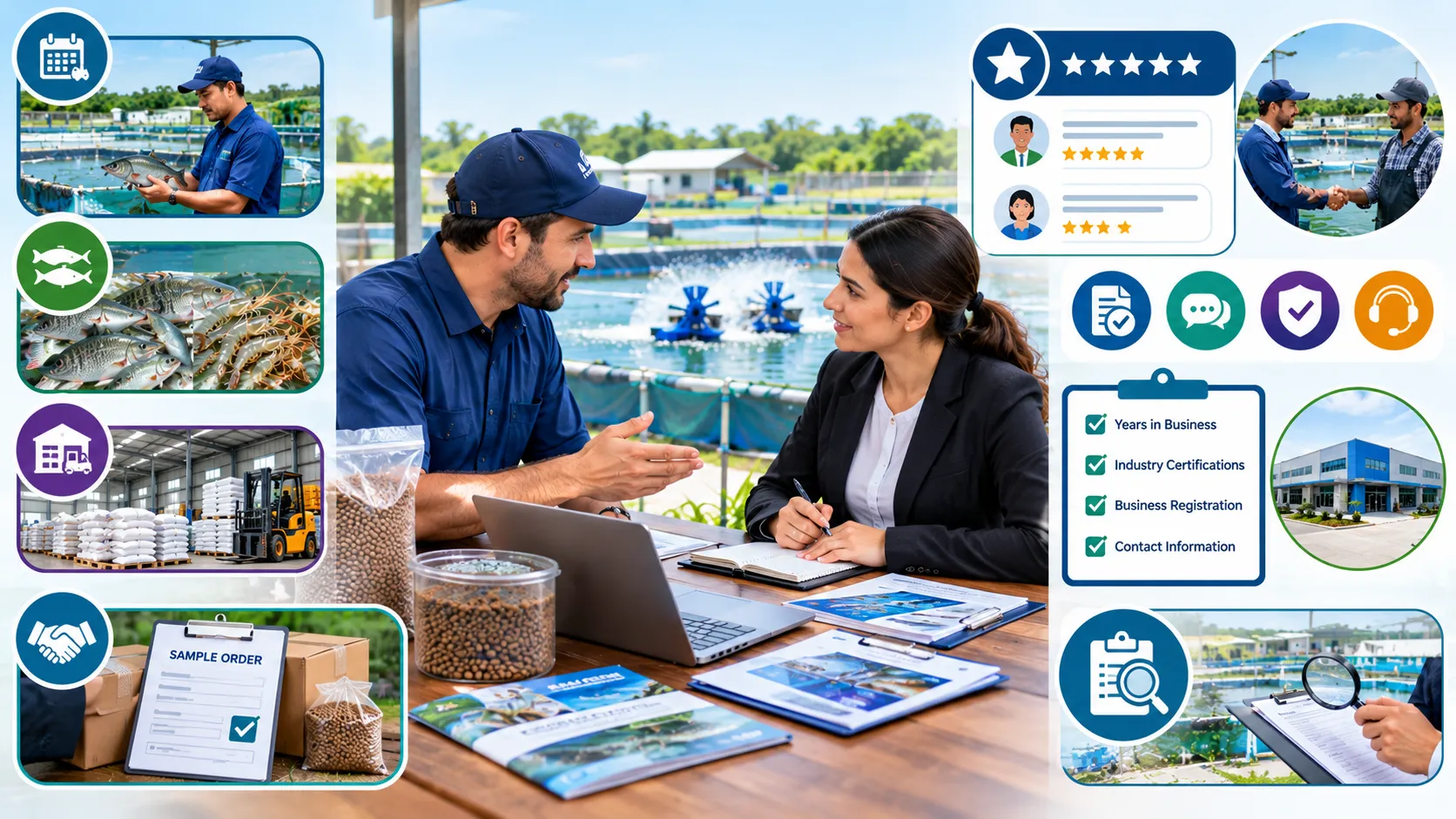
Supplier experience can indicate how well a business understands the practical challenges of commercial fish farming. However, years in business alone do not guarantee product quality or reliable service. Begin by reviewing the supplier's background. Find out how long the company has operated, which aquaculture species it serves, and whether it has experience with businesses similar to yours.
A supplier serving commercial tilapia farms may understand freshwater production requirements, while a supplier specializing in marine aquaculture may have greater expertise in salinity management, marine fish nutrition, and specialized filtration equipment.
Look for evidence of a strong reputation, including:
- Verified customer reviews and testimonials.
- References from commercial fish farms or hatcheries.
- Documented experience with large-volume orders.
- Transparent product specifications and business information.
- A clear process for handling complaints and product defects.
- Consistent communication before and after a sale.
Whenever possible, speak directly with existing customers. Ask whether orders arrive on time, whether products match their specifications, and how the supplier responds when problems occur.
You should also verify the supplier's physical business presence, relevant registrations, and contact details. For high-value purchases, consider requesting a sample order or conducting a supplier audit before committing to a long-term contract.
Avoid relying entirely on online ratings or promotional claims. A dependable supplier should be willing to provide reasonable evidence of its experience and explain how its products meet your farm's needs.
Product Quality Standards for Commercial Aquaculture Suppliers
- Fish Feed Quality: Check nutritional composition, protein and fat levels, ingredient quality, pellet size, and suitability for the target species and life stage.
- Fingerling and Shrimp Post-Larvae Quality: Examine species identity, size uniformity, visible health, transportation conditions, and relevant health certificates.
- Aquaculture Equipment Standards: Evaluate material quality, operating capacity, energy efficiency, corrosion resistance, safety features, and expected service life.
- Water Treatment Products and Chemical Safety: Verify product labeling, intended use, storage instructions, safety data, and legal authorization where applicable.
- Product Documentation and Traceability: Request technical data sheets, batch identification records, certificates of analysis, and relevant laboratory test results.
- Aquaculture Certifications and Industry Standards: Consider FAO guidance and the Global Seafood Alliance's Best Aquaculture Practices (BAP) program when assessing responsible production practices.
- Supplier Quality Verification: Confirm certification validity, review product specifications, inspect samples when appropriate, and verify that products meet your farm's requirements before purchasing.
Aquaculture Equipment and Supplies: What to Look For
- Essential Aquaculture Supplies: Identify the required supplies, including fish feed, fingerlings, shrimp post-larvae, tanks, nets, and harvesting tools.
- Aeration and Water Pump Systems: Check oxygen transfer capacity, water flow rate, operating conditions, energy consumption, and suitability for your farm.
- Water Quality Monitoring Equipment: Choose reliable dissolved oxygen meters, pH testing kits, and temperature and salinity monitoring devices.
- Filtration and Water Treatment Systems: Evaluate mechanical and biological filters, water circulation systems, and waste management equipment to maintain suitable water quality.
- Equipment Compatibility and Performance: Ensure that pumps, aerators, biofilters, and monitoring systems work efficiently together, especially in recirculating aquaculture systems (RAS).
- Spare Parts and Technical Support: Confirm the availability of replacement parts, installation instructions, maintenance schedules, warranties, and troubleshooting assistance.
- Safety, Reliability, and Backup Systems: Check electrical safety, corrosion resistance, equipment durability, backup generators, emergency aeration systems, and alarms to reduce the risk of production interruptions.
[ Get Equipment Guidance ]
Comparing Commercial Aquaculture Supplier Prices and Costs
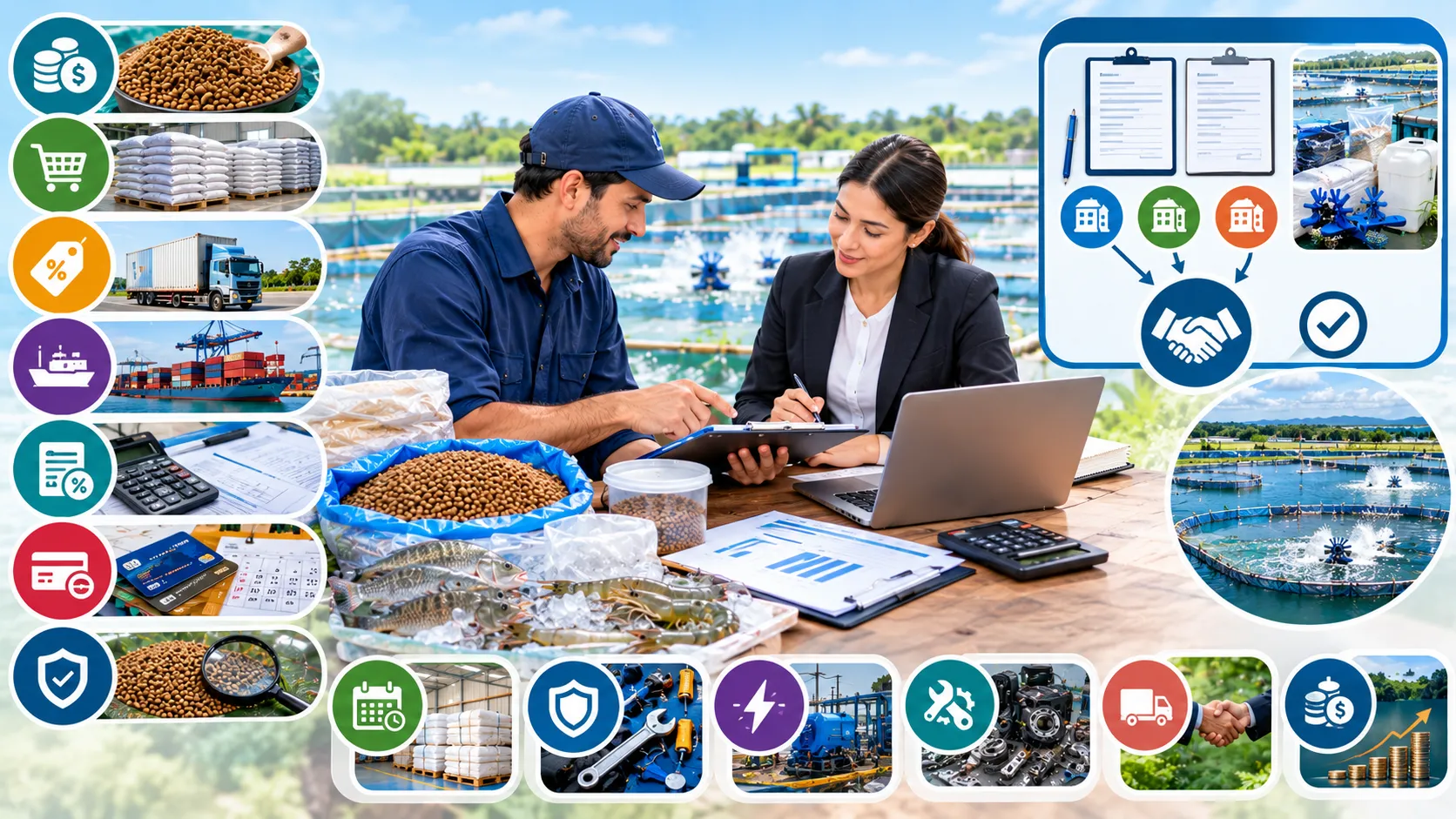
| Cost Factor | What to Compare | Why It Matters |
| Unit Price | Price per product or unit | Helps compare the initial cost of similar products. |
| Minimum Order Quantity | Minimum quantity required per order | Ensures the order meets your budget and operational needs. |
| Bulk Discounts | Discounts for large-volume purchases | May reduce the overall purchasing cost. |
| Shipping and Delivery | Freight, packaging, and delivery charges | Helps calculate the actual delivered cost. |
| Taxes and Import Duties | Applicable taxes, customs duties, and other fees | Prevents unexpected expenses. |
| Payment Terms | Advance payments, credit periods, and currency requirements | Helps manage cash flow and purchasing budgets. |
| Product Quality | Material quality, specifications, and performance | Reduces the risk of product failure and unnecessary replacement. |
| Shelf Life and Storage | Expiry dates and required storage conditions | Helps prevent feed spoilage and product waste. |
| Warranty and Replacement | Warranty coverage, repair services, and replacement policies | Reduces potential costs if equipment fails. |
| Operating Expenses | Electricity, fuel, and other running costs | Helps estimate long-term expenses. |
| Maintenance Costs | Routine servicing, repairs, and spare parts | Supports reliable equipment operation. |
| Live Animal Transportation | Transport time, temperature control, and mortality policies | Helps minimize losses during the delivery of fish or shrimp. |
| Supplier Reliability | Delivery performance and product availability | Reduces the risk of supply interruptions. |
| Total Cost of Ownership | Purchase price, delivery, operation, maintenance, and replacement costs | Identifies the supplier offering the best overall value. |
Tip: Request written quotations from at least two or three qualified suppliers and compare the same product specifications, order quantities, delivery locations, and payment terms before making a purchasing decision.
Availability of Fish Feed, Fingerlings, and Aquaculture Essentials
Consistent access to essential supplies is a major factor in commercial aquaculture management. Feed, stocking material, water quality products, and replacement parts must be available when the production cycle requires them.
Fish feed is often one of the largest recurring operating expenses in intensive aquaculture. Suppliers should offer appropriate feed formulations for the target species, life stage, feeding behavior, and production system.
For example, tilapia, catfish, trout, and shrimp have different nutritional requirements. Feed selection should therefore be based on species-specific needs and advice from qualified aquaculture nutrition professionals.
When purchasing feed, check pellet size, nutritional specifications, storage conditions, manufacturing dates, and recommended shelf life. Poor storage can damage feed quality even when the product originally met the required standards.
Fingerling selection also requires careful planning. Confirm the supplier's ability to provide the correct species, quantity, size, and delivery date. Ask about hatchery management, disease prevention, and available health records.
For shrimp farms, verify that post-larvae come from a reputable hatchery and that relevant health screening and transport procedures are documented.
Other essential supplies may include:
- Water quality testing kits and calibration solutions.
- Aeration equipment and spare parts.
- Filters and replacement media.
- Feeding tools and storage containers.
- Protective equipment and cleaning supplies.
- Approved water treatment products.
- Monitoring devices and emergency backup components.
Seasonal availability should also be considered. Some species and stocking sizes may be easier to obtain during specific production periods.
Maintaining relationships with a primary supplier and a qualified backup supplier can reduce the risk of shortages. However, alternative suppliers should be evaluated using the same quality and biosecurity requirements as the primary source.
Certifications and Compliance with Aquaculture Industry Standards
Certifications and regulatory compliance help commercial aquaculture businesses assess supplier credibility, product traceability, and responsible operating practices.
The exact requirements depend on the product, species, country, destination market, and type of aquaculture operation.
- Food and Agriculture Organization of the United Nations (FAO): The FAO publishes guidance on responsible fisheries and aquaculture, including the Code of Conduct for Responsible Fisheries.
- Global Seafood Alliance (GSA): Its Best Aquaculture Practices program provides certification standards covering aspects of responsible aquaculture production and supply chains. The specific scope of a certificate must be checked.
- Aquaculture Stewardship Council (ASC): The ASC develops standards for responsible aquaculture. Its relevance depends on the farm, product, supply chain, and certification requirements involved.
- International Organization for Standardization (ISO): Standards such as ISO 9001 address quality management systems, while ISO 14001 addresses environmental management systems. Certification does not automatically establish that every aquaculture product is suitable or compliant.
- HACCP: Hazard Analysis and Critical Control Point principles are relevant to food safety management in applicable processing and handling operations. They should not be confused with a universal certification for all aquaculture supplies.
When evaluating a supplier, request relevant certificates, license details, health documentation, and product traceability records. Verify certificates with the issuing organization or its official registry whenever possible.
For businesses operating in Pakistan, check applicable requirements from the relevant federal or provincial fisheries and livestock authorities, as well as import, quarantine, and other regulatory bodies where relevant. Requirements can differ according to the species, product category, and movement of live aquatic animals.
A certification should be viewed as one part of supplier evaluation rather than a substitute for quality checks, customer references, and operational due diligence.
Technical Support and Customer Service from Aquaculture Suppliers
- Product Selection and Technical Consultation: Choose suppliers who can recommend suitable products based on your farm's size, species, production system, and operational needs.
- Installation and Equipment Setup: Check whether the supplier provides installation guidance, commissioning assistance, and instructions for setting up aquaculture equipment correctly.
- Maintenance and Troubleshooting: Ensure the supplier offers clear maintenance schedules, troubleshooting guidance, and practical solutions to equipment problems.
- Staff Training and Product Demonstrations: Look for suppliers who provide training, demonstrations, and operating instructions to help farm staff use equipment safely and efficiently.
- Spare Parts and Repair Services: Confirm the availability of replacement parts, repair services, and qualified technicians to minimize equipment downtime.
- Warranty and Emergency Support: Review warranty terms, claim procedures, response times, and emergency support options for critical aquaculture equipment.
- After-Sales Service and Professional Advice: Evaluate the supplier's ongoing support after delivery, and consult qualified aquatic animal health professionals for complex disease diagnosis or treatment decisions.
Evaluating Supplier Capacity for Large-Scale Aquaculture Operations
- Current and Future Supply Requirements: Estimate monthly and annual demand for fish feed, fingerlings, shrimp post-larvae, equipment, and other essential supplies.
- Supplier Production and Inventory Capacity: Assess manufacturing capacity, warehouse inventory, distribution networks, and the ability to fulfill large-volume orders.
- Consistent Product Quality: Verify that suppliers maintain consistent feed formulations, product specifications, batch quality, and traceability across repeated deliveries.
- Delivery Schedules and Logistics: Confirm delivery timelines, advance ordering requirements, seasonal availability, and flexibility to adjust shipments as demand changes.
- Supply Chain Reliability: Evaluate dependence on single manufacturers, imported components, seasonal sources, and other factors that could interrupt supply.
- Contingency Planning and Business Continuity: Ask about backup suppliers, alternative sourcing arrangements, shortage management, and plans for unexpected disruptions.
- Scalability and Long-Term Support: Review the supplier's financial stability, quality control, operational capabilities, and ability to support future farm expansion without compromising product quality or service.
Sustainable and Environmentally Friendly Aquaculture Supply Options
Sustainability is increasingly important in commercial aquaculture because farming operations interact directly with water resources, aquatic ecosystems, energy systems, and surrounding communities.
Selecting responsible suppliers can help businesses reduce environmental impacts while maintaining productive operations.
For fish feed, review ingredient sourcing, nutritional efficiency, feed conversion performance, and the supplier's approach to responsible sourcing. Sustainable feed choices depend on the complete formulation rather than a single ingredient or marketing claim.
For equipment, consider energy-efficient aerators, appropriately sized pumps, durable materials, and monitoring systems that help prevent unnecessary water and energy use.
For water management, suppliers may offer filtration systems, solids removal equipment, water reuse technologies, and monitoring solutions that support responsible resource management.
Recirculating aquaculture systems (RAS) can reduce water exchange requirements compared with some conventional systems, but they also require careful design, energy use management, filtration, and emergency planning.
Other sustainability considerations include:
- Responsible sourcing of fingerlings and post-larvae.
- Strong aquatic animal health and biosecurity practices.
- Durable equipment with repairable components.
- Appropriate waste handling and nutrient management.
- Reduced feed waste through effective feeding strategies.
- Transparent environmental claims and relevant documentation.
- Compliance with local environmental regulations.
Organizations such as the FAO, ASC, and Global Seafood Alliance provide resources that can help businesses understand responsible aquaculture practices and certification approaches.
Avoid assuming that terms such as "green," "natural," or "eco-friendly" prove environmental performance. Ask suppliers for measurable evidence, certification details, product specifications, and clear explanations of their claims.
Sustainable purchasing should balance environmental responsibility, animal welfare, product performance, and long-term business viability.
Payment Terms, Warranties, and Return Policies to Review
Payment conditions, warranties, and return policies can significantly affect cash flow and purchasing risk. Before placing an order, make sure the supplier's commercial terms are clear and documented.
Common payment arrangements include advance payment, partial deposits, payment on delivery, and agreed credit terms for eligible customers. The most suitable arrangement depends on the supplier relationship, order value, and financial position of your business.
For first-time purchases, verify the company's identity and banking details before transferring funds. Avoid making large payments based solely on informal messages or verbal promises.
When purchasing equipment, review the warranty period, covered components, exclusions, and procedure for requesting repairs or replacement. Check whether the warranty includes labor, transportation, installation, or only specific manufacturing defects.
For feed and other consumable products, ask about damaged packaging, incorrect specifications, expired products, and quality complaints.
Live aquatic animals require special attention because transport stress and mortality can be affected by multiple factors. Any replacement or mortality policy should clearly define reporting deadlines, evidence requirements, responsibility during transit, and applicable exclusions.
Before finalizing an order, review:
- Deposit requirements and payment deadlines.
- Credit limits and late-payment conditions.
- Currency, taxes, and additional charges.
- Warranty duration and coverage.
- Return and replacement eligibility.
- Procedures for damaged or defective goods.
- Claims deadlines and documentation.
- Dispute resolution and cancellation terms.
For large orders, use a written purchase agreement that specifies product standards, quantities, delivery dates, inspection procedures, and remedies for non-performance.
Clear commercial terms reduce misunderstandings and help both parties maintain a professional, long-term business relationship.
How to Compare and Select the Best Commercial Aquaculture Supplier
Once you have identified potential suppliers, use a consistent process to compare their capabilities. A structured evaluation is more reliable than selecting a supplier based on price or personal recommendations alone.
Step 1: Define your requirements. List the species you farm, production system, required products, quantities, technical specifications, delivery schedule, and budget.
Step 2: Shortlist qualified suppliers. Identify companies with relevant aquaculture experience, suitable product ranges, and the capacity to meet your requirements.
Step 3: Request written quotations. Ask each supplier to provide comparable prices, product specifications, delivery costs, payment terms, and warranty details.
Step 4: Verify quality and compliance. Review relevant certificates, technical documents, batch traceability, health records, and applicable licenses.
Step 5: Check references and delivery performance. Contact existing customers where possible and ask about product quality, order accuracy, and after-sales support.
Step 6: Test the relationship. Place a manageable trial order when practical. Inspect the products, confirm delivery performance, and evaluate communication.
Step 7: Compare total value. Consider product quality, reliability, support, operational costs, and supply continuity alongside the quoted price.
Step 8: Finalize written terms. Document specifications, delivery arrangements, inspection requirements, payment conditions, and procedures for handling disputes.
A weighted supplier scorecard can help make the final decision more objective.
| Evaluation factor | Suggested weight |
| Product quality and suitability | 25% |
| Price and total cost of ownership | 20% |
| Delivery reliability | 15% |
| Experience and reputation | 10% |
| Technical support and customer service | 10% |
| Certifications and compliance | 10% |
| Supply capacity and scalability | 5% |
| Sustainability practices | 5% |
| Total | 100% |
These weights are an example, not an industry-wide standard. Adjust them according to your operation. For example, a hatchery purchasing live aquatic animals may give greater weight to health status and biosecurity, while a large recirculating aquaculture facility may prioritize equipment reliability and technical support.
Score each supplier against the same criteria using a consistent rating scale. Verify critical requirements separately because a high overall score should not compensate for a serious safety, health, or compliance failure.
The best commercial aquaculture supplier is the one that consistently meets your technical and operational requirements while offering dependable service and sustainable long-term value.
Conclusion
Commercial aquaculture supplier selection is a critical part of building a productive, reliable, and profitable fish farming business. The right supplier provides quality products, dependable deliveries, transparent pricing, technical assistance, and the capacity to support changing operational requirements.
Before making a decision, evaluate supplier experience, product specifications, feed and fingerling quality, equipment performance, certifications, sustainability practices, and commercial terms. Compare total ownership costs rather than focusing exclusively on the initial purchase price.
It is also important to verify claims, check customer references, request relevant documentation, and test supplier performance through smaller orders where practical.
Whether you manage a tilapia farm, shrimp hatchery, catfish operation, or large-scale recirculating aquaculture system, a structured supplier evaluation process can help reduce operational risks and improve purchasing decisions.
Ultimately, the goal is not simply to find a company that sells aquaculture products. It is to establish a dependable supply partnership that supports animal health, efficient production, responsible resource use, and long-term business growth.
FAQs
1. What should I look for when selecting a commercial aquaculture supplier?
Look for consistent product quality, competitive total costs, relevant industry experience, reliable delivery, technical support, appropriate certifications, and the capacity to meet your current and future needs.
2. Why is supplier reliability important in aquaculture?
Aquaculture operations depend on timely access to feed, healthy stocking material, and functional equipment. Delivery delays or inconsistent product quality can disrupt production, increase stress or mortality risks, and raise operating costs.
3. How can I verify an aquaculture supplier's product quality?
Request product specifications, technical data sheets, batch records, relevant laboratory reports, and health documentation where applicable. Inspect trial orders and verify certificates with the issuing organization when possible.
4. Should I choose the cheapest aquaculture supplier?
Not necessarily. A low purchase price may be offset by poor quality, high energy consumption, maintenance costs, delivery delays, or product losses. Compare total cost of ownership and reliability before deciding.
5. What products do commercial aquaculture suppliers provide?
Depending on their specialization, suppliers may offer fish feed, shrimp feed, fingerlings, shrimp post-larvae, pumps, aerators, filtration systems, water testing equipment, tanks, nets, monitoring devices, and water management products.
6. Which certifications are relevant to commercial aquaculture suppliers?
Relevant references may include Global Seafood Alliance Best Aquaculture Practices (BAP), Aquaculture Stewardship Council (ASC) standards, and applicable ISO management system certifications. The appropriate requirements depend on the product, supply chain, and market.
7. How important is technical support when choosing an aquaculture supplier?
Technical support helps with product selection, equipment installation, maintenance, and troubleshooting. It can reduce downtime and help farm staff use equipment correctly. Complex animal health issues may require a qualified aquatic animal health professional.
8. Can one aquaculture supplier provide everything a fish farm needs?
Some suppliers offer a broad product range, but others specialize in feed, live aquatic animals, equipment, or water treatment. A farm may benefit from a primary supplier for routine purchases and qualified backup suppliers for critical products.
9. How can I reduce the risk of aquaculture supply shortages?
Forecast demand, plan orders around production cycles, maintain appropriate inventory, monitor seasonal availability, and establish relationships with alternative qualified suppliers. Store feed and other supplies according to their recommended conditions.
10. What is the best way to compare commercial aquaculture suppliers?
Create a checklist or weighted scorecard covering quality, cost, delivery, reputation, technical support, compliance, supply capacity, and sustainability. Request comparable quotations, verify important claims, and assess performance before signing a long-term agreement.