

How to Choose Aquaculture Tanks for Large-Scale Fish Production
How to Choose Aquaculture Tanks for Large-Scale Fish Production
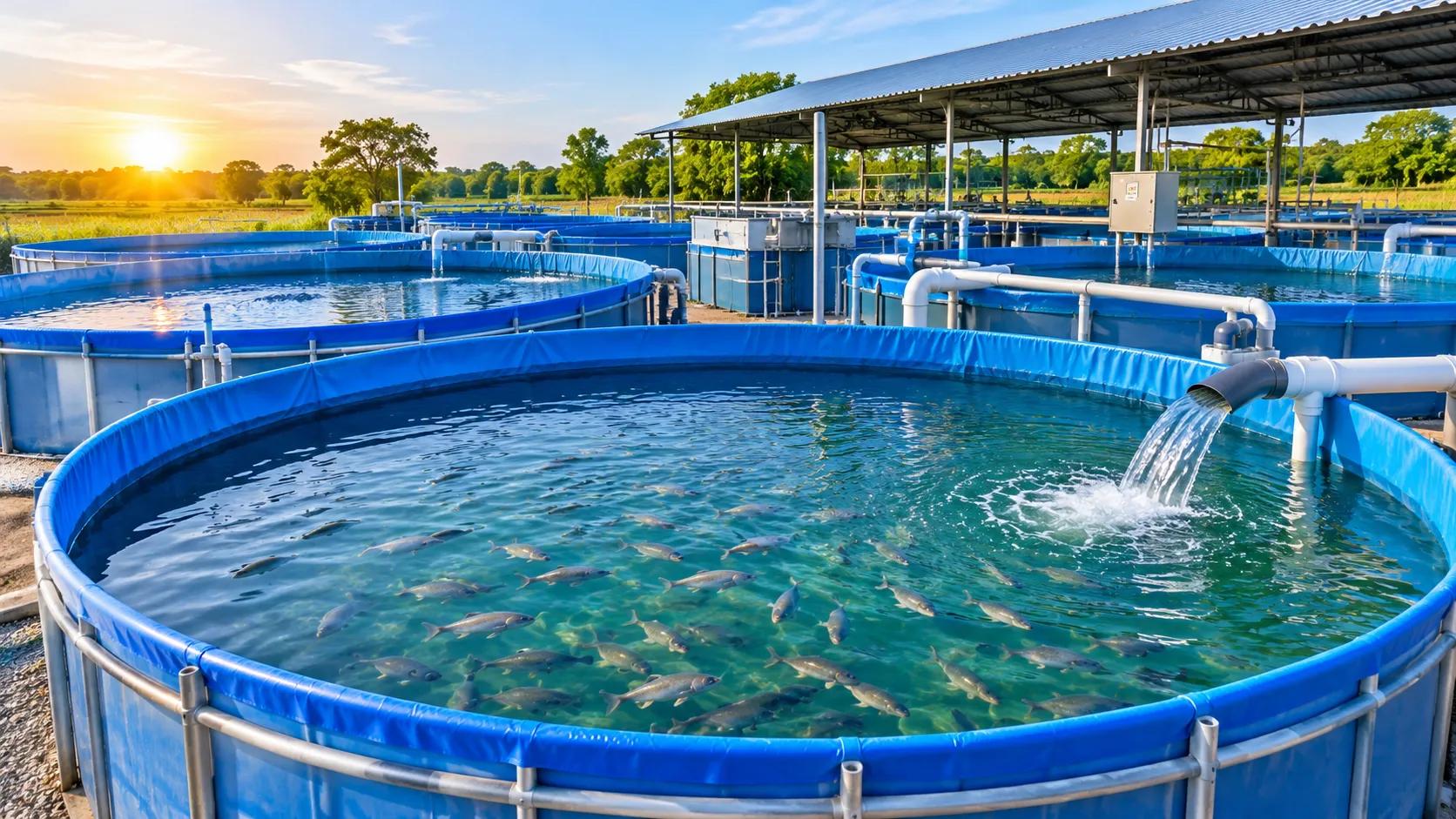
Choosing aquaculture tanks for large-scale fish production requires careful planning. A good tank should provide enough space for fish, support proper water circulation, and make daily farm operations easier.
Before purchasing a commercial fish farming tank, farmers should understand their production goals. Some farms focus on raising tilapia, while others produce catfish, trout, carp, or other fish species. Each species has different needs for water temperature, oxygen, tank depth, and swimming space.
- Production capacity: Decide how many fish you want to raise in each production cycle.
- Fish species: Choose tanks that match the size, behavior, and environmental needs of your fish.
- Tank material: Compare fiberglass, HDPE, and concrete based on durability, price, and maintenance.
- Water circulation: Make sure water can move properly throughout the tank.
- Filtration system: Select suitable mechanical and biological filtration equipment.
- Aeration: Provide enough oxygen to support healthy fish growth.
- Available space: Measure the installation area before selecting tank dimensions.
- Budget: Consider the purchase price and long-term operating expenses.
It is also important to think about future expansion. A tank system that works for a small fish farm may not support a larger commercial operation.
For this reason, many farmers choose modular aquaculture systems. These systems allow additional tanks, filters, pumps, and other equipment to be added as production increases.
The best aquaculture tank is not always the largest or most expensive option. It is the one that matches your fish species, production targets, water management plan, and available budget.
Importance of Selecting the Right Commercial Fish Farming Tanks
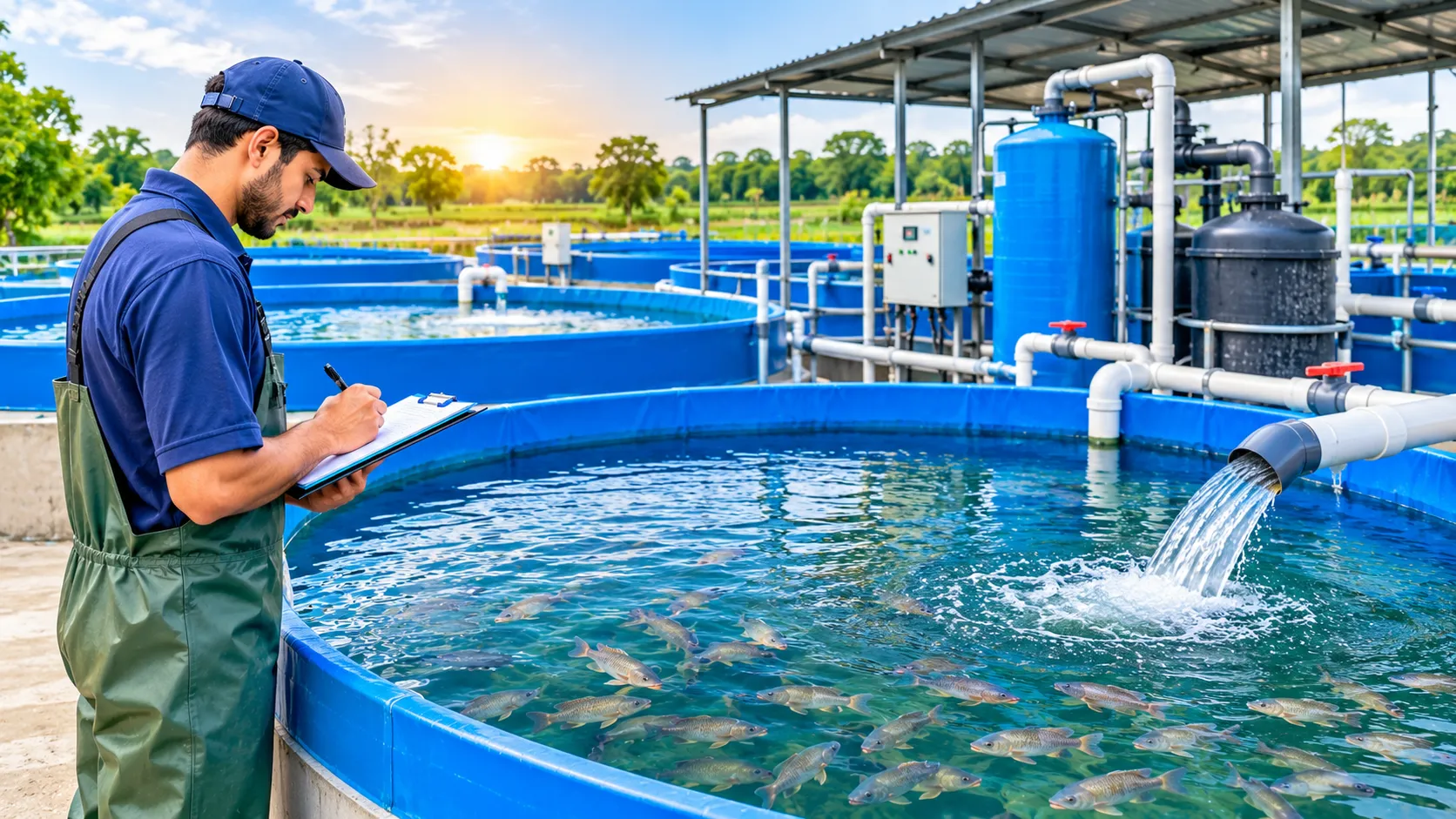
Selecting the right commercial fish farming tanks is essential for running a successful aquaculture business. Suitable tanks provide a controlled environment where fish can grow healthily while allowing farmers to manage water quality, feeding, and waste removal efficiently.
Properly designed aquaculture tanks offer several benefits:
- Better water quality: Efficient drainage helps remove fish waste and leftover feed.
- Healthy fish growth: Suitable tank space and oxygen levels reduce fish stress.
- Easy maintenance: Proper tank designs make cleaning and harvesting easier.
- Higher production efficiency: Farmers can manage stocking density and feeding schedules.
- Space optimization: Commercial tanks help maximize available farming space.
- Long-term savings: Durable materials reduce leaks, repairs, and maintenance costs.
For example, a commercial tilapia farm can use circular fish tanks connected to a centralized filtration system to maintain clean water and improve daily farm management.
Choosing the right tanks is a long-term investment that supports healthy fish, efficient production, and sustainable aquaculture operations.
Different Types of Aquaculture Tanks for Commercial Fish Farming
There are several types of aquaculture tanks available for commercial fish farming. Each type has different features, benefits, and limitations.
Farmers should compare these options before making a purchase.
Round Aquaculture Tanks
Round fish tanks are widely used in commercial aquaculture. Their circular shape supports water movement and can help move solid waste toward a central drain.
They are suitable for many fish species, including tilapia, catfish, and trout, when designed for the correct farming conditions.
Round tanks are also easier to clean because they do not have sharp corners where waste can collect.
Rectangular Fish Farming Tanks
Rectangular tanks are useful when farmers need to make the best use of limited floor space.
They can be placed side by side in indoor fish farms and controlled aquaculture facilities. However, water circulation needs careful planning because waste may collect in corners.
Square Aquaculture Tanks
Square tanks are another option for commercial fish production. They are easy to arrange in groups and can fit well into indoor farming buildings.
Their design makes it easier to organize multiple production units in a limited area.
Circular Fiberglass Tanks
Fiberglass tanks are made using reinforced plastic materials. They are lightweight compared with many concrete structures and can provide a smooth, durable surface.
These tanks are available in different sizes and are used in hatcheries, fish nurseries, and commercial fish farms.
HDPE Fish Tanks
High-density polyethylene (HDPE) tanks are made from strong plastic materials. They are resistant to corrosion and are often used in aquaculture systems that need durable, low-maintenance equipment.
Concrete Fish Farming Tanks
Concrete tanks are strong structures that can support large farming operations. They are often built for permanent installations and can be designed according to specific farm requirements.
However, concrete construction needs proper engineering, surface finishing, and waterproofing.
The right tank type depends on the fish species, farm location, production goals, and available investment.
Choosing the Ideal Tank Size and Capacity for Fish Production
Choosing the correct tank size is essential for successful large-scale fish farming. Tanks that are too small can restrict fish growth, reduce oxygen availability, and increase competition for space. On the other hand, oversized tanks may increase construction, water, and energy costs.
Before selecting commercial fish farming tanks, farmers should calculate their expected production capacity based on:
- Tank length or diameter.
- Tank width.
- Water depth.
- Fish species and stocking density.
- Filtration and oxygen supply.
For example, a rectangular tank measuring 5 meters long, 3 meters wide, and 1.5 meters deep holds approximately 22.5 cubic meters of water.
However, tank volume alone does not determine fish capacity. Proper stocking density also depends on fish size, water quality, dissolved oxygen, filtration, and water circulation.
Farmers should also leave enough space around tanks for feeding, cleaning, equipment maintenance, and harvesting. Proper tank size planning helps improve production efficiency and avoid unnecessary future expenses.
Best Aquaculture Tank Materials: Fiberglass, HDPE, and Concrete
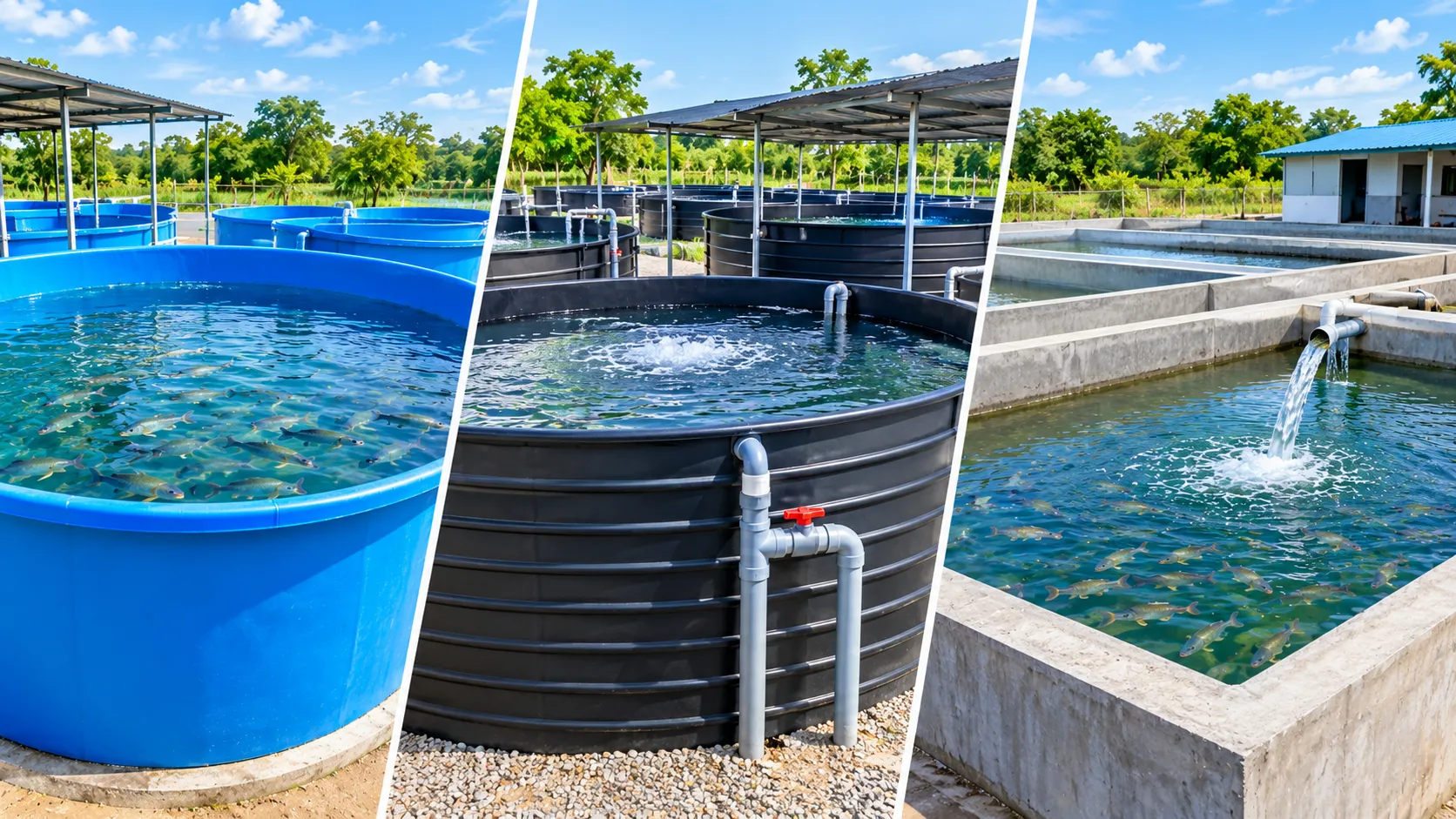
The material used to build an aquaculture tank affects its strength, lifespan, maintenance needs, and overall cost. Three popular materials used in commercial fish farming are fiberglass, HDPE, and concrete.
Fiberglass
Fiberglass tanks are made using glass fibers combined with resin. This creates a strong and relatively lightweight structure. Their smooth surfaces make cleaning easier and help reduce places where dirt and organic waste can collect. Fiberglass tanks are commonly used in hatcheries, nurseries, and commercial fish production systems.
Main benefits include:
- Lightweight construction.
- Smooth internal surfaces.
- Good corrosion resistance.
- Easy cleaning.
- Availability in different sizes and shapes.
HDPE
HDPE stands for high-density polyethylene. It is a strong plastic material used in many water storage and aquaculture products. HDPE tanks can handle regular exposure to water and many common environmental conditions.
- Good impact resistance.
- Corrosion resistance.
- Relatively low maintenance.
- Lightweight construction.
- Flexible manufacturing options.
Farmers should check that the selected HDPE material is suitable for continuous contact with aquaculture water.
Concrete
Concrete tanks are made from cement-based construction materials. They are often used in permanent commercial fish farms. Concrete can support large structures and allow farmers to build tanks according to their required dimensions.
- Strong structural support.
- Long service life when properly built.
- Custom construction options.
- Suitable for permanent installations.
However, concrete tanks require proper waterproofing and suitable internal surfaces. Poorly finished concrete may affect water quality and fish health.
Each material has its own strengths, so farmers should compare their needs before selecting one.
Fiberglass vs. HDPE vs. Concrete Tanks for Large-Scale Aquaculture
Choosing between fiberglass, HDPE, and concrete tanks can be difficult because each material offers different advantages.
The best option depends on farm size, installation conditions, budget, and maintenance requirements.
Here is a simple comparison:
| Feature | Fiberglass | HDPE | Concrete |
| Weight | Lightweight | Lightweight | Very heavy |
| Durability | High | High | High when properly built |
| Corrosion resistance | Good | Excellent | Depends on construction |
| Installation | Relatively easy | Relatively easy | More complex |
| Cleaning | Easy | Easy | Depends on surface finish |
| Custom sizing | Available | Available | Highly flexible |
| Maintenance | Low | Low | Requires structural inspection |
| Initial cost | Varies | Varies | Varies by construction |
When to Choose Fiberglass Tanks
Fiberglass tanks are a good choice for farmers who need ready-made tanks that are easy to install and clean.
They are especially useful for fish hatcheries, nursery operations, and indoor aquaculture facilities.
When to Choose HDPE Tanks
HDPE tanks are suitable for farms that want durable plastic tanks with good resistance to corrosion.
They can be useful for outdoor and indoor farming operations, depending on the product design and installation conditions.
When to Choose Concrete Tanks
Concrete tanks are worth considering when farmers need large, permanent structures.
They are often suitable for farms with enough land and the budget for professional construction.
There is no single material that works best for every fish farm. Comparing the total cost, expected service life, cleaning needs, and installation requirements will help farmers make a better decision.
Fish Stocking Density and Tank Capacity Planning
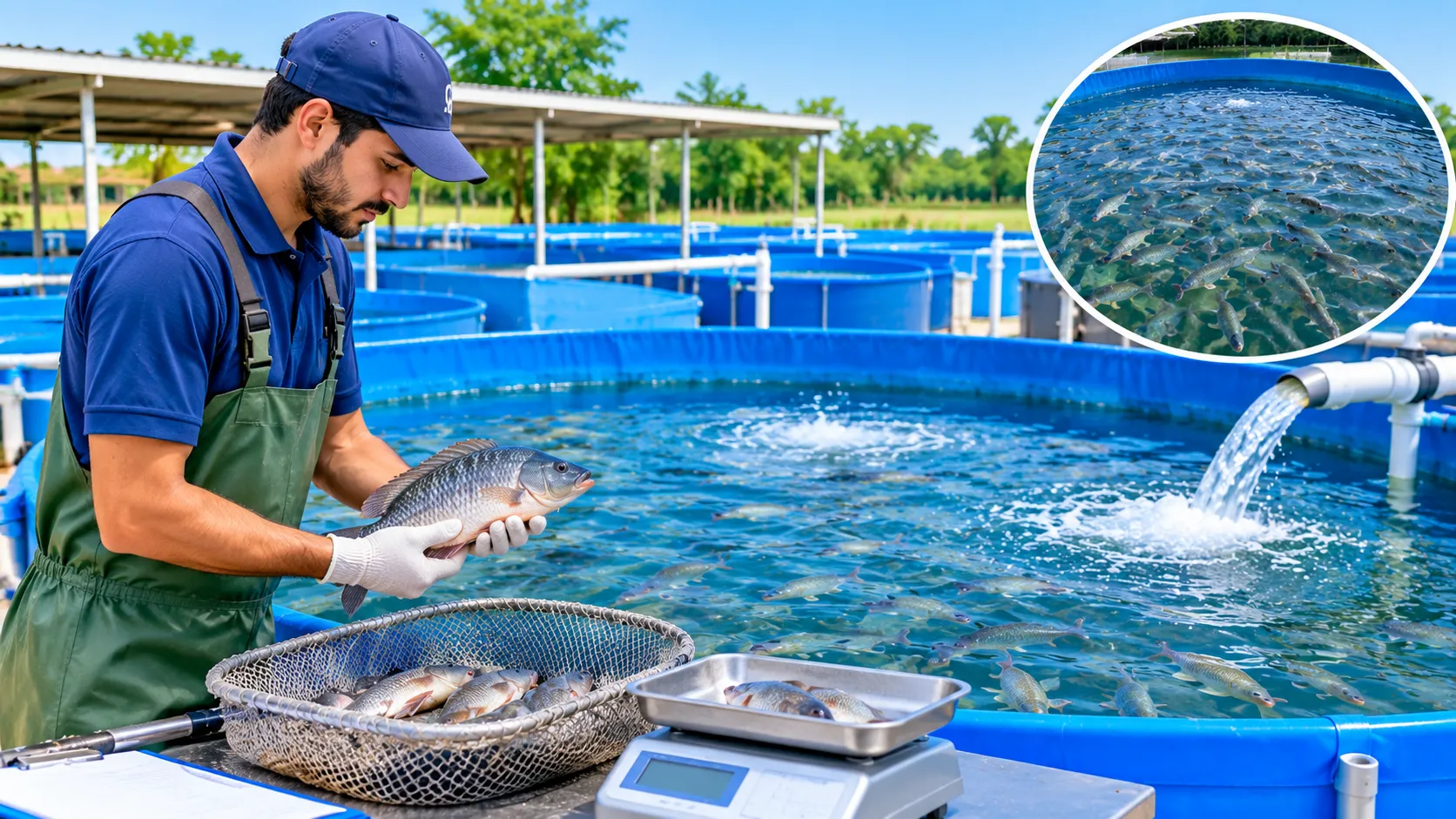
Fish stocking density refers to the amount of fish kept in a specific volume of water, usually measured in kilograms per cubic meter (kg/m³). Proper stocking density is essential for maintaining fish health, water quality, and production efficiency. Overstocking can cause oxygen shortages, fish stress, increased waste production, and poor water conditions, while very low stocking density may reduce farm productivity.
Before selecting stocking levels, farmers should consider fish species, average fish weight, harvesting size, water temperature, dissolved oxygen, filtration capacity, aeration, and water exchange rates. For example, tilapia, catfish, and trout have different stocking requirements depending on their growth conditions and environmental needs.
Farmers should start with suitable stocking levels, regularly monitor fish growth and health, and increase density only when the tank's filtration and aeration systems can support it. Proper stocking density planning helps achieve healthy fish growth and efficient commercial aquaculture production.
Water Quality Management in Commercial Aquaculture Tanks
Water quality management is one of the most important parts of commercial aquaculture.
Fish depend on clean and stable water to survive and grow. Even a well-designed tank cannot produce good results if water conditions are poor.
Several water quality factors should be monitored regularly.
Dissolved Oxygen
Dissolved oxygen is the amount of oxygen available in water for fish to breathe.
Low oxygen levels can cause stress, reduce feeding, slow growth, and even lead to fish deaths.
Aeration equipment and proper water circulation help maintain suitable oxygen levels.
Ammonia
Ammonia is produced mainly through fish waste and the breakdown of uneaten feed.
High ammonia levels can be harmful to fish. Biological filters use beneficial bacteria to convert ammonia into nitrite and then nitrate.
This process is an important part of the nitrogen cycle.
Nitrite and Nitrate
Nitrite can be toxic to fish when it reaches harmful levels.
Nitrate is usually less toxic than ammonia and nitrite, but it can still become a problem when it builds up in the water.
Regular testing helps farmers identify water quality problems before they become serious.
pH Level
pH measures how acidic or alkaline the water is. Different fish species have different suitable pH ranges.
Sudden pH changes can stress fish and affect biological filtration.
Water Temperature
Temperature affects fish metabolism, feeding behavior, oxygen demand, and growth.
Farmers should use reliable thermometers and maintain suitable temperatures for their selected fish species.
A good water quality management plan should include regular testing, waste removal, filtration, and proper water exchange.
Keeping accurate records can also help farmers identify problems and improve daily farm management.
Aquaculture Tank Shape, Depth, and Structural Design
Tank shape and structural design affect water movement, waste collection, fish behavior, and cleaning. A suitable tank should provide a safe environment for fish while making daily farm operations easier.
Tank Shape
Round tanks are often preferred because their shape supports circular water movement. This movement can help carry solid waste toward a central drain when the inlet and outlet system is properly designed. Rectangular tanks can save space, but their corners may create areas with weak water movement. These areas may collect uneaten feed and fish waste.
Tank Depth
Tank depth should match the needs of the fish species and the farm's water management system. Deeper tanks can hold more water within a smaller floor area, but they may require more careful oxygen distribution and water circulation. Shallow tanks may be easier to inspect and clean, depending on their size and design.
Structural Design
A commercial aquaculture tank must be strong enough to hold the weight and pressure of water. The foundation should be stable and level. Outdoor tanks may also need protection from weather, sunlight, and ground movement.
Important design features include:
- Smooth internal surfaces.
- Proper drainage points.
- Suitable water inlets.
- Safe tank edges.
- Strong supporting structures.
- Easy access for cleaning.
- Emergency overflow arrangements.
A well-designed tank makes it easier to manage water, remove waste, and maintain healthy fish.
Filtration Systems for Large-Scale Fish Farming
Filtration systems are essential for maintaining water quality in commercial aquaculture. As fish eat and grow, they produce waste that can build up in the water. A suitable filtration system removes solid waste and helps control harmful substances. Large-scale fish farms often use several filtration methods together.
Mechanical Filtration
Mechanical filtration removes solid materials from water. These materials may include fish waste, uneaten feed, and other suspended particles.
Common mechanical filtration equipment includes:
- Drum filters.
- Screen filters.
- Settling tanks.
- Mechanical filter chambers.
Drum filters are widely used in recirculating aquaculture systems because they can remove fine solid particles from circulating water.
Biological Filtration
Biological filtration uses beneficial bacteria to break down toxic nitrogen compounds. These bacteria convert ammonia into nitrite and then nitrate through a process called nitrification. Common biological filtration options include moving bed biofilm reactors, trickling filters, and fixed-media filters.
UV Filtration and Disinfection
Ultraviolet (UV) treatment can help reduce certain harmful microorganisms in water when correctly designed and operated. It is not a replacement for mechanical or biological filtration.
Recirculating Aquaculture Systems
A Recirculating Aquaculture System (RAS) reuses treated water instead of constantly replacing large amounts of water. A typical RAS may include fish tanks, mechanical filters, biological filters, pumps, aeration, and water treatment equipment. This system can reduce water consumption and allow greater control over farming conditions.
Aeration Systems and Dissolved Oxygen Management
Fish need dissolved oxygen to survive. In large-scale fish farming, maintaining suitable oxygen levels is especially important because many fish are kept in a limited water volume.
Aeration systems help add oxygen to water and improve water movement.
Several types of aeration equipment are used in commercial aquaculture.
Air Pumps and Diffusers
Air pumps send air through pipes to diffusers placed inside the tanks.
The diffusers release small bubbles that help transfer oxygen into the water.
Blowers
Blowers provide air to several tanks through a connected pipe system.
They are commonly used in indoor aquaculture facilities and larger fish farming operations.
Surface Aerators
Surface aerators move water and expose it to air.
They can improve oxygen transfer and water circulation in suitable tank systems.
Oxygen Cones
Oxygen cones are designed to dissolve oxygen into water efficiently. They are often used in intensive aquaculture systems with high oxygen requirements.
Farmers should choose aeration equipment according to tank volume, fish biomass, feeding rates, and oxygen demand.
It is also important to install backup aeration equipment.
Power failures and equipment breakdowns can quickly become dangerous in intensive fish farming systems. Emergency oxygen supplies, backup generators, and oxygen alarms can help reduce these risks.
Regularly checking dissolved oxygen levels is one of the best ways to protect fish health.
Aquaculture Tank Installation, Maintenance, and Durability
Proper installation and regular maintenance help commercial aquaculture tanks last longer.
Even high-quality tanks can develop problems if they are installed incorrectly or used without proper care.
The first step is preparing the installation area. The ground should be stable, level, and strong enough to support the tank when it is full of water.
Farmers should also plan the location of water pipes, drainage lines, pumps, filters, and electrical equipment.
Important Installation Steps
- Select a suitable location for the fish farm.
- Prepare a strong and level foundation.
- Position the tanks correctly.
- Connect water inlets and drainage systems.
- Install filtration and aeration equipment.
- Check all pipes, pumps, and connections.
- Fill the tanks and test the system before adding fish.
Regular Maintenance
Daily and weekly maintenance is important for keeping tanks in good condition.
Farmers should check for leaks, cracks, damaged pipes, blocked drains, and equipment problems.
Tank walls and bottoms should be cleaned when needed to remove waste and unwanted algae.
Filtration equipment should also be inspected regularly.
A maintenance schedule can include:
- Daily water quality checks.
- Regular removal of solid waste.
- Inspection of pumps and aerators.
- Cleaning of mechanical filters.
- Monitoring of biological filtration.
- Inspection of tank walls and joints.
- Testing of emergency backup systems.
The durability of a tank depends on its material, construction quality, water conditions, and maintenance practices.
Good installation and regular inspection can reduce repair costs and protect fish production.
Commercial Aquaculture Tank Costs and Long-Term Operating Expenses
The cost of commercial aquaculture tanks is an important factor when planning a large-scale fish farm.
However, farmers should not focus only on the initial purchase price.
A low-cost tank may become expensive if it requires frequent repairs, uses more energy, or creates water management problems.
The total investment should include several expenses.
Initial Tank Costs
These include the purchase or construction of tanks, delivery, installation, and foundation preparation.
Fiberglass and HDPE tanks may be available as ready-made products, while concrete tanks often require construction work.
Filtration and Aeration Costs
Commercial fish farms need pumps, filters, blowers, diffusers, pipes, and other equipment.
The size and complexity of these systems depend on fish production targets and water management needs.
Energy Expenses
Electricity is an ongoing cost in aquaculture.
Pumps, aerators, oxygen systems, and filtration equipment may operate continuously.
Energy-efficient equipment can help reduce monthly operating expenses.
Water and Labor Costs
Water supply, water treatment, tank cleaning, fish feeding, and equipment inspection all require money and labor.
Maintenance and Repair Costs
Regular maintenance helps prevent expensive equipment failures.
Farmers should also keep a budget for replacement parts and emergency repairs.
When comparing tank options, calculate the total cost of ownership.
This means considering the purchase price, installation, energy use, maintenance, expected lifespan, and replacement expenses.
The cheapest tank is not always the most economical choice. A durable tank with lower maintenance requirements may provide better value over time.
Maximizing Fish Production and Profitability with Efficient Tank Selection
Selecting the right aquaculture tanks can improve production efficiency and support the long-term profitability of a fish farming business.
However, tank selection is only one part of successful aquaculture. Farmers must also manage fish health, feeding, water quality, filtration, aeration, and operating costs.
Here are some practical ways to improve fish production.
Choose the Right Tank Material
Select fiberglass, HDPE, or concrete according to your budget, farm location, and production requirements.
A suitable material can reduce maintenance problems and extend the useful life of the farming system.
Plan Stocking Density Carefully
Avoid placing too many fish in a tank.
Use species-specific stocking plans and make sure the filtration and aeration systems can support the expected fish biomass.
Improve Water Management
Monitor dissolved oxygen, ammonia, nitrite, pH, and temperature.
Good water quality supports fish health and helps reduce production losses.
Use Efficient Filtration Systems
Mechanical and biological filtration can help remove waste and maintain stable water conditions.
Choose equipment according to the size and requirements of your fish farm.
Reduce Energy Consumption
Use properly sized pumps, efficient blowers, and suitable aeration equipment.
Regular maintenance can also help equipment operate efficiently.
Monitor Fish Growth
Record fish weight, feed consumption, mortality, and water quality.
These records help farmers identify problems and make better production decisions.
Plan for Future Expansion
Choose a tank arrangement that allows additional production units to be installed when the business grows.
Modular tank systems can make expansion easier without requiring a complete redesign.
Focus on Long-Term Profitability
A successful fish farming business needs more than high production numbers.
Farmers must balance fish growth, feed costs, energy expenses, labor, maintenance, and market prices.
The best aquaculture tank system is one that supports healthy fish, efficient farm management, and sustainable production.
Conclusion
Choosing the right aquaculture tanks for large-scale fish production is an important decision for every commercial fish farmer. Tank size, material, shape, depth, filtration, aeration, and stocking density all affect the performance of a fish farming operation.
Fiberglass, HDPE, and concrete tanks each offer different benefits. Farmers should compare these materials and select the option that matches their production goals, budget, and installation requirements.
Good water quality management, suitable filtration, and reliable aeration are also necessary for healthy fish growth.
By planning carefully and investing in the right equipment, fish farmers can reduce operating problems, improve production efficiency, and build a successful aquaculture business.
Whether you are starting a new fish farm or expanding an existing operation, selecting the right commercial fish farming tanks can help you achieve better results over the long term.
Frequently Asked Questions (FAQs)
1. What are the best aquaculture tanks for large-scale fish production?
Fiberglass, HDPE, and concrete tanks are popular choices for large-scale fish production. The best option depends on fish species, production capacity, budget, and maintenance requirements.
2. Which tank material is best for commercial fish farming?
Fiberglass and HDPE are good choices because they are durable, lightweight, and easy to maintain. Concrete tanks are also suitable for permanent, large-scale fish farming facilities.
3. What size tank is needed for commercial fish farming?
Tank size depends on the number of fish, fish species, expected harvest weight, and stocking density. Farmers should calculate water volume and filtration capacity before selecting tank dimensions.
4. Are round tanks better than rectangular aquaculture tanks?
Round tanks often provide better circular water movement and help direct fish waste toward a central drain. Rectangular tanks can save floor space, especially in indoor fish farming facilities.
5. What is the ideal stocking density for aquaculture tanks?
There is no single ideal stocking density for every fish species. It depends on fish size, oxygen availability, water quality, filtration capacity, and farming conditions.
6. How important is dissolved oxygen in fish farming tanks?
Dissolved oxygen is essential for fish survival, feeding, and growth. Low oxygen levels can cause stress, reduce fish growth, and increase mortality.
7. What filtration system is best for large-scale aquaculture?
A combination of mechanical and biological filtration is commonly used in commercial aquaculture. Drum filters and moving bed biofilm reactors are popular options in recirculating aquaculture systems (RAS).