

How to Compare Aquaculture Equipment Suppliers
Why Choosing the Right Aquaculture Equipment Supplier Matters
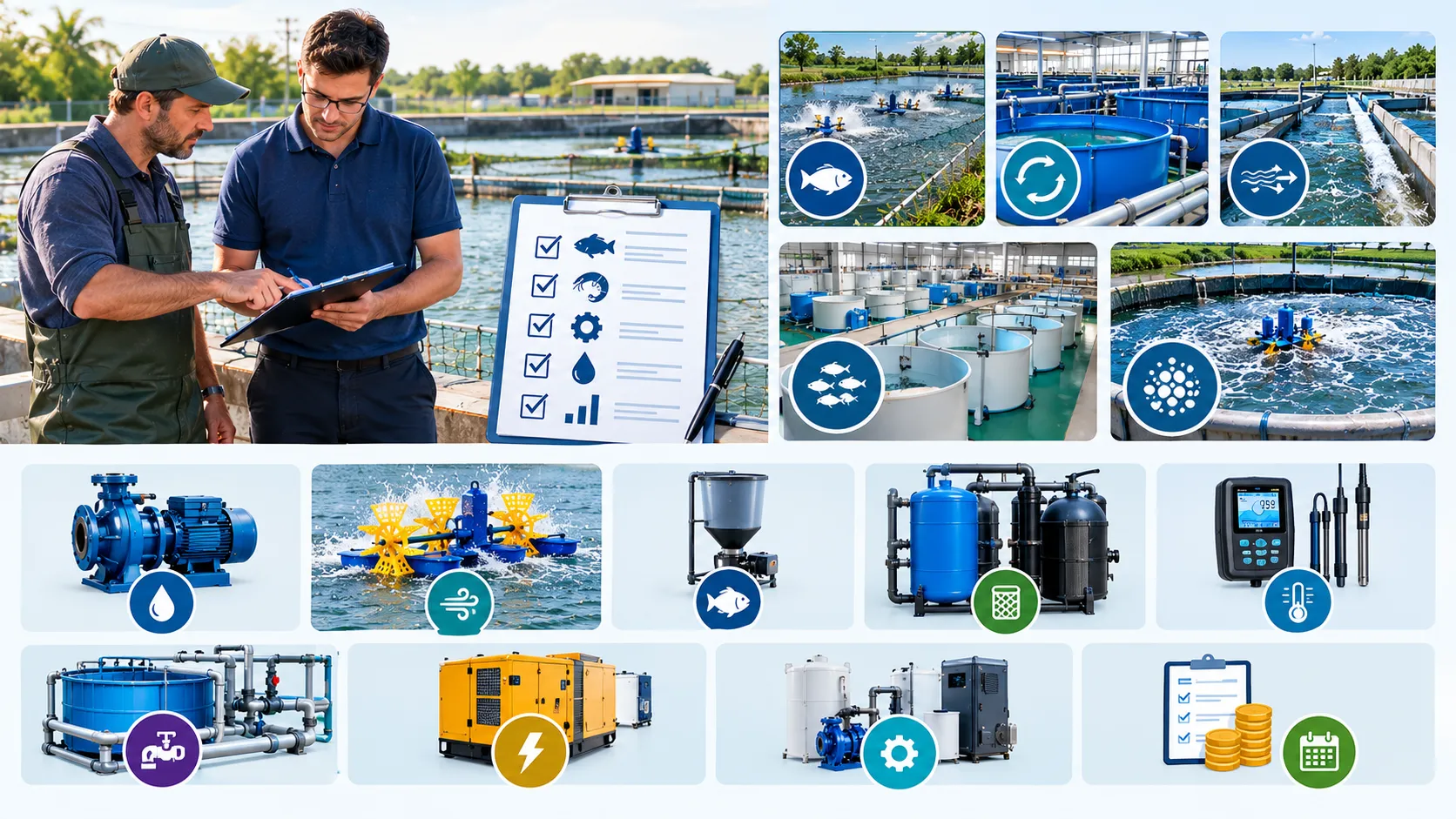
Aquaculture equipment plays a central role in maintaining the conditions required for healthy aquatic animals and consistent production. Pumps circulate water, aerators support oxygen availability, filtration systems remove waste, and monitoring devices help farmers track critical water parameters.
If any of these systems performs poorly, the consequences can include increased operating expenses, reduced growth rates, equipment downtime, and even stock losses.
Choosing a reliable supplier helps commercial buyers reduce these risks. An experienced supplier can recommend equipment suited to the farm's species, production capacity, water conditions, and operating environment. It can also provide technical guidance to help buyers select compatible components.
For example, a farm producing tilapia in a recirculating aquaculture system may require mechanical filtration, biological filtration, water circulation pumps, aeration, and oxygen monitoring. A shrimp farm using pond-based production may have different requirements, particularly for paddlewheel aerators, water exchange equipment, and pond management systems.
- Consistent equipment quality and performance.
- Access to replacement parts and technical assistance.
- Clear product documentation and warranty terms.
- More predictable delivery and installation schedules.
- Better opportunities for future equipment upgrades.
- Lower long-term maintenance and operating costs.
Ultimately, the goal is to select a supplier that offers dependable equipment, technical expertise, and long-term value rather than simply the lowest initial price.
Identify Your Commercial Aquaculture Equipment Needs
Before contacting suppliers, define what your farm actually requires. Without a clear equipment list, comparing quotations can become difficult because suppliers may recommend different products, capacities, and technical configurations.
Start by reviewing your production process, identifying operational challenges, and determining which equipment needs to be purchased, replaced, or upgraded.
A clear purchasing plan helps suppliers prepare more accurate quotations and makes it easier to compare their proposals fairly.
Assess Your Farm Size, Production Goals, and Aquaculture System
Your farm's size and production targets determine the type and capacity of equipment you need. For example, a small hatchery producing juvenile fish may require specialized tanks, incubation equipment, water circulation pumps, and precise water quality monitoring. A large commercial fish farm may need higher-capacity pumping systems, automated feeders, aeration equipment, and centralized monitoring solutions.
- Pond aquaculture: Often requires aerators, water pumps, feeding equipment, and pond management tools.
- Recirculating aquaculture systems (RAS): Typically require mechanical filtration, biofilters, circulation pumps, oxygenation equipment, and water quality monitoring.
- Flow-through systems: Depend on reliable water delivery, circulation, and appropriate water discharge management.
- Hatchery systems: May require incubation equipment, specialized tanks, precise water control, and larval rearing systems.
- Biofloc systems: Often require strong aeration, water circulation, and equipment capable of supporting suspended microbial communities.
Determine Which Equipment Your Operation Requires
- Water Pumps: Required capacity, water flow rate, and operating pressure.
- Aeration Systems: Paddlewheel aerators, diffused aeration systems, and oxygen supply equipment.
- Feeding Equipment: Automatic feeders and feeding management tools.
- Filtration Systems: Mechanical filters, biofilters, and water treatment equipment.
- Monitoring Devices: Dissolved oxygen meters and water quality sensors.
- Aquaculture Infrastructure: Tanks, pipes, valves, and water circulation components.
- Backup Power Equipment: Generators and emergency power systems.
- Essential and Optional Equipment: Separate necessary equipment from optional upgrades based on farm requirements.
- Equipment Specifications and Budget: Record capacity, species compatibility, operating hours, installation and maintenance needs, budget, and delivery deadlines for each item. Use this checklist to compare suppliers and their recommendations.
Evaluate the Supplier's Industry Experience and Reputation
A supplier's experience can indicate how well it understands the practical challenges of commercial aquaculture. Look for businesses that have supplied equipment to fish farms, shrimp farms, hatcheries, or other operations similar to yours. Experience with comparable production systems is especially valuable because equipment requirements can vary significantly between farms.
For example, a supplier familiar with RAS installations may better understand the importance of maintaining circulation, filtration efficiency, oxygen availability, and biofilter performance. Ask potential suppliers how long they have worked in the aquaculture industry and which types of customers they typically serve. Request examples of previous projects, relevant product installations, or references from commercial buyers.
You should also investigate the supplier's reputation through independent customer reviews, trade references, and documented project experience. Pay attention to recurring complaints about delayed deliveries, unreliable equipment, difficult warranty claims, or poor communication.
A company with an established reputation is not automatically the best choice, but verified experience and consistent customer feedback can help reduce purchasing risks. Also determine whether you are dealing directly with a manufacturer, an authorized distributor, or a general equipment reseller. Each business model can offer different advantages in terms of technical expertise, product availability, pricing, and access to replacement parts.
Compare Aquaculture Equipment Quality and Durability
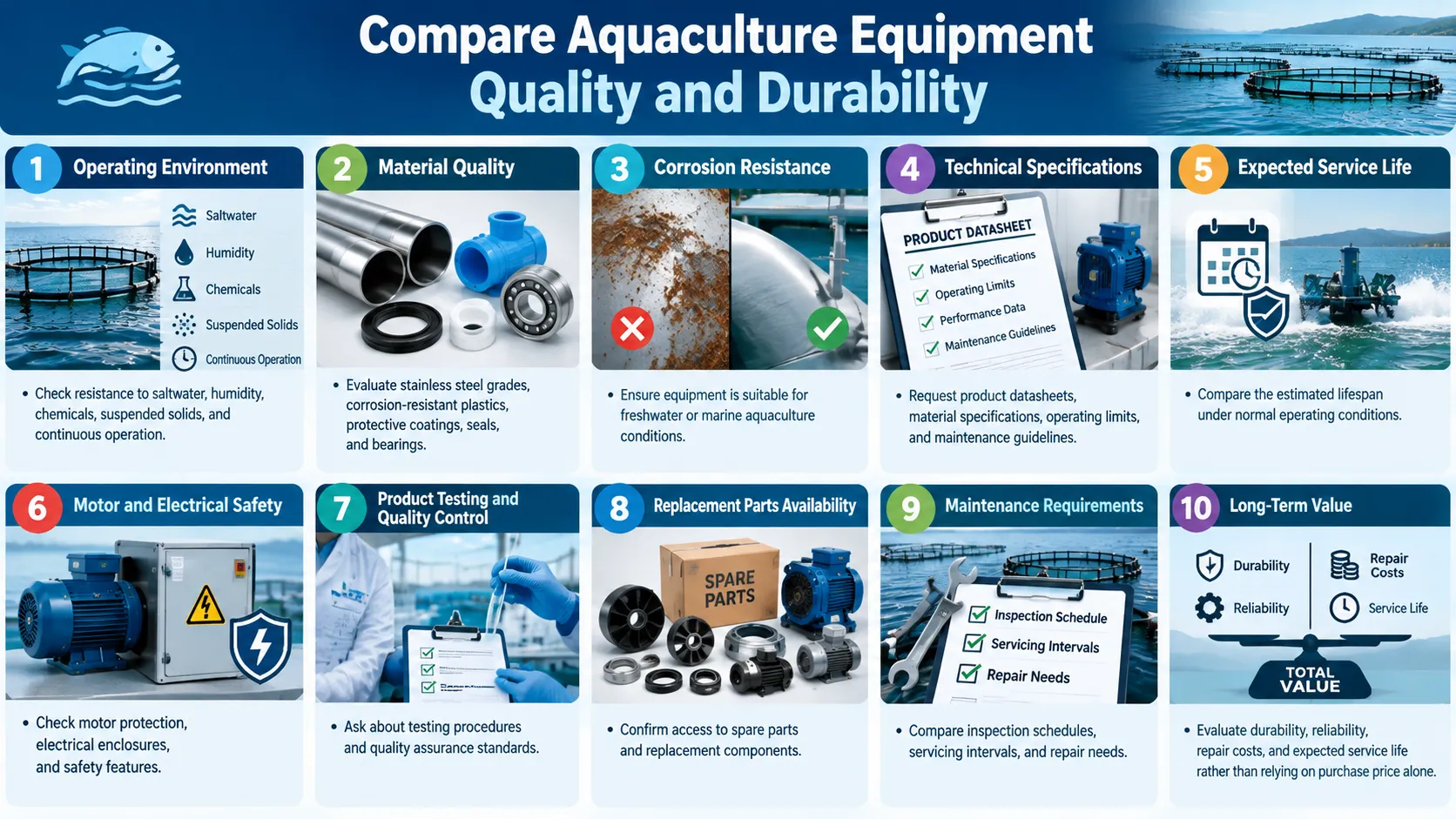
- Operating Environment: Check resistance to saltwater, humidity, chemicals, suspended solids, and continuous operation.
- Material Quality: Evaluate stainless steel grades, corrosion-resistant plastics, protective coatings, seals, and bearings.
- Corrosion Resistance: Ensure equipment is suitable for freshwater or marine aquaculture conditions.
- Technical Specifications: Request product datasheets, material specifications, operating limits, and maintenance guidelines.
- Expected Service Life: Compare the estimated lifespan under normal operating conditions.
- Motor and Electrical Safety: Check motor protection, electrical enclosures, and safety features.
- Product Testing and Quality Control: Ask about testing procedures and quality assurance standards.
- Replacement Parts Availability: Confirm access to spare parts and replacement components.
- Maintenance Requirements: Compare inspection schedules, servicing intervals, and repair needs.
- Long-Term Value: Evaluate durability, reliability, repair costs, and expected service life rather than relying on purchase price alone.
Check Product Specifications and Technical Compatibility
- Water Pump Specifications: Check flow rate, total dynamic head, energy consumption, and water characteristics.
- Aerator Performance: Evaluate oxygen transfer efficiency, power requirements, and suitability for ponds or tanks.
- Filtration Capacity: Assess hydraulic loading, waste production, treatment capacity, and species requirements.
- System Compatibility: Ensure pumps, mechanical filters, biofilters, and oxygenation equipment work together effectively.
- Biomass and Waste Load: Match equipment capacity to the farm's stocking density, biomass, and waste production.
- Water Quality Monitoring: Check measurement ranges and accuracy for dissolved oxygen, temperature, pH, salinity, and ammonia-related parameters.
- Electrical and Physical Requirements: Verify voltage, power supply, pipe connections, equipment dimensions, and installation space.
- Control System Integration: Confirm compatibility with existing controllers, automation systems, and communication protocols.
- Supplier Technical Support: Ask suppliers to explain equipment integration and confirm that their recommendations meet your farm's operating requirements.
Review the Supplier's Product Range and Availability
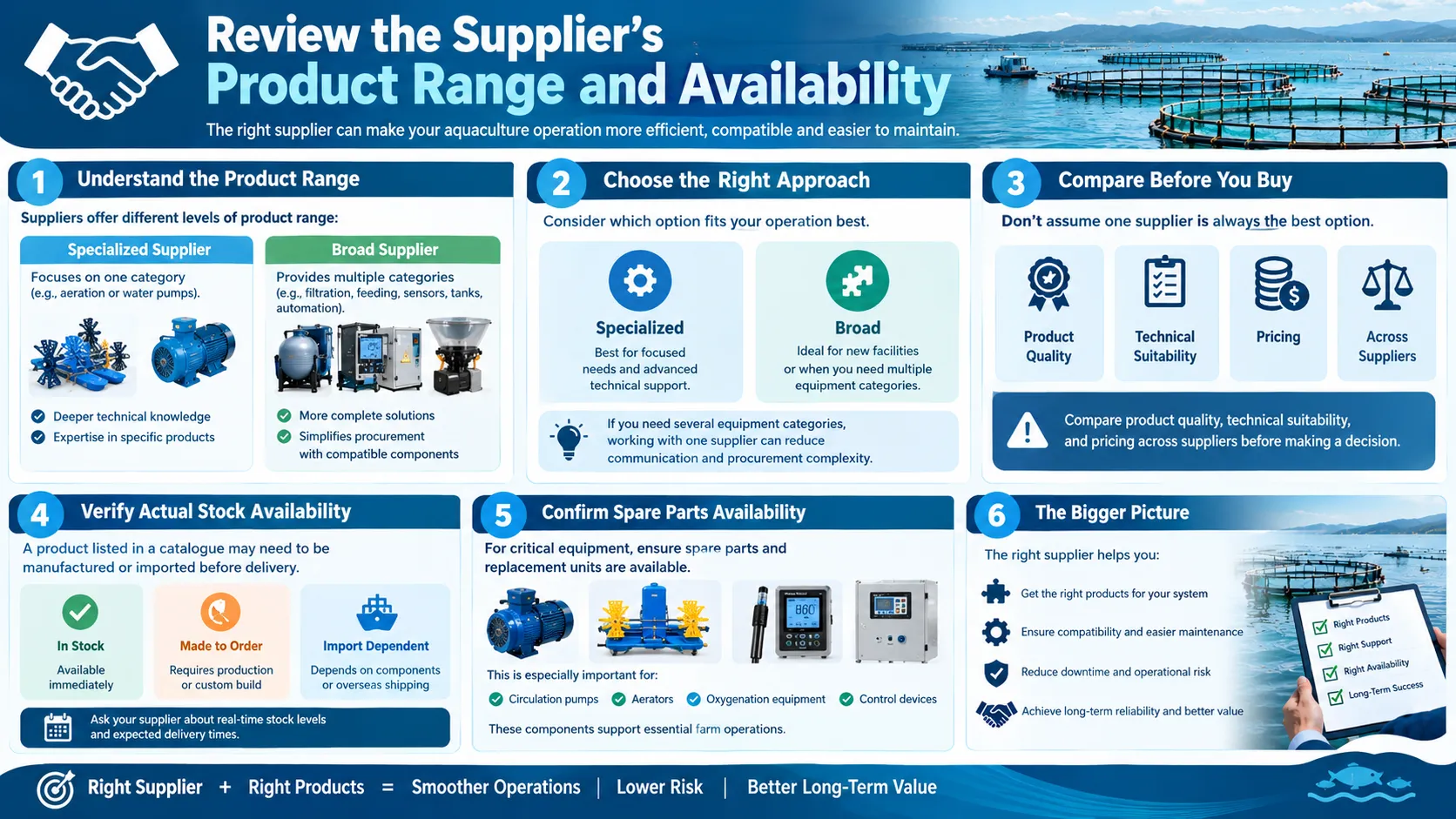
A supplier's product range can influence purchasing convenience, system compatibility, and long-term maintenance. Some suppliers specialize in one category, such as aeration equipment or water pumps. Others provide a broader selection that includes filtration systems, feeding equipment, sensors, tanks, and automation technology.
A specialized supplier may offer deeper technical knowledge in a particular product category, while a broader supplier may simplify procurement by providing multiple compatible components. Consider which approach best suits your operation. If you need several equipment categories for a new facility, working with a supplier that can coordinate multiple products may reduce communication and procurement complexity.
However, do not assume that purchasing everything from one company is always the best option. Compare product quality, technical suitability, and pricing across suppliers before making a decision. You should also verify actual stock availability. A product listed in a catalogue may need to be manufactured or imported before delivery. Ask whether the equipment is available immediately, made to order, or dependent on components from another manufacturer.
For critical equipment, confirm the availability of spare parts and replacement units. Reliable availability is particularly important for components such as circulation pumps, aerators, oxygenation equipment, and control devices that support essential farm operations.
Compare Equipment Prices and Overall Value
Price is an important consideration when purchasing commercial aquaculture equipment, but the lowest quotation does not always represent the best deal.
Two suppliers may offer products with similar descriptions but different capacities, materials, efficiency ratings, warranties, and service arrangements. A fair comparison requires you to evaluate what each quotation actually includes.
Look Beyond the Initial Purchase Price
When reviewing supplier quotations, identify the complete purchase cost rather than comparing the headline equipment price alone. Additional expenses may include freight, insurance, customs duties, taxes, installation, commissioning, training, and accessories.
For example, one supplier might quote a lower price for a pump but exclude essential valves, fittings, control equipment, or installation services. Another supplier may offer a higher initial price that includes these items. The second proposal could represent better value once all costs are considered.
Ask every supplier to provide an itemized quotation showing equipment models, quantities, unit prices, shipping charges, and any additional fees. Confirm whether the quoted price includes the exact specifications you requested.
You should also clarify payment terms, quotation validity, deposit requirements, and any potential charges for customization. Transparent pricing makes it easier to identify the actual financial commitment and avoid unexpected expenses.
Calculate Long-Term Operating and Maintenance Costs
The total cost of ownership provides a more complete picture of an equipment investment. It includes the initial purchase price and other expenses incurred throughout the equipment's useful life. For commercial aquaculture operations, these expenses can include electricity, routine maintenance, replacement parts, labor, servicing, and downtime.
Consider two water pumps with similar purchase prices. If one pump consumes less electricity while delivering the required flow and pressure, it may offer meaningful savings over several years. Likewise, a durable aerator that requires fewer repairs may cost less to operate than a cheaper alternative that frequently needs replacement parts.
Total Cost of Ownership = Purchase Cost + Installation Cost + Operating Cost + Maintenance Cost + Repair Cost − Residual Value
For a practical comparison, use the same evaluation period for every supplier and base your estimates on realistic operating conditions. Include the expected operating hours, local electricity prices, maintenance schedules, and replacement part costs. This approach helps you identify which equipment offers the strongest long-term financial value.
Assess Energy Efficiency and Operating Performance
- Energy Consumption: Compare electricity usage of pumps, aerators, oxygenation equipment, and filtration systems.
- Power Consumption Data: Request verified energy consumption figures and performance curves from suppliers.
- Pump Efficiency: Evaluate energy use at the required water flow rate and total dynamic head.
- Aeration Efficiency: Compare oxygen transfer performance under conditions similar to your farm's operating environment.
- Motor Efficiency: Check motor efficiency ratings and operating recommendations.
- Performance Comparison: Compare equipment energy consumption under equivalent operating conditions.
- Variable-Speed Drives: Determine whether adjustable motor speeds can reduce unnecessary energy consumption.
- Automatic Controls: Evaluate automation and monitoring systems for improving energy management.
- Operating Cost Savings: Estimate long-term electricity expenses based on daily operating hours and local electricity rates.
- Supplier Verification: Request technical evidence to confirm efficiency claims and ensure the equipment meets your farm's performance requirements.
Check Customization Options for Your Aquaculture System
- Customization Requirements: Identify equipment modifications needed for your farm's layout, production capacity, species, and water conditions.
- Pump and Pipe Configuration: Check options for customized pump sizing, pipe arrangements, and water circulation.
- Filtration and Tank Design: Evaluate filtration capacity, tank dimensions, and compact equipment layouts.
- Environmental Compatibility: Ensure equipment suits freshwater, brackish water, or marine aquaculture conditions.
- Control Systems and Automation: Check options for customized control panels, sensor integration, and automated feeding schedules.
- Performance and Warranty: Confirm that modifications will not compromise equipment performance, reliability, or warranty coverage.
- Technical Drawings and Specifications: Request equipment layouts, design drawings, and detailed technical specifications.
- Manufacturing and Installation: Determine how customization affects lead times, installation, and maintenance requirements.
- Spare Parts Availability: Confirm that replacement components remain available for customized equipment.
- Supplier Design Support: Ask suppliers to review your system design and recommend practical modifications that meet your operational needs without adding unnecessary complexity.
Evaluate Delivery Times and Shipping Options
Delivery reliability is particularly important when purchasing equipment for a new aquaculture facility or replacing a critical component. Delays can disrupt installation schedules, postpone production, and increase labor or storage expenses. Ask each supplier to confirm the expected dispatch date, estimated delivery time, shipping method, and product availability. For international purchases, clarify who is responsible for export documentation, customs clearance, import duties, and delivery to your facility.
The responsibilities of buyers and sellers can be documented through agreed shipping terms, including applicable Incoterms rules. For example, the quotation should clearly explain whether the price covers delivery to your premises or whether you must arrange transportation after the goods leave the supplier's warehouse.
Check packaging standards, insurance arrangements, and procedures for reporting damaged or missing items. For large equipment, verify transportation dimensions, unloading requirements, and whether specialized lifting equipment will be necessary. You should also ask suppliers how they handle unexpected delays and whether replacement equipment or alternative shipping arrangements are available for urgent requirements. Reliable delivery planning helps ensure that equipment arrives when it is needed and reduces the risk of unnecessary disruption.
Review Warranty Coverage and Return Policies
- Warranty Period: Confirm the warranty duration for each aquaculture equipment item.
- Warranty Coverage: Check which manufacturing defects, parts, labor, and replacement costs are covered.
- Warranty Start Date: Verify whether coverage begins on the purchase, delivery, or commissioning date.
- Warranty Exclusions: Review exclusions related to improper installation, poor maintenance, water conditions, electrical issues, and unauthorized modifications.
- Claim Procedures: Understand the documentation, inspection process, and steps required to submit a warranty claim.
- Return Eligibility: Confirm whether unused, defective, or customized equipment can be returned.
- Return Charges: Check restocking fees, return shipping costs, and other potential charges.
- Repair, Replacement, or Refund: Clarify how the supplier handles defective products and determines the appropriate resolution.
- Written Documentation: Request written warranty terms and return policies before placing an order to avoid misunderstandings and protect your business.
Compare Installation, Maintenance, and Technical Support
- Installation Services: Confirm whether the supplier provides professional installation for pumps, filtration systems, aeration equipment, and automated controls.
- Technician Experience: Check the supplier's experience with commercial aquaculture installations.
- Installation Scope: Verify whether equipment positioning, pipe connections, electrical integration, calibration, testing, and commissioning are included.
- Staff Training: Ask whether operating instructions, technical manuals, and practical training sessions are provided.
- Maintenance Guidance: Request maintenance schedules, inspection procedures, cleaning instructions, and troubleshooting guides.
- Technical Support Channels: Check the availability of telephone, email, remote diagnostics, and on-site assistance.
- Emergency Response Time: Confirm how quickly the supplier responds to urgent equipment failures.
- After-Hours Support: Determine whether technical assistance is available outside standard business hours.
- Spare Parts and Repairs: Check the availability of replacement parts and repair services to minimize downtime.
- Overall Support Reliability: Choose suppliers that can provide timely technical assistance and help maintain safe, efficient, and reliable farm operations.
Check Spare Parts Availability and After-Sales Service
- Spare Parts Availability: Check the availability of pump seals, bearings, impellers, motors, aerator components, filters, sensors, and electrical parts.
- Local Spare Parts Stock: Confirm which components are available locally and which require special orders.
- Long-Term Availability: Ensure essential replacement parts remain available throughout the equipment's expected service life.
- Replacement Part Costs: Request current prices for common spare parts and frequently replaced components.
- Delivery Times: Check expected delivery periods for standard and specialized replacement parts.
- Critical Spare Parts Inventory: Maintain essential backup components for equipment responsible for oxygen delivery, water circulation, and filtration.
- Inventory Planning: Determine spare parts requirements based on equipment reliability, delivery times, and the potential impact of equipment failure.
- Warranty and Repair Support: Confirm how the supplier handles warranty claims, equipment repairs, and replacement requests.
- After-Sales Communication: Evaluate the supplier's responsiveness to technical questions and service requests.
- Service Reliability: Choose suppliers with dependable after-sales support to reduce repair delays, minimize downtime, and protect your production schedule.
Verify Certifications, Safety Standards, and Compliance
Ensure equipment meets the safety, technical, and legal requirements of your country and intended application. Ask suppliers for relevant certifications, test reports, declarations of conformity, and installation documents. Verify the specific product model and applicable ISO or IEC standards rather than relying on general certification claims. For imported equipment, confirm local compliance requirements before placing your order.
Which Details Should an Aquaculture Equipment Quote Include?
A useful quotation should provide enough information for you to understand the complete cost and technical suitability of the proposed equipment.
- Supplier information: Company name, contact details, and relevant business information.
- Product identification: Manufacturer, model number, product description, and quantity.
- Technical specifications: Capacity, power requirements, performance data, materials, and operating limits.
- Itemized pricing: Unit prices, total equipment costs, taxes, and applicable additional charges.
- Shipping information: Delivery method, estimated dispatch date, delivery time, and freight charges.
- Installation requirements: Installation services, commissioning, accessories, and labor costs.
- Warranty details: Coverage period, exclusions, and claim procedures.
- Payment terms: Deposit requirements, payment schedule, and accepted payment methods.
- Spare parts information: Availability, pricing, and expected replacement part delivery times.
- Quotation validity: The period during which the quoted prices and terms remain valid.
Also request operating manuals, relevant certifications, and maintenance documentation when appropriate. If a quotation lacks important information, ask the supplier to clarify it before comparing the proposal with competing offers. A complete quotation reduces uncertainty and makes it easier to evaluate the actual value of each supplier's offer.
How to Choose the Best Aquaculture Equipment Supplier for Your Business
Follow these steps to choose a reliable aquaculture equipment supplier:
Step 1: Define Your Requirements. List the equipment, capacity, technical specifications, and delivery deadlines your farm needs.
Step 2: Shortlist Qualified Suppliers. Choose suppliers with relevant aquaculture experience, suitable products, and credible references.
Step 3: Compare Quotations. Request itemized quotes using the same specifications to compare prices fairly.
Step 4: Evaluate Equipment Quality. Check product performance, durability, compatibility, and compliance with applicable standards.
Step 5: Calculate Total Costs. Consider purchase price, installation, energy consumption, maintenance, and replacement parts.
Step 6: Verify Warranty and Support. Review warranty coverage, spare parts availability, technical assistance, and repair services.
Step 7: Confirm Delivery and Terms. Check delivery schedules, payment conditions, installation responsibilities, and warranty agreements before ordering.
Step 8: Compare and Select the Best Supplier. Use a supplier scorecard to evaluate quality, cost, reliability, experience, and long-term support before making your final decision.
Final Thoughts
Comparing aquaculture equipment suppliers requires careful consideration of product quality, technical suitability, pricing, energy efficiency, delivery reliability, and long-term service.
For commercial buyers, the purchasing decision can influence production efficiency, operating expenses, maintenance requirements, and the overall reliability of the aquaculture system.
A supplier offering the lowest price may not deliver the best value if its equipment is unsuitable, difficult to maintain, or expensive to operate. Similarly, a premium product is not automatically the right choice unless its specifications and performance justify the investment.
The most effective approach is to define your requirements, request comparable quotations, verify supplier claims, and calculate the total cost of ownership before committing to a purchase.
Pay particular attention to equipment compatibility, spare parts availability, warranty conditions, and technical support. These factors can become especially important when your farm depends on continuous water circulation, filtration, and oxygen supply.
By using a structured supplier comparison process, commercial aquaculture buyers can make better-informed decisions, reduce purchasing risks, and invest in equipment that supports reliable production.
Ultimately, the right aquaculture equipment supplier should be more than a source of products. It should be a dependable business partner capable of helping your operation maintain performance, manage costs, and grow sustainably over time.
FAQs
How Can Buyers Verify an Aquaculture Equipment Supplier's Reliability?
Buyers can verify reliability by reviewing independent customer feedback, requesting references, examining technical datasheets, checking relevant certifications, and confirming warranty terms.
They should also ask about manufacturing or distribution experience, delivery performance, spare parts availability, and technical support arrangements.
For major equipment purchases, speaking directly with existing commercial customers can provide valuable insight into the supplier's actual performance and service quality.
What Should Commercial Aquaculture Buyers Look for in a Supplier?
Look for quality equipment, technical expertise, transparent pricing, reliable delivery, warranty coverage, and dependable after-sales support.
How Can Buyers Compare Aquaculture Equipment Prices Fairly?
Compare itemized quotations with identical specifications, including shipping, installation, warranty, taxes, and long-term operating costs.
Why Is After-Sales Support Important When Choosing a Supplier?
Reliable after-sales support ensures timely repairs, spare parts availability, reduced downtime, and consistent aquaculture operations.
Should Buyers Prioritize Equipment Quality or Initial Cost?
Balance initial cost with durability, energy efficiency, maintenance expenses, warranty protection, and expected equipment lifespan.
How Can Buyers Verify an Aquaculture Equipment Suppliers Reliability?
Check customer reviews, references, certifications, technical documentation, warranty terms, delivery records, and spare parts availability.