Organic vs Synthetic Fertilizers: Healthy Soil & Plants
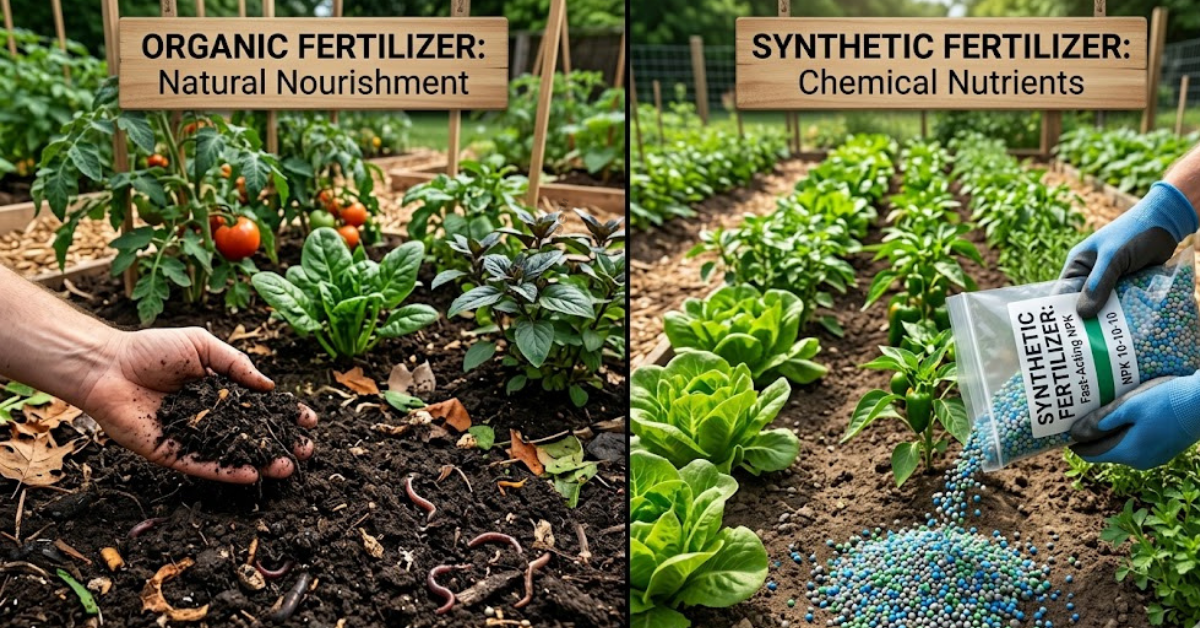
Organic fertilizers come from plant matter, animal waste, manure, compost, bone meal, and fish emulsion for natural soil feeding. These fertilizers improve soil health, soil structure, water retention, and microbial life through slow nutrient release in the ground.
Soil microorganisms break down organic material and turn it into usable nutrients for stronger plant growth over time. Organic options reduce runoff risk, protect soil microbes, and support sustainable farming with long-term soil improvement.
However, organic products work slowly and need warmth and moisture to release nutrients properly into the soil. Synthetic fertilizers are made from minerals and petroleum products for fast plant nutrition.
These fertilizers are water-soluble and provide quick nutrient uptake directly to plant roots . They contain precise Nitrogen, Phosphorus, and Potassium (NPK) levels for fast green-up and quick deficiency control.
Synthetic products cost less and show fast results for lawns, gardens, and crop fields. Overuse can harm soil life, cause salt buildup, and increase pollution in nearby water sources. Excess synthetic fertilizer can also burn plants and reduce healthy microbial activity in the soil.
Organic fertilizers focus on building a healthy soil ecosystem instead of only feeding the plant . Synthetic fertilizers mainly support fast plant nutrition instead of improving soil conditions. A balanced fertilization approach uses organic inputs for soil health and synthetic products for quick nutrient support.
Both fertilizer types eventually break down into the same basic nutrient elements used by plants . Choosing the right fertilizer depends on soil conditions, plant needs, and environmental goals.
What Are Organic Fertilizers?

Organic fertilizers are natural products made from plants, animals, and minerals instead of chemical fertilizers. They include manure, compost, bone meal, blood meal, and seaweed for natural plant nutrition.
These fertilizers feed soil microorganisms, which slowly release nutrients for healthy plant growth. Organic fertilizers improve soil structure, water retention, and microbial life in the soil. They also provide micronutrients along with Nitrogen, Phosphorus, and Potassium (NPK).
What Are Synthetic Fertilizers?
Synthetic fertilizers are man-made chemical products made from processed minerals, gases, and petroleum byproducts. They provide water-soluble nutrients like Nitrogen, Phosphorus, and Potassium (NPK) for fast plant uptake.
These fertilizers are fast-acting and show quick results in crop growth and lawn care. Products like urea, ammonium sulfate, monoammonium phosphate, and potassium sulfate are common examples. Overuse can cause nutrient runoff, plant burn, and harm soil organic matter.
Nutrient Sources in Organic and Synthetic Fertilizers
Organic fertilizers use plant matter and animal matter for slow nutrient release and better soil health. Synthetic fertilizers use manufactured minerals and atmospheric nitrogen for fast plant uptake. Both types provide Nitrogen, Phosphorus, and Potassium (NPK) for healthy plant growth.
Plant-Based & Animal-Based Inputs
- Poultry manure and dairy manure add natural nutrients to the soil.
- Blood meal and bone meal support strong plant development.
- Fish emulsion and feather meal feed soil microbes slowly.
- Compost improves soil organic matter and structure.
- Alfalfa meal and cottonseed meal support natural plant nutrition.
- Rock phosphate provides mineral phosphorus.
- Chilean nitrate supplies natural nitrogen.
Mineral & Chemical Formulations
- Urea provides fast nitrogen for plant growth.
- Ammonium nitrate delivers quick nutrient absorption.
- Ammonium phosphate supports root and flower growth.
- Potassium sulfate improves plant strength.
- Made using the Haber-Bosch process from nitrogen gas.
- Nutrients are water-soluble and fast-acting.
- These fertilizers add little organic matter to the soil.
Nitrogen, Phosphorus, Potassium (NPK) Overview
- Nitrogen (N) helps green leaf growth.
- Phosphorus (P) supports strong roots and flowers.
- Potassium (K) improves plant health and strength.
- Organic fertilizers release NPK slowly.
- Synthetic fertilizers provide precise NPK ratios quickly.
How Organic Fertilizers Work in Soil
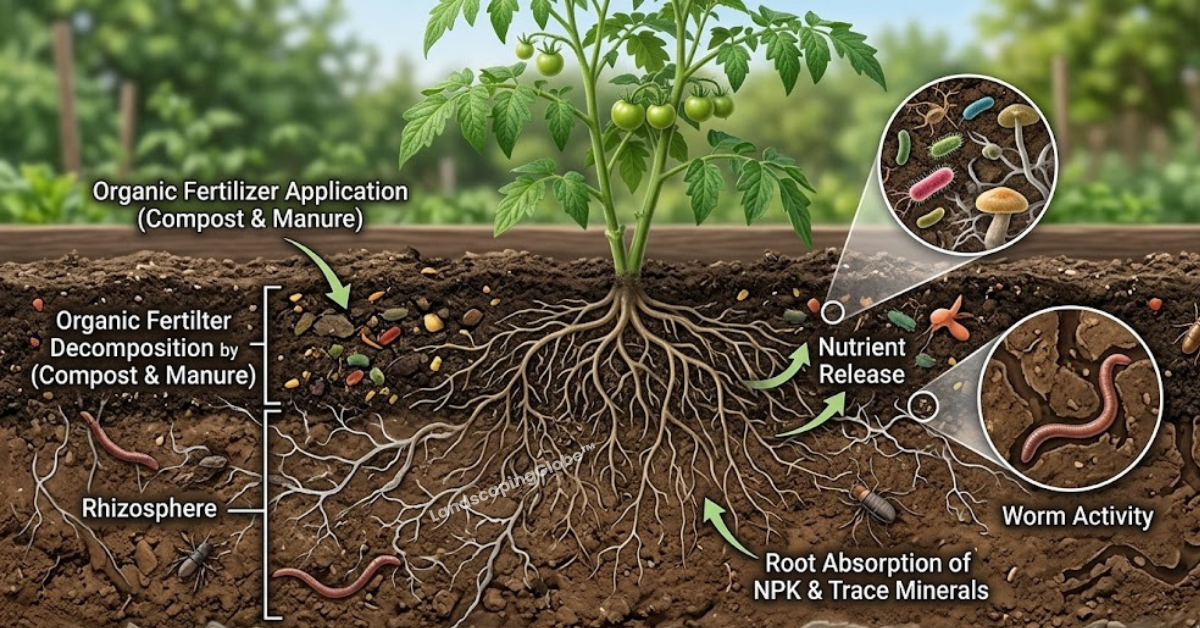
Organic fertilizers feed soil microorganisms, slowly releasing nutrients from plant matter, animal matter, and minerals, improving soil health over time. They create a soil ecosystem where plants absorb nutrients gradually, unlike synthetic fertilizers that act fast but temporarily.
Role of Soil Microorganisms
- Bacteria, fungi, and worms consume organic matter, breaking it down for plant-available nutrients.
- Microbes transform complex compounds into simple ions that plant roots can absorb.
- Soil microbial life increases with manure, compost, bone meal, and fish emulsion additions.
- Active microbes improve soil fertility, creating a living system feeding plants continuously.
Nutrient Release Process
- Organic fertilizers like alfalfa meal, cottonseed meal, and seaweed/kelp release nutrients slowly.
- Mineralization converts organic compounds into nitrogen, phosphorus, and potassium (NPK).
- Nutrients match plant needs throughout the growing season, reducing nutrient leaching and root burn.
- Continuous application builds long-term soil fertility and supports beneficial microbes.
Soil Structure & Water Retention
- Organic matter from fertilizers improves soil texture and aeration.
- Water-holding capacity increases with compost and manure use.
- Soil structure becomes more resilient, supporting healthy root growth and nutrient absorption.
- Regular use reduces runoff, protects waterways, and enhances microbial ecosystems.
How Synthetic Fertilizers Feed Plants
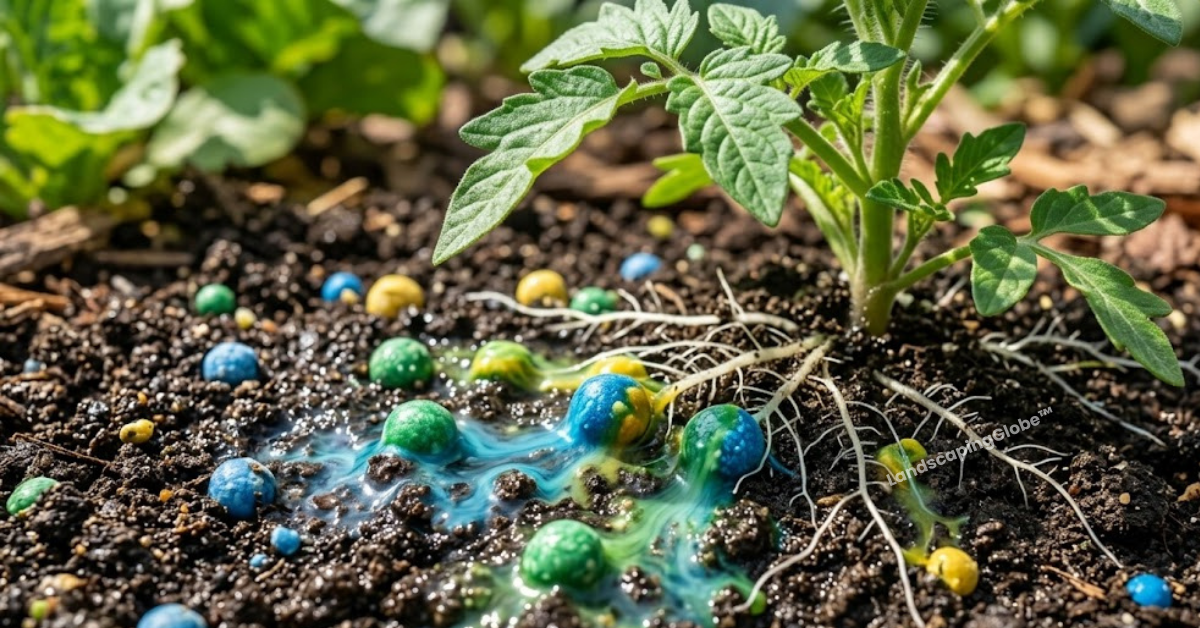
Synthetic fertilizers provide water-soluble, concentrated nutrients like Nitrogen (N), Phosphorus (P), and Potassium (K) for rapid plant growth.
They act quickly, directly feeding plants instead of improving soil structure, requiring frequent reapplication and careful management.
Water-Soluble Nutrients
- Synthetic fertilizers dissolve in water, allowing roots to absorb nutrients almost instantly.
- Nutrients include urea, ammonium nitrate, ammonium phosphate, and potassium sulfate.
- Fast dissolution supports immediate plant greening and growth.
- These fertilizers do not add significant organic matter to the soil.
- Water solubility increases the risk of nutrient leaching into groundwater and waterways.
Fast Nutrient Absorption
- Plants absorb concentrated macronutrients quickly for rapid leaf, root, and flower development.
- Nitrogen (N) promotes leafy growth, Phosphorus (P) strengthens roots, and Potassium (K) boosts plant health.
- Effects appear faster than organic fertilizers, giving a rapid green-up or crop boost.
- Quick uptake helps correct temporary nutrient deficiencies during the growing season.
Targeted Deficiency Control
- Synthetic fertilizers allow precise NPK ratios for specific crops and soil conditions.
- They are ideal for correcting nutrient deficiencies efficiently.
- Over-application can burn plants due to concentrated nutrients.
- Frequent application may be required because nutrients are short-lived.
- Proper use improves crop yield but does not enhance long-term soil fertility.
Organic vs Synthetic Fertilizers
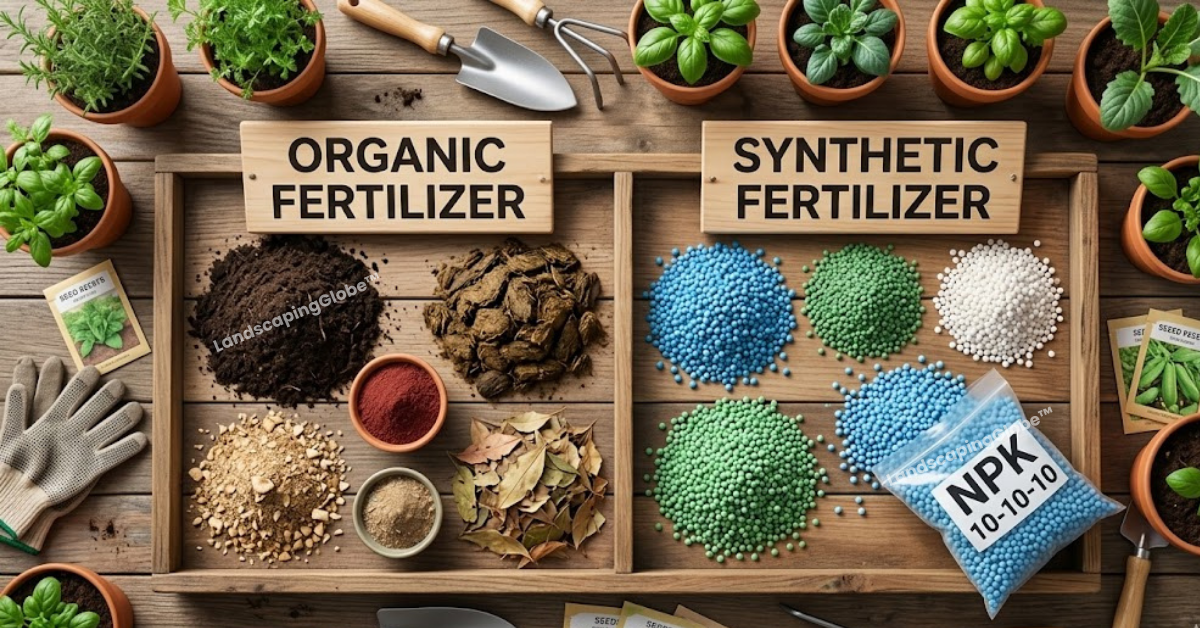
| Aspect | Organic Fertilizers | Synthetic Fertilizers |
| Nutrient Release Speed | Nutrients like N, P, K release slowly as microbes break down manure, compost, and bone meal. | Nutrients are water-soluble and absorbed quickly by roots, giving an immediate plant boost. |
| Soil Health Impact | Improves soil fertility, aeration, microbial life, and builds long-term soil structure. | Feeds plants directly but has little effect on soil structure or microbial ecosystems. |
| Environmental Effects | Gentle on the environment, reduces runoff, and protects waterways and soil ecosystems. | Excess nutrients can cause groundwater contamination, river eutrophication, and harm wildlife. |
| Cost & Application Frequency | Usually more expensive, larger quantities, but fewer applications needed due to slow nutrient release. | Cost-effective, concentrated, needs frequent applications, but risks plant burn and nutrient leaching. |
Advantages of Organic Fertilizers
| Aspect | Organic Fertilizers Advantages |
| Long-Term Soil Improvement | Increases soil organic matter, aeration, and water-holding capacity, improving soil fertility, structure, and root development long-term. |
| Microbial Activity Support | Feeds beneficial bacteria, fungi, and microorganisms, boosting soil microbial activity, decomposition of organic matter, and natural ecosystem balance. |
| Reduced Runoff Risk | Slow-release nutrients reduce leaching, chemical runoff, and pollution in groundwater and waterways, protecting aquatic life and preventing plant burn. |
| Natural Micronutrients | Provides trace minerals like iron, zinc, copper, and plant-based nutrients, enhancing plant resilience, pest resistance, and long-term crop nutrition. |
Limitations of Organic Fertilizers
Organic fertilizers are beneficial for long-term soil health, but they have slow nutrient release, variable nutrient levels, and weather-dependent effectiveness, making them less ideal for immediate results.
Slow Results
- Nutrients in organic fertilizers like manure, compost, and bone meal release slowly, requiring microbial activity for plant absorption.
- Plants do not get an immediate growth boost, making these fertilizers unsuitable for quick fixes.
- Slow decomposition limits fast nutrient availability, delaying visible leaf greening and crop growth.
- Requires patience as soil microbes gradually convert organic matter into plant-available NPK.
- Slow-release nature is ideal for long-term soil improvement, but not for rapid crop response.
Nutrient Level Variations
- Nutrient content varies in organic sources like compost, manure, and plant meals, making precise fertilizer application challenging.
- Inconsistent nitrogen, phosphorus, and potassium (NPK) levels can affect crop yields.
- Different batches of organic fertilizers may contain varying trace minerals and nutrient concentrations.
- Precise fertilizer calculations are difficult, sometimes requiring soil testing.
- Variation limits predictable plant growth, making supplementation with synthetic fertilizers sometimes necessary.
Weather Dependency
- Organic fertilizers need warm, moist soil and active microbial populations to function effectively.
- Cold or dry conditions slow decomposition, delaying nutrient release.
- Excess rainfall can cause nutrient leaching, reducing availability for plants.
- Environmental factors affect organic matter breakdown, impacting long-term fertilization efficiency.
- Weather dependency makes the timing of application critical for optimal plant nutrient uptake.
Advantages of Synthetic Fertilizers
Synthetic fertilizers provide fast-acting nutrients, precise N-P-K ratios, and easy application options, supporting rapid plant growth, higher yields, and targeted deficiency correction.
Quick Plant Response
- Synthetic fertilizers are water-soluble, delivering nutrients directly to plant roots for immediate absorption and visible leaf greening.
- Ideal for correcting nutrient deficiencies quickly in vegetables, lawns, and field crops.
- Rapid plant growth supports efficient crop production in large-scale farming.
- Provides a fast nutrient boost, improving plant health in hydroponics or controlled environments.
- Ensures predictable results, helping growers maintain consistent growth and yield.
Precise Nutrient Ratios
- Manufactured synthetic fertilizers allow an exact N-P-K formulation, supporting targeted plant nutrition.
- Enables customization for different crop species, growth stages, and soil conditions.
- Helps prevent over-application or under-fertilization, reducing plant burn risk.
- High nutrient concentration ensures less product is needed per unit of plant growth.
- Improves fertilizer efficiency, providing reliable and measurable nutrient delivery.
Easy Availability
- Synthetic fertilizers are mass-produced and widely available in granular, liquid, or blendable forms.
- Convenient for large farms or home gardening, with easy transport and storage.
- Can be applied via fertigation, foliar spray, or broadcast, saving labor and time.
- Consistent quality ensures predictable nutrient content for all crops.
- Available globally, supporting high-demand agriculture, horticulture, and turf management.
Limitations of Synthetic Fertilizers
Synthetic fertilizers provide fast nutrients, but excessive use can damage soil microbes, build up salts and acids, and pollute waterways, harming ecosystems.
Soil Microbe Damage
- Overuse of synthetic fertilizers reduces soil organic matter and kills beneficial bacteria, fungi, and mycorrhizae, harming long-term soil fertility.
- Decreases earthworm activity, disrupting soil structure, nutrient cycling, and plant root development.
- Continuous application can create "dead soil," reducing natural microbial populations needed for healthy ecosystems.
- Weakens the soil food web, making crops more disease-prone and dependent on repeated fertilization.
- Kills microbes faster in high-concentration nitrogen formulations, reducing long-term soil productivity.
Salt & Acid Buildup
- Synthetic fertilizers can increase soil salinity and acidify pH levels, creating toxic conditions for roots and microbes.
- Excess ammonium nitrate or urea leads to salt accumulation, limiting water uptake by plants.
- Alters soil chemistry, reducing nutrient availability and harming beneficial organisms.
- Continuous application can degrade soil structure and reduce water-holding capacity.
- High concentration formulations risk fertilizer burn and plant stress, especially in sensitive crops.
Pollution & Runoff Risks
- Excess nutrients from synthetic fertilizers run off into rivers, lakes, and groundwater, causing eutrophication and oxygen-depleted dead zones.
- Nitrogen and phosphorus overuse increases nitrate pollution, affecting human and aquatic health.
- Can release greenhouse gases like nitrous oxide, contributing to climate change.
- High runoff risks contaminate soil, water, and crops, creating environmental and food safety concerns.
- Short-term benefits lead to repeated applications, increasing long-term ecosystem stress.
Organic vs Synthetic Fertilizers for Different Uses
| Use Case | Organic Fertilizers | Synthetic Fertilizers |
| Home Gardens | Compost, manure, and bone meal improve soil microbial life, fertility, and structure, safe for children, pets, and edible plants. | Provide fast-acting N-P-K nutrients, correcting deficiencies quickly for immediate greening and supporting rapid plant growth. |
| Lawns & Turf | Slowly improves soil structure, water retention, and microbial activity, reducing chemical runoff and supporting eco-friendly turf management. | Gives rapid greening, precise N-P-K ratios, ideal for high-traffic turf and fast recovery, especially during cool seasons. |
| Vegetable Crops | Compost and vermicompost supply slow-release nutrients, enhancing soil fertility, water retention, and microbial activity, safe for edible crops. | Supplies quick N-P-K nutrients, correcting deficiencies, boosting vegetable yield, ideal for short-season crops with precise nutrient management. |
| Large-Scale Farming | Green manure and compost build long-term soil structure, support soil biology, and reduce dependence on repeated chemical applications. | Offers high-concentration nutrients, ensures uniform plant growth, increases yield efficiency, and supports rapid growth in commercial agriculture. |
Environmental Impact of Fertilizer Types
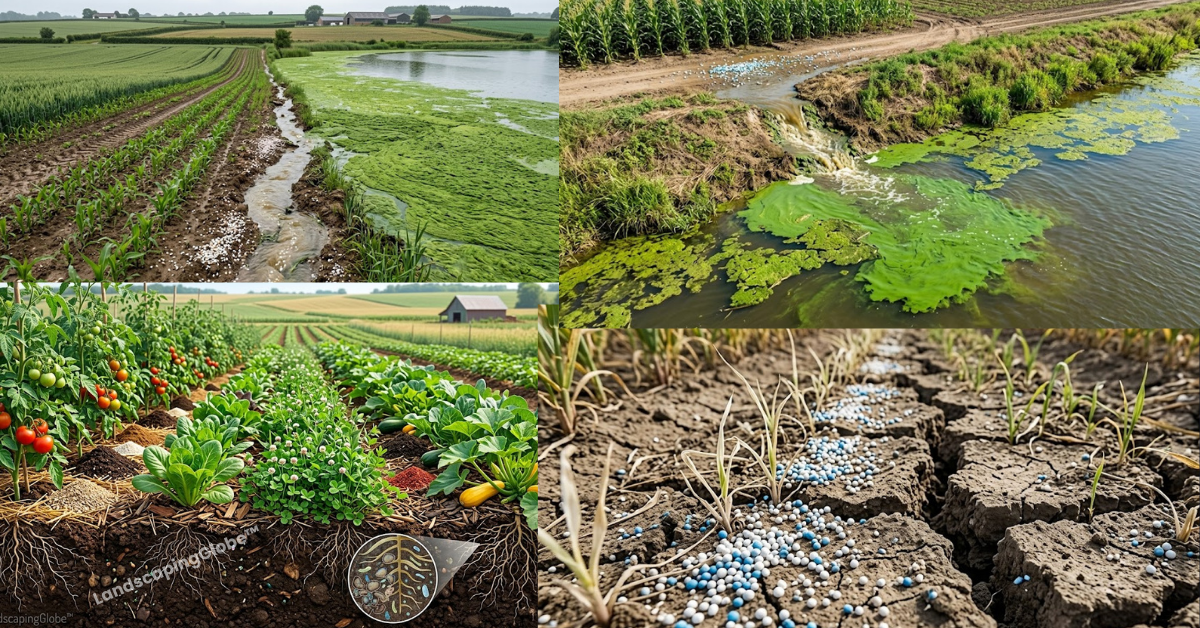
Fertilizer types affect soil health, water quality, and climate change, with synthetic fertilizers increasing GHG emissions and nutrient runoff.
Water Contamination
Synthetic fertilizers like NPK and ammonium-based fertilizers often cause nitrate and phosphorus runoff, leading to eutrophication, algal blooms, and dead zones in waterways.
Organic fertilizers such as compost and manure reduce water pollution risk while improving microbial activity and soil water retention, but mismanagement still threatens groundwater.
Soil Degradation
Excess chemical fertilizers degrade soil structure, reduce organic matter, and lower microbial diversity, causing acidification and long-term fertility loss in agricultural lands.
Organic amendments improve soil texture, support beneficial microbes, increase water-holding capacity, and promote sustainable soil fertility, reducing dependence on synthetic nutrients.
Sustainable Farming Practices
Practices like controlled-release fertilizers, mulching, composting, and soil testing minimize nutrient runoff, lower GHG emissions, and enhance long-term soil health and ecosystem balance.
Combining organic fertilizers with precision application and cover crops supports sustainable agriculture, reduces environmental pollution, and mitigates climate change impacts effectively.
Balanced Fertilization Approach
A Balanced Fertilization Approach combines organic fertilizers, synthetic fertilizers, and micronutrients using soil testing to optimize N-P-K, crop yield, and environmental protection.
Combining Organic & Synthetic
Combining organic manures, compost, and synthetic NPK fertilizers improves soil structure and microbial activity, and ensures nutrient availability for sustainable crop growth.
Seasonal Nutrient Planning
Applying nutrients according to seasonal crop growth, using fertilizer timing, prevents deficiencies, reduces runoff, and maximizes plant uptake while enhancing soil fertility.
Soil Testing Benefits
Soil testing identifies existing nutrient levels, pH, and micronutrients, guiding fertilizer application, preventing over-fertilization, and promoting balanced, environmentally-friendly fertilization strategies.
FAQ:
Which is better, organic or synthetic fertilizer?
It depends. Organic fertilizers improve soil structure, microbial life, and long-term fertility, while synthetic fertilizers provide quick nutrients and precise N-P-K ratios for fast plant growth.
What are the disadvantages of organic fertilizer?
Organic fertilizers act slowly, have variable nutrient levels, can be expensive, and require microbial activity in warm, moist soil to work effectively.
How do organic farmers fertilize if not with synthetic fertilizers?
They use compost, manure, cover crops, green manure, and organic amendments to release nutrients slowly and improve soil health.
What are the disadvantages of synthetic fertilizer?
Synthetic fertilizers can harm soil microbes, cause salt and acid buildup, lead to water pollution, and may burn plants if over-applied.
Is Miracle-Gro a synthetic fertilizer?
Yes, Miracle-Gro is a synthetic, water-soluble fertilizer with precise N-P-K ratios, designed for fast plant growth.
Why should gardeners combine organic and synthetic fertilizers?
Combining organic and synthetic fertilizers gives fast nutrients and long-term soil health, improving plant growth, yield, and environmental sustainability.