

How to Select Aeration Equipment for Commercial Aquaculture Farms
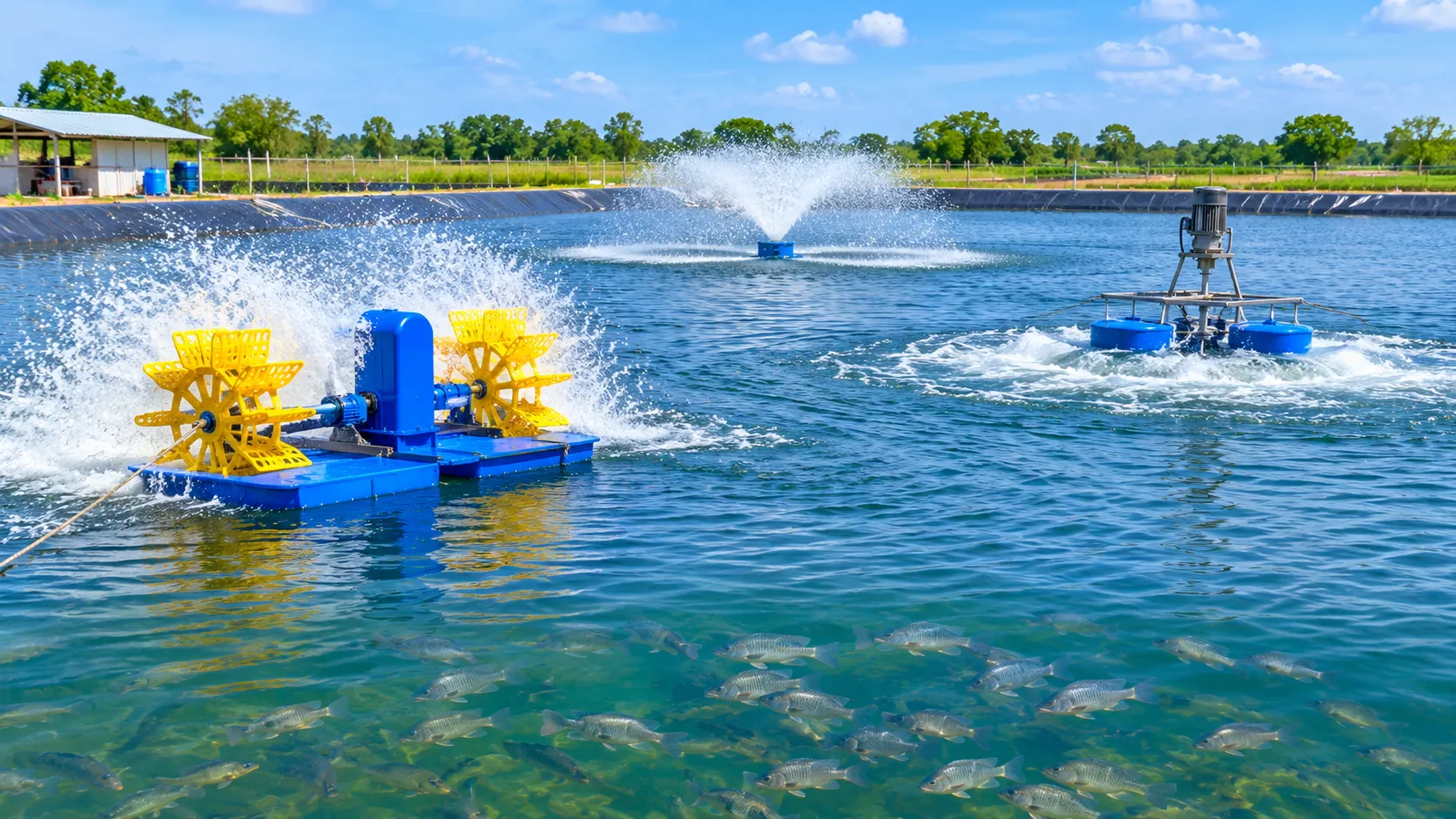
How to Select Aeration Equipment for Commercial Aquaculture Farms
Aeration is one of the most important parts of a successful commercial aquaculture farm. Fish and shrimp need enough oxygen to grow, stay healthy, and survive. When oxygen levels become too low, fish may stop eating, grow slowly, become stressed, or even die. This can cause serious financial losses for fish farmers.
Choosing the right aeration equipment helps maintain healthy water conditions and supports better farm production. However, not every aerator works well in every fish pond. The best choice depends on pond size, water depth, fish species, stocking density, water temperature, and daily oxygen demand.
Commercial fish farms use different types of aeration systems, including paddlewheel aerators, surface aerators, diffused air systems, and aspirator aerators. Each system has its own benefits, costs, and working methods.
Importance of Dissolved Oxygen in Aquaculture
Dissolved oxygen (DO) is the amount of oxygen available in water for fish and other aquatic animals. It is one of the most important factors in aquaculture because fish need oxygen to breathe, digest food, and produce energy.
When dissolved oxygen levels are healthy, fish can eat properly, grow faster, and maintain a strong immune system. However, low oxygen levels can cause stress, poor feeding, slow growth, and fish deaths.
In commercial fish ponds, oxygen levels can change throughout the day. During daylight, algae and aquatic plants produce oxygen through photosynthesis. At night, they use oxygen for respiration. This means oxygen levels often become lowest just before sunrise.
- High fish stocking density.
- Excess fish feed and organic waste.
- High water temperature.
- Algae blooms and sudden algae die-offs.
- Poor water circulation.
- Decomposition of organic matter.
- High biological oxygen demand (BOD).
Most warm-water fish farming systems aim to maintain dissolved oxygen around 5 mg/L or higher when possible. However, the ideal level depends on fish species, water temperature, and farming conditions.
For example, tilapia can tolerate lower oxygen levels for short periods, while many other fish species need higher oxygen levels for healthy growth.
Installing suitable aquaculture aeration equipment helps add oxygen to the water and improve circulation. Regular DO monitoring with a dissolved oxygen meter also helps farmers identify oxygen problems before they become serious.
Types of Aeration Equipment Used in Commercial Fish Farms
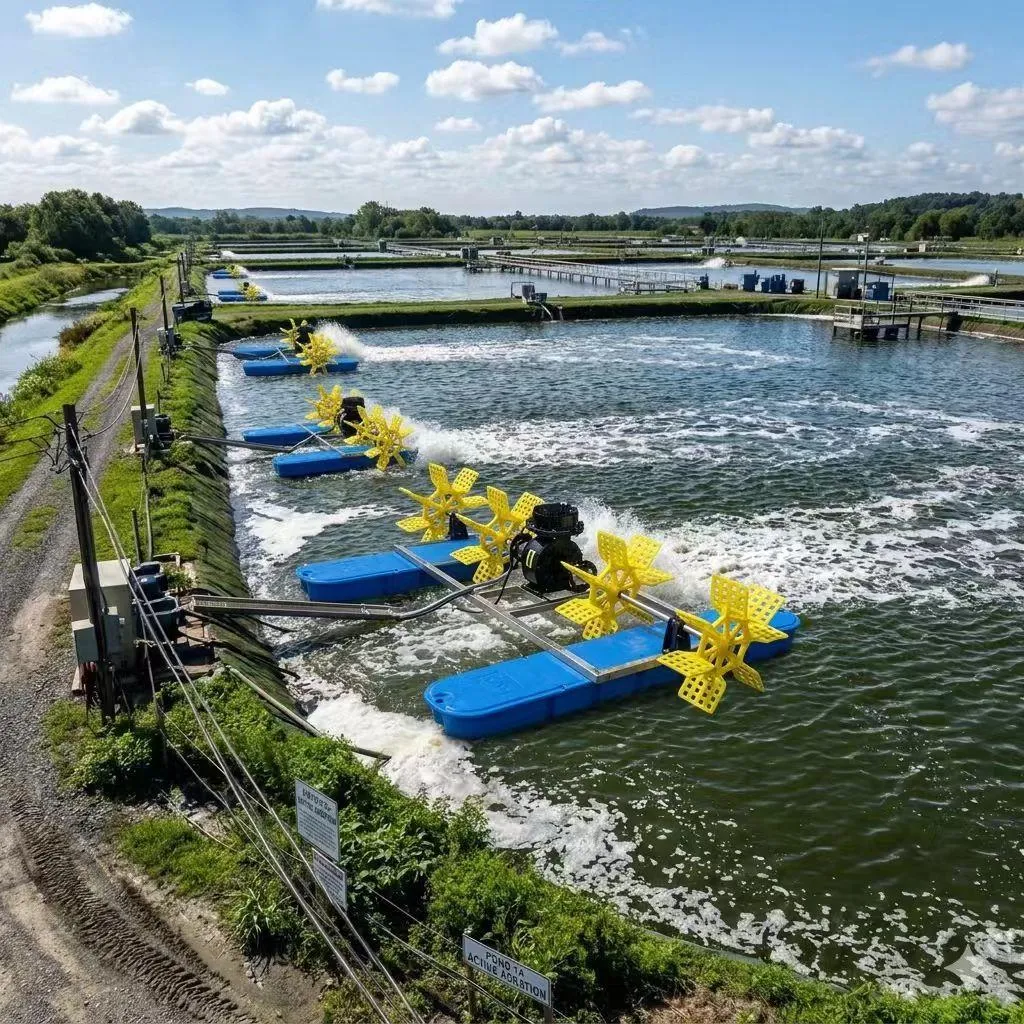
Commercial fish farms use different types of aeration equipment to maintain oxygen levels and improve water movement. The right equipment depends on pond conditions, production targets, and available power.
Here are the most common types of aquaculture aerators.
1. Paddlewheel Aerators
Paddlewheel aerators are widely used in commercial fish and shrimp farms. They have rotating paddles that splash water into the air. This helps transfer oxygen from the atmosphere into the pond.
They also create water currents that move oxygen-rich water across the pond. Paddlewheel aerators are useful for large ponds with high fish stocking densities.
2. Surface Aerators
Surface aerators move water from the pond into the air. When the water falls back into the pond, it mixes with air and increases dissolved oxygen.
These systems are available in different sizes and designs. They are useful for ponds that need surface water movement and additional oxygen.
3. Diffused Air Aeration Systems
Diffused air aeration systems use an air blower, pipes, and underwater diffusers. The blower sends air through pipes, and the diffusers release small bubbles into the water.
As bubbles rise, they transfer some oxygen into the water and create circulation. These systems are commonly used in fish tanks, hatcheries, and suitable deeper water systems.
4. Propeller-Aspirator Aerators
Propeller-aspirator aerators use a rotating propeller to pull air into the water. They mix air and water while creating strong circulation.
These aerators can be useful in commercial ponds where both oxygen transfer and water movement are important.
5. Venturi Aerators
Venturi aerators use moving water to create low pressure, which pulls air into the water stream. They can add oxygen without needing a separate air blower in some setups.
They are often used in water circulation systems and smaller aquaculture applications.
6. Cascade Aerators
Cascade aerators allow water to flow over steps or surfaces. This breaks the water into smaller streams and increases contact with air.
They can be useful where gravity-fed water is available, reducing the need for extra mechanical power.
Key Factors to Consider When Selecting Aquaculture Aerators
Choosing the right aerator is not only about buying a powerful machine. Farmers should understand their production needs and pond conditions before making a purchase.
Consider these important factors:
- Oxygen Transfer Capacity: Check how much oxygen the equipment can transfer into water. A machine with a higher oxygen transfer capacity may support a larger fish population, but its actual performance depends on water conditions.
- Pond Size and Shape: Large ponds may need several aerators placed at suitable points. Pond shape also affects water movement. A poorly placed aerator may leave some areas with low oxygen.
- Fish Species: Different fish species have different oxygen requirements. For example, tilapia, catfish, carp, trout, and shrimp do not all respond to low dissolved oxygen in the same way.
- Stocking Density: A pond with more fish needs more oxygen. High stocking density also increases waste production and biological oxygen demand.
- Energy Consumption: Check the motor's power rating in kilowatts (kW) or horsepower (HP). Also compare the amount of oxygen transferred per unit of electricity.
- Equipment Quality: Look for strong motors, corrosion-resistant materials, reliable electrical components, and good-quality diffusers or propellers.
- Maintenance Requirements: Choose equipment with accessible spare parts and simple maintenance procedures. This can reduce downtime and repair costs.
- Power Supply and Backup: Commercial farms should consider electricity availability, voltage stability, and backup power. A generator or other suitable backup system can help protect fish during power failures.
Choosing Aeration Equipment Based on Pond Size and Water Depth
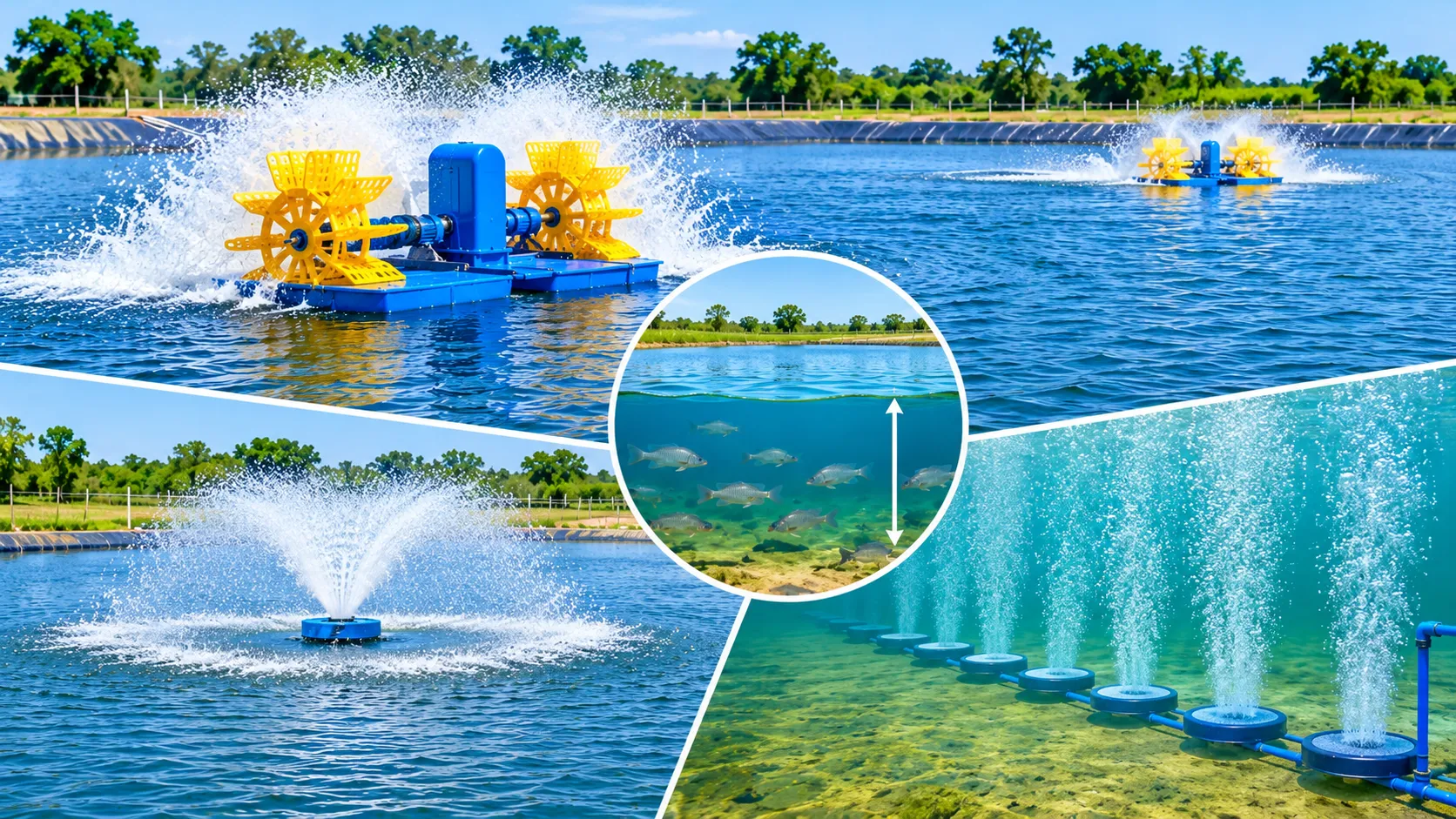
Pond size and water depth are important factors when selecting the right aeration equipment for aquaculture farms. Before purchasing an aerator, measure the pond's length, width, and average depth to estimate its total water volume.
Water Volume = Length × Width × Average Depth
For example, a pond measuring 100 × 50 × 1.5 metres contains 7,500 cubic metres of water.
Aeration for Shallow Ponds
Shallow ponds generally work well with paddlewheel and surface aerators, which create water movement and improve oxygen distribution.
Aeration for Deeper Ponds
Deeper ponds may benefit from diffused air systems that release bubbles near the bottom and support vertical water circulation.
Aeration for Large Commercial Ponds
Large ponds often require multiple aerators strategically placed to improve circulation and prevent low-oxygen zones.
The best aeration equipment depends on pond volume, fish stocking density, water temperature, and oxygen demand. There is no single horsepower recommendation for every pond.
Fish Stocking Density and Oxygen Requirements
Fish stocking density means the number or total weight of fish kept in a particular amount of water. It is usually measured as fish per cubic metre, kilograms per cubic metre, or kilograms per hectare.
Stocking density directly affects oxygen demand. More fish need more oxygen for breathing, especially during feeding and active growth.
For example, a pond with 5,000 fish will generally have a lower oxygen demand than a similar pond containing 20,000 fish of the same size.
However, fish numbers alone do not provide the full picture. Farmers should also consider average fish weight and total biomass.
Important factors include:
- Total fish biomass in the pond.
- Daily feed quantity.
- Fish species and growth stage.
- Water temperature.
- Natural oxygen production.
- Organic waste and decomposition.
- Required minimum dissolved oxygen level.
Feed management is also important. Uneaten feed and fish waste increase biological oxygen demand (BOD). Bacteria use oxygen while breaking down this organic material.
High-density fish farms should consider continuous or automatic aeration systems with suitable backup equipment. A dissolved oxygen sensor can help farmers monitor changing conditions and operate aerators when oxygen levels approach their chosen safety limit.
Paddlewheel Aerators vs. Diffused Air Aeration Systems
Paddlewheel aerators and diffused air aeration systems are two common choices in commercial aquaculture. Both increase oxygen levels, but they work in different ways.
| Feature | Paddlewheel Aerator | Diffused Air System |
| Working method | Splashes water into air | Releases air bubbles underwater |
| Main components | Motor, paddles, float | Blower, pipes, diffusers |
| Water movement | Strong horizontal movement | Rising bubbles create circulation |
| Common use | Commercial fish and shrimp ponds | Tanks and suitable pond systems |
| Installation | Usually floating | Requires underwater diffuser placement |
| Maintenance | Motor and paddle inspection | Blower, pipe, and diffuser cleaning |
Advantages of Paddlewheel Aerators
- Create strong water movement.
- Support oxygen distribution across ponds.
- Commonly used in commercial pond farming.
- Suitable for emergency aeration when correctly sized.
Advantages of Diffused Air Aeration
- Can distribute air through several diffuser points.
- Helps circulate water from lower areas.
- Useful in tanks and deeper water systems.
- Can provide continuous aeration.
Surface Aerators, Aspirator Aerators, and Propeller Pumps
Surface aerators, aspirator aerators, and propeller pumps are designed to move water and improve oxygen transfer. However, their working methods and applications are different.
Surface Aerators
Surface aerators bring water into contact with the atmosphere. They use rotating blades, impellers, or other mechanical parts to splash or spray water.
They are useful for improving surface oxygen transfer and mixing water in commercial ponds.
Aspirator Aerators
Aspirator aerators pull air into moving water through an air-intake system. They mix air and water using a propeller or similar mechanism.
They can provide oxygen transfer and water circulation at the same time.
Propeller Pumps
Propeller pumps move large amounts of water from one location to another. They are mainly used for circulation and water movement.
Some systems can be combined with air-intake equipment to improve aeration.
When selecting these machines, compare motor power, flow rate, oxygen transfer capacity, installation needs, and operating costs.
A farmer should not assume that every water pump is an aerator. A circulation pump may move water without transferring enough oxygen to meet the needs of a high-density fish pond.
How to Calculate Aeration Capacity for Commercial Fish Ponds
Calculating aeration capacity helps farmers choose equipment that can supply enough oxygen for their fish. It also helps prevent unnecessary electricity costs from oversized machines.
The first step is to understand the pond's water volume and oxygen requirement.
1. Calculate Pond Water Volume
For a rectangular pond, use:
Water Volume = Length × Width × Average Depth
For example:
- Length: 100 metres
- Width: 50 metres
- Average depth: 1.5 metres
- Total water volume: 7,500 m³
2. Calculate the Oxygen Required
The amount of oxygen needed depends on the current dissolved oxygen level and the target level.
Use this formula:
Oxygen Required (kg) = Water Volume (m³) × DO Increase (mg/L) ÷ 1,000
For example, if the pond contains 7,500 m³ of water and the farmer wants to increase dissolved oxygen by 2 mg/L:
7,500 × 2 ÷ 1,000 = 15 kg of oxygen.
This is the theoretical oxygen needed to increase the whole pond's DO by 2 mg/L. Actual aerator requirements will be higher because oxygen transfer is not 100% efficient and fish, bacteria, and other organisms continue consuming oxygen.
3. Check Aerator Oxygen Transfer Capacity
Check the manufacturer's Standard Oxygen Transfer Rate (SOTR) and Standard Aeration Efficiency (SAE).
These measurements help farmers understand how much oxygen an aerator can transfer under standard testing conditions.
4. Consider Peak Oxygen Demand
Oxygen demand can increase during hot weather, heavy feeding, high stocking density, and algae die-offs.
For this reason, farmers should size their aeration systems for demanding conditions rather than average conditions.
For accurate equipment sizing, consider working with an aquaculture engineer or aerator manufacturer.
Energy-Efficient Aeration Equipment for Aquaculture Farms
Electricity is a major operating expense for many commercial aquaculture farms. Aerators may run for several hours each day, especially during hot weather and periods of high fish production. Choosing energy-efficient equipment can help reduce electricity bills without compromising fish health. Here are some ways to improve energy efficiency.
- Choose Aerators With High SAE Ratings: Compare the standard aeration efficiency of different machines. Equipment that transfers more oxygen per unit of electricity can help reduce long-term energy costs.
- Use Variable Frequency Drives (VFDs): A variable frequency drive controls motor speed according to operating requirements. It can help reduce unnecessary power use in compatible aeration and circulation systems.
- Install Automatic DO Controllers: Automatic dissolved oxygen controllers use sensors to monitor oxygen levels. They can switch compatible aerators on or off according to set oxygen limits.
- Maintain Proper Water Circulation: Correct aerator placement helps distribute oxygen throughout the pond. Poor placement can waste energy while leaving some areas with low oxygen.
- Clean Equipment Regularly: Dirty diffusers, damaged paddles, blocked pipes, and worn motor parts can reduce system performance.
- Compare Long-Term Energy Costs: Do not select equipment based only on its purchase price. Calculate expected electricity consumption, maintenance expenses, and replacement costs.
Energy-efficient aeration helps farmers manage operating costs while maintaining healthy pond conditions.
Water Temperature, Quality, and Fish Species Considerations
Water temperature and quality have a direct effect on oxygen availability in aquaculture ponds. These conditions should be considered before selecting aeration equipment.
Water Temperature
Warm water holds less dissolved oxygen than cold water. At the same time, fish and many microorganisms may consume oxygen faster in warmer conditions.
This creates additional oxygen pressure during hot weather.
For example, a fish pond in summer may need more aeration than the same pond during cooler months.
Water Quality
Poor water quality can increase oxygen demand and reduce fish health. Important water quality parameters include:
- Dissolved oxygen (DO).
- pH level.
- Ammonia.
- Nitrite.
- Water temperature.
- Alkalinity.
- Salinity.
- Biological oxygen demand (BOD).
Ammonia is especially important because high levels can harm fish. Aeration supports water circulation and oxygen availability, but it does not replace proper ammonia management.
Fish Species
Different fish species have different environmental needs.
| Fish Species | Important Consideration |
| Tilapia | Monitor oxygen during high-density production |
| Catfish | Can tolerate lower DO for limited periods, but still need good oxygen management |
| Carp | Maintain suitable oxygen for feeding and growth |
| Trout | Require cold, oxygen-rich water |
| Shrimp | Need oxygen throughout the pond, including near the bottom |
Farmers should select aeration equipment according to the species, production system, and local climate. Regular water testing helps identify problems before they affect fish growth and survival.
Commercial Aquaculture Aerator Costs and Operating Expenses
The cost of commercial aquaculture aeration equipment depends on its type, size, motor power, material quality, and manufacturer.
A small aerator usually costs less than a large industrial system. However, the initial purchase price is only one part of the total investment.
Farmers should consider the following expenses:
- Equipment Purchase Cost: This includes the aerator, motor, propeller, blower, diffuser, pipes, electrical components, and other required parts.
- Installation Cost: Installation expenses may include electrical wiring, floating platforms, underwater pipe systems, mounting equipment, and labour.
- Electricity Cost: Electricity is often one of the largest ongoing expenses. Calculate the expected power consumption and daily operating hours before purchasing an aerator. For example:
Electricity Consumption (kWh) = Motor Power (kW) × Operating Hours
A 1.5 kW aerator running for 10 hours uses 15 kWh of electricity.
Multiply this figure by the local electricity tariff to estimate the daily running cost.
- Maintenance Cost: Motors, bearings, propellers, belts, diffusers, and pipes may require cleaning, servicing, or replacement.
- Backup Power Cost: Commercial farms may need generators, backup motors, or other emergency power systems to protect fish during electricity failures.
How to Get Better Value for Money
Compare at least two or three equipment suppliers. Ask for product specifications, energy consumption, warranty details, spare parts availability, and technical support.
A low-cost aerator may become expensive if it consumes too much electricity or requires frequent repairs.
Installation and Maintenance of Aquaculture Aeration Systems
Proper installation and regular maintenance help aquaculture aeration equipment work safely and efficiently.
Even high-quality aerators may perform poorly if they are installed incorrectly or not maintained.
Installation Guidelines
- Check pond size, depth, and shape before installation.
- Select suitable aerator locations to improve water circulation.
- Keep electrical connections protected from water.
- Install underwater diffusers at suitable depths.
- Use strong floating platforms for floating aerators.
- Follow manufacturer instructions for motor installation.
- Test the equipment before starting full operation.
- Measure dissolved oxygen at different pond locations.
Aerators should be positioned to reduce dead zones and avoid creating excessive water currents that may disturb pond banks or concentrate waste in unwanted areas.
Regular Maintenance Tasks
- Clean paddlewheel blades and propellers.
- Inspect motor bearings and electrical connections.
- Check air blowers and diffuser performance.
- Remove dirt and blockages from pipes.
- Check floating equipment for damage.
- Replace worn or damaged components.
- Monitor unusual noise, vibration, and overheating.
Farmers should also maintain a service record. Recording inspection dates, repairs, electricity use, and equipment performance makes it easier to identify problems.
A well-maintained aeration system can provide reliable oxygen supply and reduce unexpected equipment failures.
Best Practices for Selecting Long-Term Aeration Solutions
Selecting aeration equipment is a long-term investment for commercial aquaculture farms. The right system should support current fish production and allow room for future expansion.
Before making a final decision, follow these best practices.
- Understand Your Farm's Oxygen Demand: Calculate pond volume, total fish biomass, stocking density, and expected oxygen consumption. Do not depend only on pond surface area.
- Select Equipment for Your Pond Conditions: Consider pond depth, water temperature, salinity, and fish species. Different aerators work better under different conditions.
- Compare Equipment Performance: Review SOTR, SAE, motor power, air delivery, and water circulation capacity. Ask suppliers for reliable performance data.
- Consider Energy Efficiency: Choose equipment that provides suitable oxygen transfer without unnecessary electricity consumption.
- Plan for Emergency Aeration: Keep backup equipment or a suitable generator available. Power failures can become dangerous when fish ponds have high stocking densities.
- Use Dissolved Oxygen Monitoring: Install reliable DO meters or automatic sensors. Check oxygen levels regularly, especially before sunrise when pond oxygen is often at its lowest.
- Check Warranty and Technical Support: Choose manufacturers or suppliers that offer spare parts, maintenance guidance, and after-sales service.
- Plan for Future Farm Expansion: If you plan to increase fish production, choose an aeration system that can be expanded or upgraded when oxygen demand increases.
The best aeration equipment is not always the biggest or most expensive machine. It is the system that matches your farm's oxygen requirements, water conditions, production goals, and budget.
Conclusion
Selecting the right aeration equipment is essential for maintaining good water quality and successful commercial aquaculture production. Paddlewheel aerators, surface aerators, diffused air systems, propeller-aspirator aerators, and Venturi systems all offer different benefits.
Before purchasing equipment, farmers should consider dissolved oxygen requirements, pond size, water depth, fish stocking density, water temperature, oxygen transfer efficiency, and electricity costs.
Regular maintenance and dissolved oxygen monitoring are equally important for keeping fish healthy and preventing unexpected losses.
By choosing the right equipment and planning for long-term operation, commercial fish farmers can improve oxygen management, support healthy fish growth, reduce operating expenses, and build a more productive aquaculture farm.
Frequently Asked Questions
1. What is the best aeration equipment for commercial fish farms?
Paddlewheel aerators are a popular choice for commercial fish ponds because they provide oxygen transfer and strong water circulation. Diffused air systems can also work well in suitable tanks and deeper water systems.
2. How much dissolved oxygen do fish need in aquaculture ponds?
Many warm-water aquaculture systems aim for around 5 mg/L or higher. However, the exact requirement depends on fish species, water temperature, and production conditions.
3. Which aerator is more energy-efficient?
Energy efficiency depends on aerator design, operating conditions, and water depth. Compare Standard Aeration Efficiency (SAE) rather than relying only on motor horsepower.
4. Why are paddlewheel aerators popular in aquaculture?
Paddlewheel aerators create surface turbulence, transfer oxygen into water, and produce currents that help distribute oxygen throughout commercial ponds.
5. Can diffused air aeration replace paddlewheel aerators?
Sometimes, but not in every situation. Diffused air systems are useful in suitable water depths and tank systems, while paddlewheel aerators often provide stronger horizontal circulation in large ponds.
6. How can farmers reduce aeration electricity costs?
Farmers can use efficient aerators, maintain equipment, improve aerator placement, and install automatic dissolved oxygen controllers.
7. When should aquaculture aerators operate?
Aerators should operate whenever oxygen demand requires them. Low oxygen often occurs before sunrise, but heavy feeding, hot weather, and algae die-offs may require additional aeration at other times.